

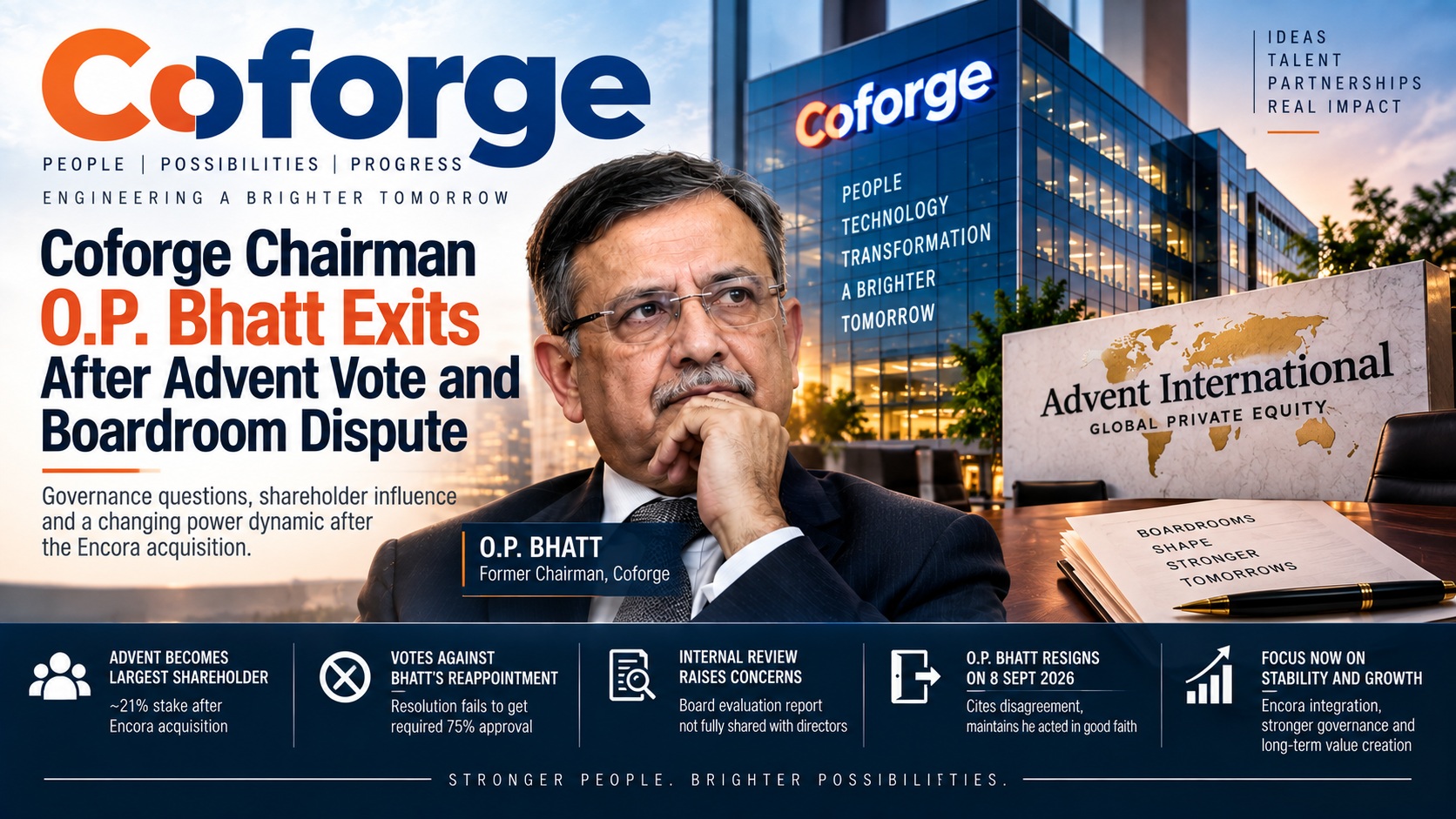
Coforge has found itself at the centre of an unusual corporate-governance episode after chairman O.P. Bhatt abruptly resigned following a shareholder vote that blocked his continuation and an internal review that raised questions about the company’s board-evaluation process.
Bhatt, the former chairman of State Bank of India and one of India’s most experienced corporate directors, resigned from Coforge’s board with immediate effect on 8 September 2026.
His departure came after Coforge’s largest shareholder, private equity major Advent International, voted against his reappointment as an independent director.
The development is particularly significant because Advent only recently became Coforge’s largest shareholder following the IT services company’s $2.39 billion acquisition of US-based digital engineering company Encora.
What initially appeared to be a routine board reappointment has consequently evolved into a much larger discussion about shareholder influence, board oversight and the governance structure of one of India’s fastest-growing IT services companies.
Advent Blocks Bhatt’s Reappointment
The immediate trigger for the leadership uncertainty emerged at Coforge’s annual general meeting.
Bhatt required at least 75% shareholder approval for his reappointment because he would cross the age threshold applicable to independent directors during the proposed term.
But the resolution failed to receive the necessary support.
Advent International, Coforge’s largest shareholder with approximately 21% ownership, voted against the proposal.
The decision was particularly striking because only weeks earlier, Coforge’s nomination and remuneration committee had approved Bhatt’s continuation.
Even more unusually, that committee included an Advent nominee.
The episode therefore raised an obvious question: why did Coforge’s largest shareholder ultimately oppose a proposal that had previously advanced through a committee containing its own representative?
Advent’s Position Has Changed Dramatically
Understanding the controversy requires looking at the transformation of Coforge’s shareholder base.
Coforge does not have a traditional promoter controlling the company.
That makes large institutional shareholders particularly important.
Advent International became the company’s biggest shareholder following Coforge’s acquisition of Encora, a US-based digital engineering and data company.
The transaction, announced in December 2025, was valued at approximately $2.39 billion and represented the largest acquisition ever undertaken by an Indian IT services company.
Because much of the consideration was paid through Coforge shares, Encora’s shareholders—including Advent—received a significant ownership position in the combined company.
Advent ultimately emerged with roughly 21% of Coforge.
That instantly transformed the private equity firm from an external investor into one of the most influential participants in Coforge’s corporate structure.
The Encora Deal Also Changed Coforge’s Board
Advent’s influence extends beyond share ownership.
As part of the Encora transaction, representatives associated with Advent joined Coforge’s board.
Shweta Jalan and Atin Jain joined as directors in April 2026, while Advent senior adviser Vivek Sharma also became a board member.
Sharma has subsequently been appointed interim chairman following Bhatt’s departure.
The result is a significantly different board from the one Coforge had before the Encora acquisition.
This makes Bhatt’s exit especially important.
It occurred only months after the completion of a transformative acquisition that simultaneously expanded Coforge’s business, altered its ownership structure and introduced a powerful new shareholder into its boardroom.
Why Advent May Have Opposed Another Term
One issue reportedly contributing to Advent’s position was the length of Bhatt’s proposed continuation.
Bhatt’s existing tenure was scheduled to end in April 2027.
The proposed extension would have allowed him to remain chairman until April 2032.
By that point, Bhatt would have been 82.
Advent reportedly had reservations about such a lengthy extension at a time when Coforge is undergoing a rapid transformation driven by acquisitions, artificial intelligence, digital engineering and international expansion.
Age alone, however, does not fully explain what subsequently unfolded.
A separate issue involving Coforge’s annual board evaluation became increasingly important.
Internal Audit Raises Questions Over Board Evaluation
Coforge conducts a board evaluation as part of its corporate-governance process.
The exercise assesses the performance of the board, its committees and individual directors.
An internal review subsequently examined how the Board Evaluation Report had been handled and presented.
According to disclosures from Coforge, the review found that material information contained in the evaluation had not been fully presented to the board.
The complete evaluation reports were reportedly available only to Bhatt and the chairman of the nomination and remuneration committee.
Other directors, including independent directors, did not receive the complete reports.
This became particularly significant because Bhatt himself had reportedly received the lowest performance rating among the categories evaluated.
That information was not fully disclosed or discussed when the evaluation results were presented.
KPMG Review Deepens the Governance Questions
KPMG Assurance and Consulting Services, Coforge’s internal auditor, examined the underlying documents, board minutes and recordings associated with the evaluation process.
The review identified discrepancies between the original evaluation findings and what was ultimately presented to directors.
This transformed the matter from a disagreement over whether Bhatt should receive another term into a broader corporate-governance issue.
A board evaluation only serves its purpose when directors receive an accurate picture of the findings.
If material criticism is excluded from the information provided to the board, directors may be unable to properly evaluate governance and leadership performance.
Coforge’s board subsequently sought an explanation from Bhatt.
Bhatt Maintained That He Acted in Good Faith
Bhatt did not accept the implication that his actions represented intentional wrongdoing.
In his resignation communication, he maintained that he had acted in good faith.
However, he acknowledged that a disagreement had emerged over the nature of his actions during the board-evaluation process.
Bhatt concluded that continuing on the board under those circumstances would not be conducive to its effective functioning.
He therefore resigned with immediate effect.
Importantly, Coforge’s board did not formally ask Bhatt to resign.
The company had sought his explanation regarding the internal auditor’s observations and was still considering his response when he decided to step down.
That distinction matters when assessing the episode.
Bhatt’s resignation was ultimately his own decision amid an unresolved disagreement rather than a formal dismissal by the company.
A Remarkable Turnaround in Just 43 Days
The speed of the change makes the episode particularly unusual.
On 27 July, Coforge’s nomination and remuneration committee approved Bhatt’s continuation as chairman for another five years beginning in May 2027.
Only weeks later, the shareholder vote failed.
Then came the internal-audit concerns.
The board sought explanations.
And in the early hours of 8 September, Bhatt submitted his resignation.
In roughly six weeks, Coforge went from preparing for another five years under Bhatt’s chairmanship to searching for new long-term board leadership.
For a large listed technology company, such a rapid reversal inevitably attracted investor attention.
Coforge Shares Reacted Sharply
The stock market initially responded negatively to the uncertainty.
Coforge shares fell more than 5% following disclosure of Bhatt’s resignation.
The reaction reflected concerns about governance and potential boardroom instability rather than any immediate deterioration in the company’s underlying operations.
That distinction is important.
There has been no indication that the board-evaluation controversy relates to Coforge’s financial statements, accounting or operating performance.
Instead, the dispute centres on board processes, disclosure and leadership alignment.
Nevertheless, governance uncertainty can still affect investor confidence, particularly at a company undergoing a major strategic transformation.
Why Governance Matters More After Encora
The timing could hardly be more important.
Coforge is integrating the largest acquisition in its history.
The Encora transaction significantly increases the company’s exposure to digital engineering, data, cloud and artificial intelligence.
It also expands Coforge’s scale and geographic reach.
Large acquisitions require disciplined integration.
Management must combine employees, customers, technologies, operating structures and corporate cultures while simultaneously delivering the financial benefits promised to shareholders.
Strong board oversight becomes especially important during such periods.
The chairman plays a critical role in maintaining that oversight and ensuring alignment between management, independent directors and major shareholders.
A sudden leadership dispute therefore creates additional complexity at exactly the moment when Coforge requires stability.
Advent Is No Longer a Passive Shareholder
Another important takeaway is the role being played by Advent International.
Private equity investors often exert significant influence over companies in which they own large stakes.
But Coforge is a publicly listed, professionally managed company without a conventional promoter.
Advent’s approximately 21% holding therefore gives it substantial influence despite not controlling a majority of shares.
Its decision to vote against Bhatt’s continuation demonstrates that it is willing to actively exercise those shareholder rights.
The episode represents a relatively rare example in corporate India of a minority institutional investor effectively preventing the continuation of a sitting chairman.
That could signal a more assertive governance role from Advent going forward.
Vivek Sharma Becomes Interim Chairman
Following Bhatt’s departure, Coforge appointed Vivek Sharma as interim chairman.
Sharma is a senior adviser to Advent International and joined Coforge’s board after completion of the Encora transaction.
His appointment reinforces perceptions that Advent’s influence over Coforge’s governance has increased substantially.
At the same time, Coforge must maintain an appropriate balance between representation of its largest shareholder and the independence expected from the board of a widely held listed company.
The search for longer-term board leadership will therefore be closely watched.
The identity and independence of Coforge’s eventual chairman could provide an important signal about how the company intends to balance those interests.
The Boardroom Turmoil Did Not End With Bhatt
The situation became more complicated only two days after Bhatt’s departure.
D.K. Singh, who chaired Coforge’s nomination and remuneration committee, also resigned.
Singh referred to differences within the board and expressed concern that the addition of Advent-linked directors could lead to changes in the company’s direction and priorities.
Coforge subsequently disputed suggestions of serious board friction, describing such allegations as unfounded.
Nevertheless, two senior board departures within days of each other inevitably increased scrutiny.
The issue was no longer simply about one chairman’s failed reappointment.
It had become a broader debate about Coforge’s evolving governance structure following the Encora transaction.
The Underlying Business Remains Strong
Despite the boardroom controversy, Coforge remains one of the fastest-growing major Indian IT services companies.
The company has built a differentiated position across financial services, insurance, travel, transportation and other technology-intensive industries.
Its strategy has also become increasingly ambitious.
Coforge has used acquisitions to accelerate growth, broaden capabilities and increase its international presence.
Encora represents the largest expression of that strategy.
The combination is designed to create a technology services company with approximately $2.5 billion in revenue and stronger capabilities in AI-led engineering, cloud, data and digital services.
That strategic opportunity remains intact regardless of the chairman’s departure.
Brokerages Have Largely Separated Governance From Operations
Several analysts have consequently distinguished between the board controversy and Coforge’s underlying operating performance.
Brokerages including Nuvama and CLSA remained constructive on the company following Bhatt’s resignation.
Their argument is that the issue appears primarily related to board conduct and governance procedures rather than Coforge’s financial reporting or business execution.
The company has also maintained its operating outlook.
That does not make the governance questions irrelevant.
But it suggests investors should differentiate between two separate issues: whether Coforge’s board processes require strengthening, and whether the company’s growth strategy has materially deteriorated.
At present, there is considerably more evidence for the former than the latter.
Encora Integration Becomes the Real Test
Ultimately, Coforge’s financial performance over the next several years will depend far more on the success of Encora than on the immediate market reaction to the chairman’s departure.
The acquisition is transformational in scale.
If Coforge successfully integrates Encora, captures revenue synergies and expands its presence in AI, data and digital engineering, the combined company could move into a significantly larger tier of global IT services providers.
If integration proves difficult, the acquisition could place pressure on margins, management bandwidth and shareholder returns.
This makes governance particularly important.
The board must ensure that management remains focused on execution while maintaining appropriate financial discipline.
A New Balance of Power at Coforge
The larger significance of O.P. Bhatt’s resignation lies in what it reveals about Coforge after Encora.
The company that existed before the acquisition had a very different ownership and governance structure.
Today, Advent International owns roughly one-fifth of Coforge, has representation on the board and has demonstrated its willingness to exercise its voting power on major governance decisions.
At the same time, Coforge remains a publicly listed company without a promoter.
This creates an unusual governance environment.
Advent has enough ownership to exert significant influence but does not possess outright control.
Independent directors therefore become particularly important in ensuring that decisions continue to represent the interests of all shareholders.
Governance Will Remain Under the Microscope
Coforge now faces two simultaneous challenges.
The first is operational: successfully integrating Encora and delivering the growth expected from the largest acquisition in Indian IT services history.
The second is institutional: rebuilding confidence around its board processes following the resignations of Bhatt and D.K. Singh.
Neither challenge should automatically overshadow the other.
Coforge’s growth trajectory remains strong, but strong financial performance does not eliminate the need for transparent governance.
Likewise, a boardroom controversy does not necessarily imply that the underlying business has weakened.
Investors will therefore be watching how quickly Coforge establishes stable board leadership, strengthens its evaluation and disclosure processes and demonstrates that Advent’s growing influence can coexist with effective independent oversight.
A Defining Moment for Coforge
O.P. Bhatt’s departure is ultimately about much more than the resignation of a chairman.
It marks a turning point in Coforge’s evolution following the Encora acquisition.
A new largest shareholder has emerged. The board has changed. The company has dramatically increased its global scale. And its governance structure is adjusting to this new reality.
Advent International’s decision to oppose Bhatt’s continuation demonstrated the power that a large minority shareholder can exercise in a promoter-less company.
The subsequent board-evaluation controversy added another layer of complexity, culminating in Bhatt’s resignation and further changes within the board.
The immediate uncertainty may eventually fade.
What matters over the longer term is whether Coforge can emerge with stronger governance while maintaining the aggressive growth strategy that made it one of India’s fastest-growing technology services companies.
If the company successfully integrates Encora, preserves board independence and converts its expanded AI, engineering and data capabilities into sustained growth, the current controversy could ultimately become a relatively brief chapter in a much larger transformation.
But for now, the message from Coforge’s boardroom is clear: after the Encora deal, the balance of power inside the company has changed—and investors will be watching closely to see what that means for its next phase.
Feel free to share your experiences and insights in the comments below. Let’s continue the conversation and grow together as a community of traders and analysts.
By sharing this experience and insights, I hope to contribute to the collective knowledge of our professional community, encouraging a culture of strategic thinking and informed decision-making.
As always, thorough research and risk management are crucial. The dynamic nature of financial markets demands vigilance, agility, and a deep understanding of the tools at your disposal. Here’s to profitable trading and navigating the election season with confidence!
Ready to stay ahead of market trends and make informed investment decisions? Follow our page for more insights and updates on the latest in the financial world!
For a free online stock market training by Yogeshwar Vashishtha (M.Tech IIT) this Saturday from 11 am – 1 pm, please sign up with https://pathfinderstrainings.in/training/freetrainings.aspx
Experience profits with my winning algo strategies – get a free one-month trial with ₹15 lakh capital! – https://terminal.algofinders.com/algo-terminal
Disclaimer
This article should not be interpreted as investment advice. For any investment decisions, consult a reputable financial advisor. The author and publisher are not responsible for any losses incurred by investors or traders based on the information provided.