

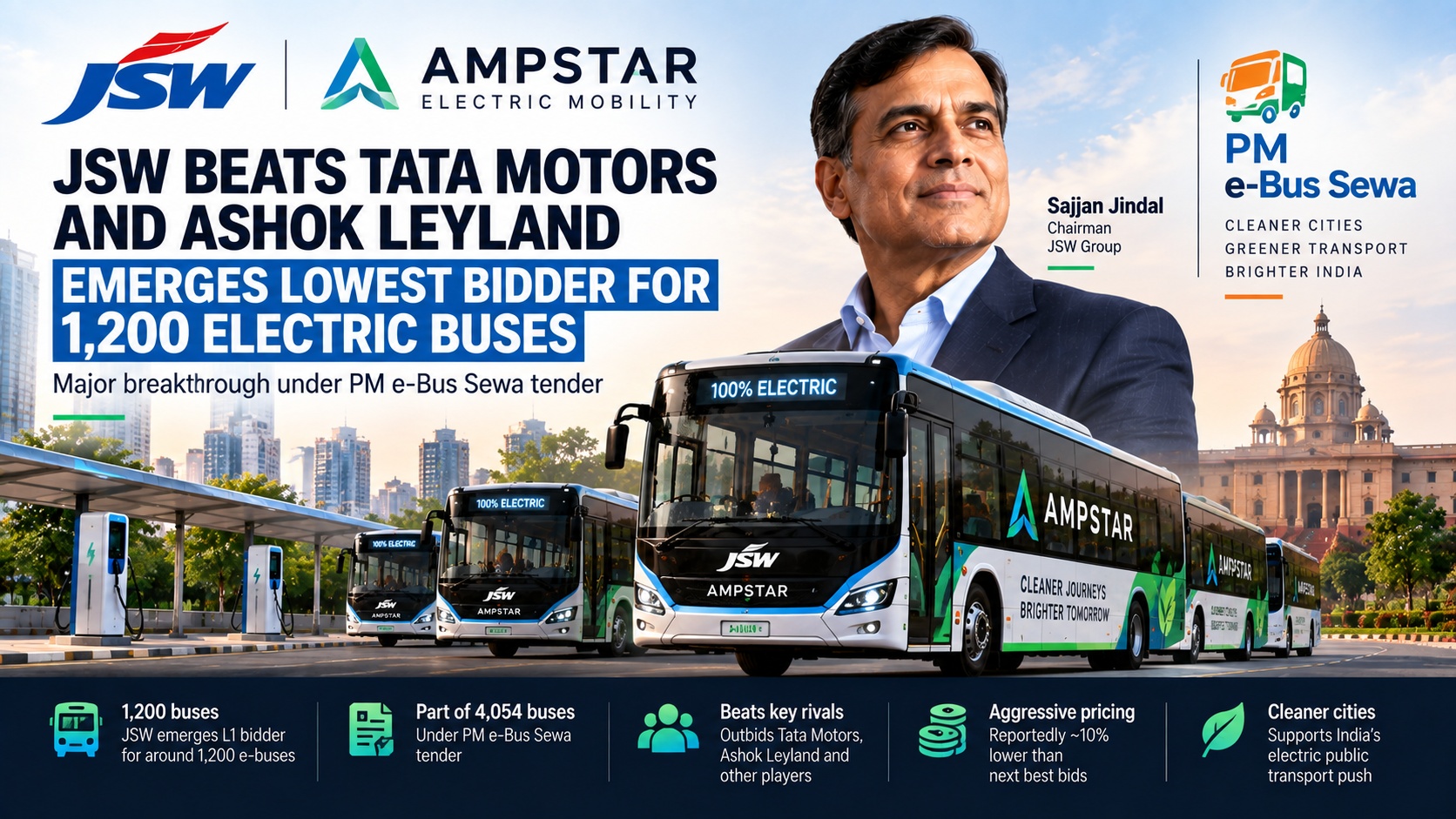
JSW Group has made a dramatic entry into India’s electric bus market, emerging as the lowest bidder for around 1,200 buses in a massive government tender and beating established commercial-vehicle manufacturers including Tata Motors and Ashok Leyland.
The development represents an important breakthrough for Sajjan Jindal’s rapidly expanding automotive ambitions.
JSW entered the electric commercial vehicle business only recently through JSW Greentech and launched its AMPSTAR brand in September. Yet within weeks of the commercial launch, the group has positioned itself for one of the largest electric bus orders in the country.
The aggressive bid also demonstrates how intensely JSW intends to compete as India accelerates the electrification of public transportation.
JSW Emerges L1 for Around 1,200 Buses
The latest tender covers 4,054 electric buses under the government’s PM e-Bus Sewa programme.
JSW emerged as the lowest, or L1, bidder for approximately 1,200 of those buses.
That potentially gives the newcomer close to 30% of the entire tender.
The significance becomes clearer when considering the competitors.
JSW was bidding against companies with decades of commercial-vehicle experience, including Tata Motors and Ashok Leyland, as well as specialised electric bus manufacturers.
For a relatively new entrant to capture such a substantial portion of a major government procurement programme indicates how aggressively JSW is approaching the market.
Aggressive Pricing Was Central to the Strategy
Price appears to have played a decisive role.
The difference between the lowest and second-lowest bids was reportedly around 10% in several cases, illustrating how aggressively JSW priced its offering.
Such a strategy can help a newcomer establish scale quickly.
Electric bus manufacturing involves substantial fixed investments in factories, engineering, homologation, supply chains and service infrastructure. Securing large orders early allows a manufacturer to utilise that capacity and spread fixed costs across a larger number of vehicles.
JSW therefore appears willing to prioritise market entry and scale as it establishes AMPSTAR.
The challenge will be ensuring that aggressive bidding still produces sustainable economics over the lifetime of the contracts.
Government Contracts Are Critical to the E-Bus Industry
India’s electric bus market remains heavily dependent on government procurement.
Unlike electric two-wheelers and passenger cars, where individual consumers create most demand, urban bus fleets are primarily operated by government transport authorities.
Large central procurement programmes therefore determine a significant portion of industry demand.
The PM e-Bus Sewa programme aims to support the deployment of 10,000 electric buses across 116 tier-II and tier-III cities.
It complements the PM E-Drive programme, which is supporting another 14,028 electric buses, primarily across larger metropolitan areas.
Together, these programmes are creating one of the world’s largest government-backed electric public transportation markets.
JSW Learned From Its Previous Tender Attempt
The latest result also shows how quickly JSW has progressed.
Earlier this year, the group participated in another major government tender covering 6,230 electric buses.
JSW bid aggressively across several cities and frequently undercut established manufacturers, but ultimately failed to secure an order.
That first attempt nevertheless provided an important indication of its intentions.
JSW was already among the second- or third-lowest bidders in markets including Pune, Ahmedabad, Hyderabad and Delhi.
The latest PM e-Bus Sewa tender appears to represent the next stage of that strategy: converting aggressive pricing into actual orders.
AMPSTAR Gives JSW Its Own Commercial Vehicle Brand
JSW formally entered commercial electric mobility with the launch of AMPSTAR in September.
The brand will manufacture electric buses and trucks and is positioned as a complete commercial mobility platform rather than simply a vehicle manufacturer.
JSW intends to provide vehicles alongside charging infrastructure, financing, operating solutions and after-sales support.
Customers can choose different ownership models, including conventional purchases, leasing and Battery-as-a-Service.
This approach is particularly important for commercial vehicles because the upfront cost of an electric bus can be considerably higher than that of a comparable diesel vehicle.
Flexible financing and operating models can reduce the initial financial burden for fleet operators.
A Major Manufacturing Base Is Already Ready
JSW Greentech has established its electric commercial vehicle manufacturing facility at Chhatrapati Sambhajinagar in Maharashtra.
The broader AMPSTAR operation is being developed to manufacture both electric trucks and buses.
The company has previously outlined annual capacity of around 10,000 trucks and 5,000 buses.
Winning an order involving approximately 1,200 buses would therefore immediately provide meaningful utilisation for the bus manufacturing operation.
That matters because JSW has already committed around ₹2,000 crore to building its electric commercial mobility business.
Large government orders can help accelerate the path toward scale.
JSW Is Building More Technology In-House
The group is also attempting to control more of the technology underlying its vehicles.
JSW has been developing its electric bus platform, vehicle control unit and battery-pack design internally as it seeks greater control over costs and product development.
Its electric drivetrain architecture is being developed in-house, although the company also sources technology and components globally.
Like most Indian electric vehicle manufacturers, JSW continues to rely partly on international supply chains, including components and battery cells sourced from China.
The AMPSTAR 12-metre city bus, however, has already reached localisation levels of around 70%, according to the company.
Greater localisation could become increasingly important as JSW attempts to maintain aggressive pricing without sacrificing profitability.
The Tender Model Carries Significant Risk
Winning the tender is only the beginning.
Government electric bus contracts frequently operate under the Gross Cost Contract model.
Under this structure, the operator typically supplies, operates and maintains the buses for an extended period while the transport authority pays a predetermined amount for each kilometre operated.
This creates a very different risk profile from simply selling a bus.
Manufacturers and operators must consider battery degradation, electricity consumption, maintenance expenses, financing costs and vehicle availability across years of operation.
A bid that appears attractive initially can become financially difficult if those assumptions prove too optimistic.
That is why the aggressive pricing seen in India’s recent electric bus tenders has attracted considerable industry attention.
Payment Security Makes Government Orders More Viable
The government has attempted to address one of the industry’s biggest concerns through the PM e-Bus Sewa Payment Security Mechanism.
The ₹3,435 crore mechanism provides protection against payment defaults by state transport authorities.
Payment security is critical because electric bus contracts require companies to invest significant capital upfront while recovering that investment gradually through operating payments.
Reducing the risk of delayed state payments makes these contracts more attractive to manufacturers, operators and lenders.
That, in turn, allows companies such as JSW to bid more aggressively.
Competition in Electric Buses Is Becoming Fierce
JSW is entering a market that is rapidly becoming one of the most competitive segments of India’s automobile industry.
Established manufacturers such as Tata Motors and Ashok Leyland are competing against newer electric-focused companies including EKA Mobility, PMI Electro, JBM and Olectra Greentech.
Government procurement has allowed several newer companies to challenge traditional commercial-vehicle manufacturers.
Now JSW is attempting to do the same—with considerably greater financial resources behind it.
The latest tender is particularly significant because it demonstrates that India’s electric bus market is not necessarily going to be dominated by the companies that historically controlled diesel buses.
India’s Electric Bus Market Is Accelerating
The timing of JSW’s entry is favourable.
Electric bus sales in India increased 55% year-on-year during April-September FY27 to 3,723 vehicles, the highest first-half figure recorded so far.
Electric buses accounted for approximately 8.55% of total bus sales during the period, compared with 5.47% a year earlier.
Government procurement remains the primary driver, but the direction is increasingly clear.
India is gradually shifting its urban public transportation fleet away from diesel and toward electric propulsion.
That creates a potentially enormous long-term opportunity for manufacturers able to combine competitive pricing, reliable technology and large-scale manufacturing.
Another Step in Sajjan Jindal’s Auto Ambitions
The electric bus order should also be viewed within Sajjan Jindal’s broader automotive strategy.
JSW’s automobile interests now extend across electric trucks, buses and passenger vehicles.
The group operates JSW MG Motor India through its partnership with SAIC Motor and is separately developing additional passenger-vehicle ambitions.
AMPSTAR gives JSW a dedicated platform for commercial electric mobility.
The strategy increasingly resembles the way JSW entered and expanded in other capital-intensive industries: invest heavily, build scale quickly and compete aggressively for market share.
The Bigger Picture
Emerging as the lowest bidder for approximately 1,200 electric buses represents an important validation of JSW’s decision to enter commercial electric mobility.
Only months earlier, the company participated aggressively in a 6,230-bus tender but failed to secure orders.
Now it has potentially captured almost 30% of a 4,054-bus government tender while competing against some of India’s most established commercial-vehicle manufacturers.
The next challenge is execution.
JSW must manufacture the buses, operate them reliably, control battery and maintenance costs and demonstrate that its aggressive bids can generate sustainable returns over the contract period.
If it succeeds, the implications could extend well beyond this particular order.
AMPSTAR could quickly establish itself as a serious challenger in India’s electric commercial vehicle industry, forcing established players such as Tata Motors and Ashok Leyland—and newer electric specialists—to respond.
For Sajjan Jindal, that would mark another important step toward turning JSW from a steel-and-energy conglomerate into a significant force in India’s rapidly changing automobile industry.
Feel free to share your experiences and insights in the comments below. Let’s continue the conversation and grow together as a community of traders and analysts.
By sharing this experience and insights, I hope to contribute to the collective knowledge of our professional community, encouraging a culture of strategic thinking and informed decision-making.
As always, thorough research and risk management are crucial. The dynamic nature of financial markets demands vigilance, agility, and a deep understanding of the tools at your disposal. Here’s to profitable trading and navigating the election season with confidence!
Ready to stay ahead of market trends and make informed investment decisions? Follow our page for more insights and updates on the latest in the financial world!
For a free online stock market training by Yogeshwar Vashishtha (M.Tech IIT) this Saturday from 11 am – 1 pm, please sign up with https://pathfinderstrainings.in/training/freetrainings.aspx
Experience profits with my winning algo strategies – get a free one-month trial with ₹15 lakh capital! – https://terminal.algofinders.com/algo-terminal
Disclaimer
This article should not be interpreted as investment advice. For any investment decisions, consult a reputable financial advisor. The author and publisher are not responsible for any losses incurred by investors or traders based on the information provided.