

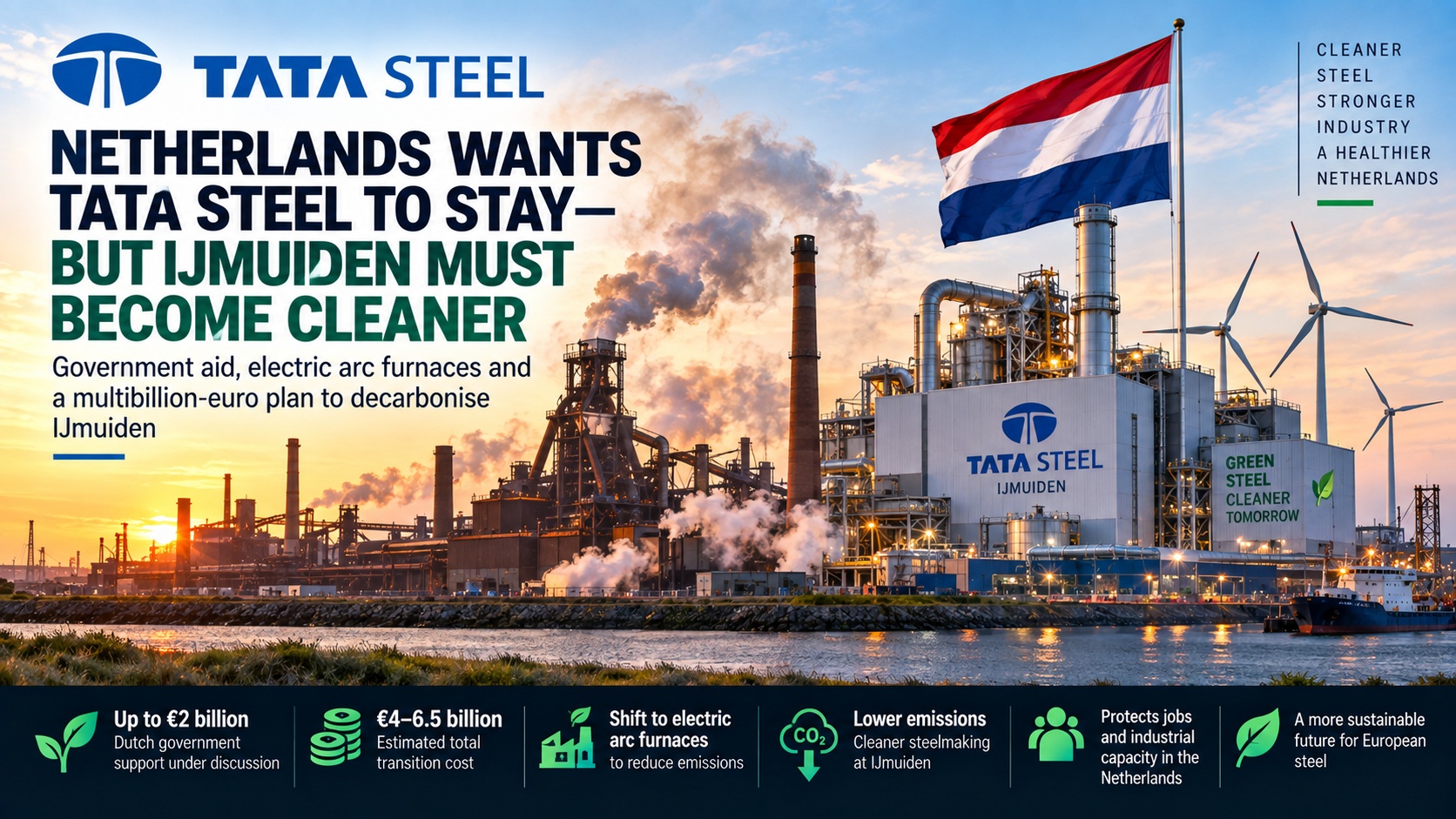
Tata Steel’s future in the Netherlands is approaching a critical decision point as the Dutch government attempts to balance two competing priorities: preserving one of the country’s most strategically important industrial assets while dramatically reducing the environmental impact of steel production.
At the centre of the negotiations is Tata Steel’s massive IJmuiden steelworks in North Holland.
The Netherlands wants Tata Steel to continue producing steel domestically, recognising the importance of having its own steelmaking capacity rather than becoming increasingly dependent on imports. But government support comes with an equally clear condition—the IJmuiden operation must become substantially cleaner.
Tata Steel and the Dutch government are consequently negotiating a multibillion-euro transformation that could replace traditional coal-intensive steelmaking with lower-carbon technologies.
The two sides had hoped to reach an agreement by the end of September but have now extended negotiations until 1 March 2027.
Up to €2 Billion of Government Support
The financial scale of the transformation is enormous.
Tata Steel signed a non-binding agreement with the Netherlands government in September 2025 that could provide up to €2 billion in state support for the decarbonisation of IJmuiden.
However, government funding would cover only part of the total investment.
The complete transformation is estimated to cost between €4 billion and €6.5 billion.
The remaining capital would need to come from Tata Steel’s own cash flows, debt financing and support from parent Tata Steel.
The company has also applied for approximately €300 million from the European Union’s Innovation Fund.
For Tata Steel, government participation is therefore central to whether the economics of the project ultimately work.
Why IJmuiden Matters to the Netherlands
The IJmuiden facility is not simply another industrial plant.
It is the Netherlands’ only primary steel manufacturing facility and has annual production capacity of approximately 7 million tonnes.
That makes it strategically important for the country’s manufacturing economy.
Steel is essential for automobiles, construction, machinery, infrastructure, energy systems and defence-related industries. Losing domestic primary steelmaking capacity would increase dependence on foreign suppliers at a time when governments across Europe are becoming increasingly concerned about industrial security.
The Dutch government therefore wants Tata Steel to remain.
But maintaining domestic production cannot come at the expense of environmental and public-health objectives.
The government’s position is essentially that the Netherlands wants steel—but cleaner steel.
Coal-Fired Steelmaking Is the Core Problem
Traditional primary steelmaking is extremely carbon intensive.
Blast furnaces rely heavily on coal and coke to convert iron ore into iron, producing substantial carbon dioxide emissions in the process.
Tata Steel’s IJmuiden facility currently uses this conventional production route.
The proposed transformation would progressively replace coal-intensive infrastructure with technologies including direct reduced iron and electric arc furnaces.
Electric arc furnaces can operate using electricity rather than relying primarily on coke-fired blast furnaces.
When that electricity comes from renewable sources, the carbon intensity of steel production can fall dramatically.
The transition therefore represents much more than upgrading existing machinery. Tata Steel would effectively be rebuilding the fundamental production system of one of Europe’s largest steel plants.
Negotiations Extended by Five Months
The complexity of that transformation explains why Tata Steel and the Dutch government have struggled to finalise their agreement.
After failing to reach an acceptable position by the end of September, both sides extended negotiations by five months.
The new target is to conclude a tailor-made agreement by 1 March 2027.
Several issues remain unresolved.
These include the timeline for closing existing coke and gas plants, regulatory certainty surrounding steel slag, electricity network tariffs and the sequencing of billions of euros of capital expenditure.
Changes to the European Union’s carbon-emissions framework have added another layer of uncertainty.
The project therefore needs to work not only technically but financially and politically.
Energy Costs Could Determine Green Steel Economics
Electric arc furnaces reduce dependence on coal, but they dramatically increase the importance of electricity.
That makes power prices crucial.
A steel plant consuming enormous quantities of electricity cannot remain competitive if grid charges or renewable power costs are significantly higher than those faced by competitors elsewhere.
Tata Steel is therefore paying close attention to discussions surrounding Dutch network tariffs.
This illustrates one of the central challenges facing Europe’s green industrial transition.
Installing cleaner equipment is only part of the solution. Governments must also ensure that sufficient renewable electricity is available at prices that allow energy-intensive industries to compete globally.
Otherwise, Europe risks reducing domestic emissions simply by moving industrial production—and the associated emissions—to other countries.
Tata Steel Says Government Aid Is Essential
Tata Steel has previously warned that without government support, the economics of investing billions of euros in cleaner production technology would be difficult to justify.
The company has even indicated that IJmuiden could ultimately face closure if an economically viable transition cannot be established.
Such an outcome would be significant for both Tata Steel and the Netherlands.
For Tata Steel, IJmuiden remains one of its most important European assets.
For the Dutch government, losing the country’s only primary steel plant would mean jobs, industrial capability and strategic manufacturing capacity disappearing from the domestic economy.
That gives both sides a powerful incentive to find a compromise.
Port Talbot Provides a Preview
Tata Steel has already faced a similar challenge in the United Kingdom.
Its Port Talbot steelworks had become heavily loss-making, while its coal-fired blast furnaces required enormous investment to meet future environmental requirements.
The UK government eventually agreed to provide a £500 million grant toward a £1.25 billion green steel project.
Tata Steel subsequently shut both blast furnaces and began developing a new electric arc furnace.
The new facilities are currently under construction.
IJmuiden is different because the Dutch operation remains economically stronger than Port Talbot, but the basic dilemma is similar: traditional European blast-furnace steelmaking is becoming increasingly difficult to sustain without enormous investment.
IJmuiden Is the Bigger Decarbonisation Challenge
The Dutch project is substantially larger than Tata Steel’s UK transition.
While the Port Talbot programme involves investment of approximately £1.25 billion, the Netherlands estimates that transforming IJmuiden could require €4-6.5 billion.
The difference reflects the scale and complexity of the Dutch operation.
IJmuiden has approximately 7 million tonnes of annual steelmaking capacity and remains an integrated primary steel facility.
Transforming such a large industrial complex while attempting to maintain production and profitability represents an enormous engineering and financial challenge.
European Carbon Rules Add Pressure
Tata Steel does not have unlimited time to make the transition.
Europe’s carbon-pricing framework increasingly penalises emissions-intensive industrial production.
Historically, steelmakers received free carbon allowances to protect European industry from international competitors operating under less stringent environmental rules.
Those protections are gradually changing as Europe introduces its Carbon Border Adjustment Mechanism and modifies the system of free CO₂ allowances.
For Tata Steel, the timing matters enormously.
Invest too early and the company could commit billions before the economics of green steel become sufficiently attractive.
Invest too late and increasingly expensive carbon emissions could undermine the competitiveness of the existing plant.
Cleaner Steel Could Eventually Become a Competitive Advantage
The transition is not purely about complying with environmental regulations.
Green steel could eventually become commercially valuable.
Automakers, infrastructure companies and manufacturers are increasingly attempting to reduce emissions throughout their supply chains.
Steel represents a substantial portion of the embedded carbon in cars, buildings and industrial equipment.
If Tata Steel can produce significantly lower-carbon steel at IJmuiden, it could potentially sell those products to European customers seeking to meet their own sustainability targets.
The challenge is ensuring customers are willing to pay enough of a premium to compensate for the higher cost of cleaner production.
Tata Steel Must Balance Europe With India
The negotiations also matter because Tata Steel is simultaneously investing heavily elsewhere.
India remains the company’s primary growth market, where steel demand is expanding and production economics are generally more attractive.
The company is increasing Indian capacity while also financing major restructuring programmes in Britain and the Netherlands.
Every additional billion euros committed to Europe therefore has an opportunity cost.
Tata Steel must decide how much capital it can reasonably allocate to preserving European operations while continuing to fund expansion in India.
Government support becomes crucial in balancing those competing priorities.
The Bigger Picture
The IJmuiden negotiations represent one of the clearest examples of the challenge facing European heavy industry.
Governments want cleaner manufacturing.
They also want industrial independence, domestic jobs and strategic production capacity.
Achieving both objectives is extremely expensive.
For the Netherlands, allowing Tata Steel to disappear would weaken domestic industrial capability and increase dependence on imported steel.
For Tata Steel, spending as much as €6.5 billion without sufficient government assistance or regulatory certainty could produce unacceptable financial returns.
That is why the negotiations have become so important.
A Decision With Decades of Consequences
The extension to 1 March 2027 gives Tata Steel and the Dutch government another five months to resolve the financial, regulatory and operational details surrounding IJmuiden’s transformation.
Up to €2 billion of Dutch government support remains potentially available, while Tata Steel must determine how much additional capital it is willing to commit.
If an agreement is reached, IJmuiden could gradually evolve from a traditional coal-intensive steelworks into one of Europe’s largest lower-carbon steelmaking complexes.
If negotiations fail, questions surrounding the long-term future of the facility could return.
Both sides therefore have considerable incentive to reach a deal.
The Netherlands wants Tata Steel to stay because domestic steelmaking matters economically and strategically.
Tata Steel wants to preserve a valuable European operation—but only if the transition makes financial sense.
The challenge between now and March 2027 is finding a structure capable of achieving both objectives: keeping steelmaking in the Netherlands while making the steel itself substantially cleaner.
Feel free to share your experiences and insights in the comments below. Let’s continue the conversation and grow together as a community of traders and analysts.
By sharing this experience and insights, I hope to contribute to the collective knowledge of our professional community, encouraging a culture of strategic thinking and informed decision-making.
As always, thorough research and risk management are crucial. The dynamic nature of financial markets demands vigilance, agility, and a deep understanding of the tools at your disposal. Here’s to profitable trading and navigating the election season with confidence!
Ready to stay ahead of market trends and make informed investment decisions? Follow our page for more insights and updates on the latest in the financial world!
For a free online stock market training by Yogeshwar Vashishtha (M.Tech IIT) this Saturday from 11 am – 1 pm, please sign up with https://pathfinderstrainings.in/training/freetrainings.aspx
Experience profits with my winning algo strategies – get a free one-month trial with ₹15 lakh capital! – https://terminal.algofinders.com/algo-terminal
Disclaimer
This article should not be interpreted as investment advice. For any investment decisions, consult a reputable financial advisor. The author and publisher are not responsible for any losses incurred by investors or traders based on the information provided.