

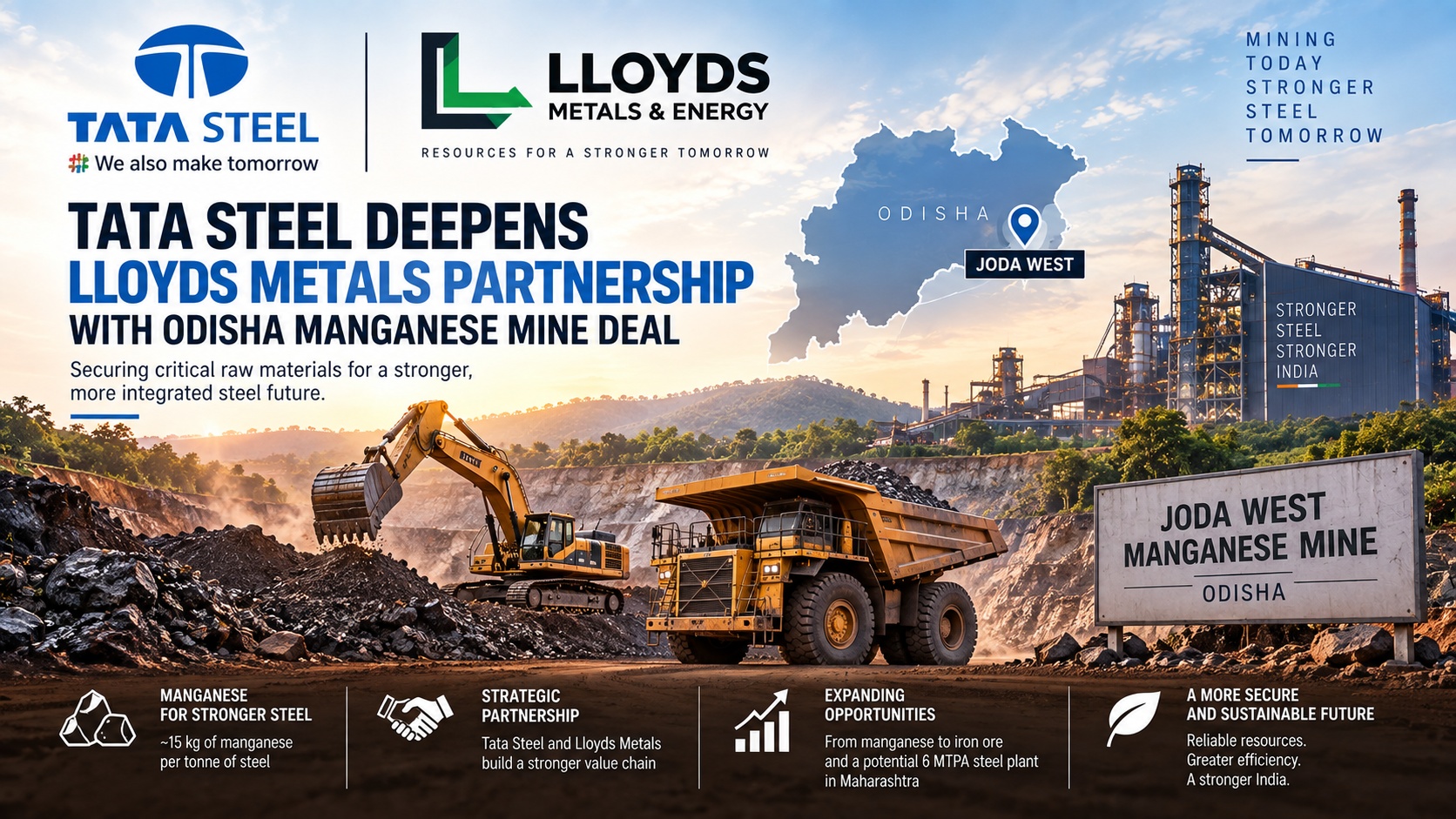
Tata Steel is strengthening its control over critical raw materials by expanding its partnership with Lloyds Metals & Energy, this time through the development and operation of a manganese mine in Odisha.
The steelmaker has selected Brahmani River Pellets Ltd. (BRPL) as the mine developer and operator for its Joda West manganese mine. The move is significant not only for Tata Steel’s mining operations but also because BRPL brings together Tata Steel and Lloyds Metals, two companies that are increasingly collaborating across mining and steelmaking projects.
For Tata Steel, the arrangement forms part of a broader strategy to secure raw materials, improve mining efficiency and optimise capital expenditure as it expands its steelmaking operations in India.
BRPL Takes Charge of Joda West Mine
BRPL has been appointed as the mine developer and operator, or MDO, for Tata Steel’s Joda West manganese mine in Odisha.
BRPL is fully owned by Thriveni Pellets Pvt. Ltd., in which Tata Steel owns 50.01%, while Lloyds Metals & Energy owns the remaining 49.99%.
The ownership structure effectively combines Tata Steel’s scale and experience in steelmaking with Lloyds Metals’ growing mining expertise.
If BRPL delivers the required operational efficiency at Joda West, Tata Steel could consider using the company for some of its other mining operations as well.
This means Joda West could potentially become the starting point for a much broader mining relationship between the two groups.
Why Manganese Matters to Tata Steel
Manganese is an important ingredient in steelmaking because it improves the strength, hardness and toughness of steel.
Approximately 15 kg of manganese is required for every tonne of steel, although the amount varies depending on the grade being produced.
Specialised products such as high-tensile and corrosion-resistant steels generally require greater manganese content.
This becomes increasingly relevant as Tata Steel shifts its portfolio toward higher-value steel products rather than focusing purely on increasing volumes.
Securing reliable manganese supplies therefore supports both production stability and the company’s broader premiumisation strategy.
Tata Steel Already Has Significant Manganese Resources
Tata Steel currently has manganese ore capacity of approximately 300,000 tonnes annually across its Tiringpahar, Bamebari, Joda West and Khondbond mines.
The company already meets its manganese requirements internally.
However, efficient operation of these mines remains important, particularly because their existing mining leases are scheduled to expire in 2030.
Using specialist mine developers can allow Tata Steel to increase productivity while limiting the amount of capital and management resources it needs to deploy directly.
The company plans to continue using a combination of its own mining operations and the MDO model depending on the requirements of individual assets.
Tata Steel and Lloyds Metals Are Building a Much Larger Partnership
The Joda West agreement is only one part of an expanding relationship between Tata Steel and Lloyds Metals.
In December, the companies signed a memorandum of understanding to explore mining opportunities in Maharashtra, particularly opportunities to increase iron ore production.
Iron ore is Tata Steel’s most important raw material, making greater access to captive and strategically controlled supplies extremely valuable.
The partnership could also extend much further downstream.
Tata Steel and Lloyds Metals are exploring the development of a new greenfield steel plant in Maharashtra with planned capacity of 6 million tonnes annually.
The project would be developed in two phases.
If it proceeds, the partnership would therefore span multiple stages of the steel value chain—from extracting raw materials to processing iron ore and ultimately producing finished steel.
Raw-Material Security Is a Major Competitive Advantage
One of Tata Steel’s biggest advantages in India has historically been its access to captive raw materials.
Steel manufacturing is highly exposed to fluctuations in iron ore, coking coal, manganese and other commodity prices.
Companies that control part of their raw-material requirements can reduce their dependence on external suppliers and gain greater visibility over production costs.
This becomes particularly important during periods of commodity volatility.
By strengthening its mining partnerships and improving the productivity of existing mines, Tata Steel can protect one of the structural advantages of its Indian steel business.
Lloyds Metals Gains a Powerful Strategic Partner
The partnership is equally important for Lloyds Metals.
The company has been rapidly expanding its presence in mining and steel-related businesses.
Working alongside Tata Steel gives Lloyds Metals access to one of India’s largest and most experienced integrated steel producers.
Successful execution at Joda West could potentially create opportunities for Lloyds Metals to participate in additional Tata Steel mining projects.
The proposed Maharashtra steel plant would take the relationship even further, creating a partnership that goes beyond providing mining services.
Building an Integrated Steel Ecosystem
The broader direction of the Tata Steel-Lloyds Metals relationship is becoming increasingly clear.
Joda West provides an opportunity to collaborate in manganese mining.
Their Maharashtra agreement focuses partly on increasing iron ore production.
And the proposed 6-million-tonne greenfield plant could eventually extend the partnership into large-scale steelmaking.
Together, these projects could create a highly integrated relationship covering mining, raw-material processing and finished steel production.
For Tata Steel, this can provide additional raw-material security while allowing the company to leverage external mining expertise and optimise capital expenditure.
For Lloyds Metals, it provides an opportunity to expand alongside one of India’s largest steelmakers.
The Bigger Picture
The Joda West manganese mine may appear relatively small compared with Tata Steel’s massive overall operations, but strategically it represents something more important.
It shows Tata Steel strengthening its upstream supply chain at a time when the company is expanding its Indian operations and increasing its focus on higher-value steel.
It also demonstrates that the partnership with Lloyds Metals is evolving from individual mining opportunities into a broader industrial relationship.
With approximately 300,000 tonnes of existing annual manganese capacity, new iron ore opportunities being explored in Maharashtra and a potential 6-million-tonne greenfield steel plant under consideration, the two companies are gradually connecting several pieces of the steelmaking value chain.
If BRPL successfully improves efficiency at Joda West, the partnership could expand to additional mines and projects.
For Tata Steel, the strategy is ultimately about ensuring that future steel growth is supported by secure, efficiently operated raw-material resources—an advantage that could become increasingly valuable as India’s steel industry continues to expand.
Feel free to share your experiences and insights in the comments below. Let’s continue the conversation and grow together as a community of traders and analysts.
By sharing this experience and insights, I hope to contribute to the collective knowledge of our professional community, encouraging a culture of strategic thinking and informed decision-making.
As always, thorough research and risk management are crucial. The dynamic nature of financial markets demands vigilance, agility, and a deep understanding of the tools at your disposal. Here’s to profitable trading and navigating the election season with confidence!
Ready to stay ahead of market trends and make informed investment decisions? Follow our page for more insights and updates on the latest in the financial world!
For a free online stock market training by Yogeshwar Vashishtha (M.Tech IIT) this Saturday from 11 am – 1 pm, please sign up with https://pathfinderstrainings.in/training/freetrainings.aspx
Experience profits with my winning algo strategies – get a free one-month trial with ₹15 lakh capital! – https://terminal.algofinders.com/algo-terminal
Disclaimer
This article should not be interpreted as investment advice. For any investment decisions, consult a reputable financial advisor. The author and publisher are not responsible for any losses incurred by investors or traders based on the information provided.