

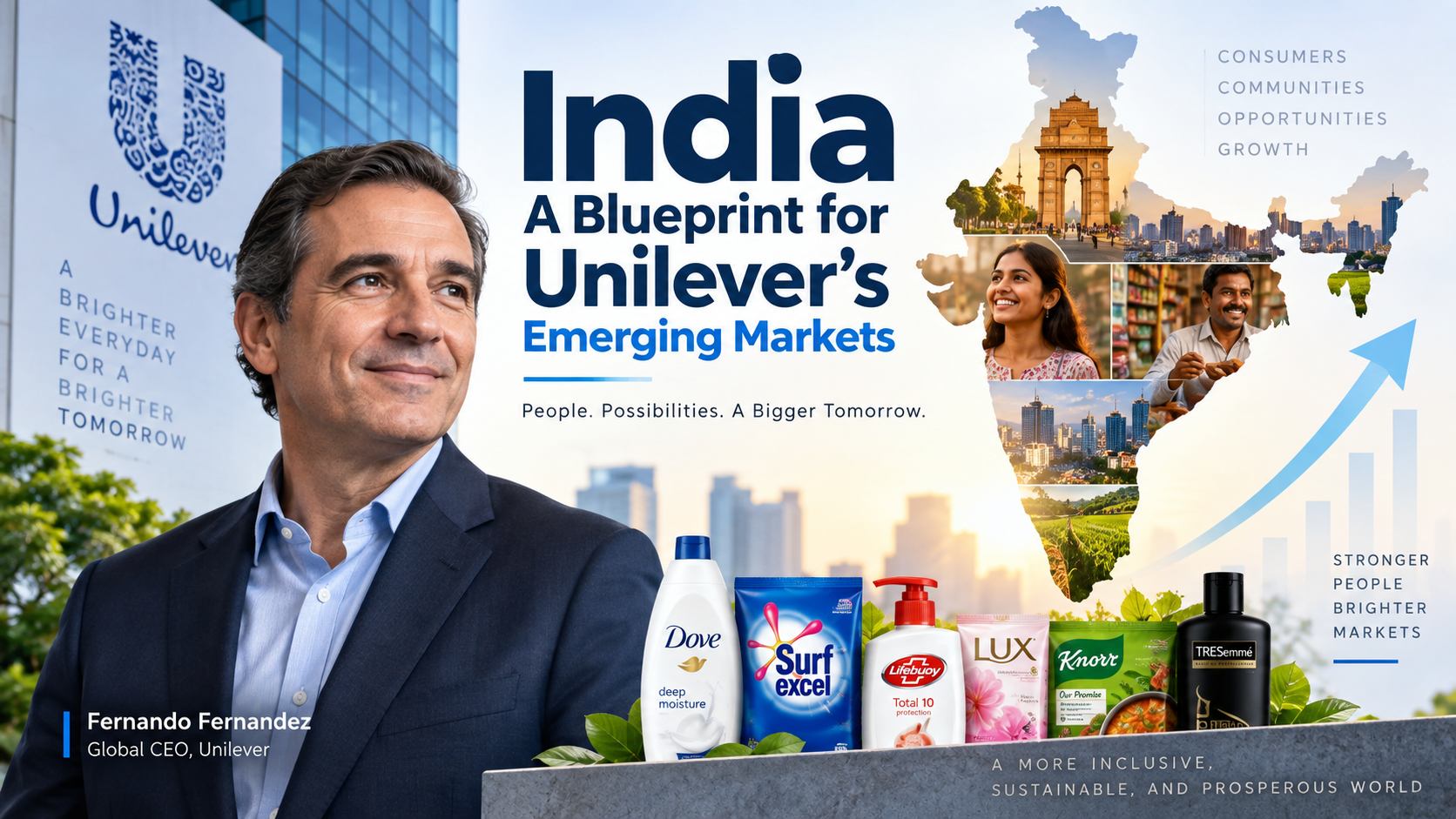
India is becoming increasingly central to Unilever’s global growth strategy, with the consumer goods giant viewing the country as a model for how it can expand across emerging markets. Unilever CEO Fernando Fernandez has described India as a “blueprint” for the company’s emerging-market operations, highlighting the scale of the opportunity created by changing consumer behaviour, rising incomes, digitalisation and new retail channels.
For Hindustan Unilever Limited (HUL), this positioning could significantly strengthen its importance within the multinational group. India is already one of Unilever’s largest markets, but management believes the country still has substantial room for growth as millions of consumers gradually increase their spending on branded and premium consumer products.
India at the Heart of Unilever’s Emerging-Market Strategy
Emerging markets currently generate around 62% of Unilever’s revenue, making them critical to the company’s long-term performance. These economies offer several structural advantages, including expanding populations, urbanisation, increasing household wealth and growing participation of women in the workforce.
Within this group, India occupies a particularly important position.
Unilever has spent decades building an extensive distribution network and understanding consumption patterns across Indian cities, towns and villages. This deep market knowledge gives HUL an advantage as consumption increasingly expands beyond India’s largest metropolitan areas.
Smaller towns and rural markets are becoming particularly important. Improvements in roads, electrification, digital connectivity and household infrastructure are gradually bringing millions of consumers closer to organised markets and branded consumer products.
At the same time, India’s relatively low per-capita FMCG consumption suggests considerable headroom for long-term expansion.
HUL Becomes Even More Important to Unilever
HUL’s strategic importance within the global organisation is also increasing following changes to Unilever’s international portfolio.
After the restructuring of Unilever’s international foods operations, HUL is expected to represent roughly 17% of Unilever’s revenue, according to global management. That makes the Indian subsidiary one of the group’s most important individual businesses and a major contributor to future growth.
India and the United States have consequently emerged as Unilever’s two major anchor markets.
The company is increasingly concentrating investments, innovation and acquisitions in these markets, particularly in faster-growing categories such as beauty, wellbeing and personal care.
Premiumisation Could Unlock the Next Growth Phase
One of India’s biggest opportunities lies in premiumisation.
Premiumisation does not necessarily mean convincing consumers to immediately purchase expensive luxury products. In a market as diverse as India, even relatively small improvements in product quality, pack sizes or price points can represent meaningful upgrades in consumer spending.
For example, consumers moving from basic sachets to slightly higher-priced variants can create enormous incremental demand when multiplied across hundreds of millions of purchases.
At the wealthier end of the market, India also contains a rapidly expanding group of consumers with spending power comparable to consumers in developed economies. This creates opportunities for premium skincare, haircare, personal care and wellness brands.
HUL’s acquisition of premium beauty brand Minimalist fits directly into this strategy. Such targeted acquisitions can help the company capture younger, digitally native consumers while complementing its enormous portfolio of established mass-market brands.
Quick Commerce Becomes a Structural Advantage
India’s rapidly expanding quick-commerce industry is another major component of HUL’s strategy.
Platforms offering groceries and household products within minutes are changing how urban consumers purchase everyday goods. For a company with well-known brands and enormous product availability, this transition could be particularly beneficial.
HUL CEO Priya Nair has indicated that quick commerce offers better profitability for the company than modern trade and traditional general trade.
Recognising the opportunity, HUL established a dedicated quick-commerce organisation earlier in 2026, allowing the company to make faster decisions and focus more closely on this rapidly growing distribution channel.
Quick commerce represented around 3% of HUL’s revenue at the time, but its importance could increase considerably as instant-delivery platforms expand their geographical reach and product assortment.
Gen Z and Digital Marketing Reshape Consumer Brands
India’s enormous younger population represents another transformation taking place within the FMCG industry.
The country has hundreds of millions of Gen Z consumers who discover products differently from previous generations. Social media, influencers, online reviews and digital marketplaces increasingly influence purchasing decisions.
HUL is responding by expanding influencer-led marketing and working with tens of thousands of digital creators. Artificial intelligence is also becoming part of its marketing strategy, helping the company produce larger volumes of personalised content and improve advertising effectiveness.
For established FMCG companies, the challenge is no longer simply maintaining brand recognition. Brands must remain culturally relevant to younger consumers while adapting to rapidly changing digital trends.
HUL’s “Winning in New India” Strategy
HUL has formalised many of these priorities under its “Winning in New India” strategy.
The company plans to increase capital expenditure from approximately 2% of turnover to around 3%, providing additional resources for manufacturing capacity, technology, supply-chain improvements and high-growth product categories.
The broader objective is to generate sustainable, volume-led growth rather than relying excessively on price increases.
HUL has also been investing heavily in expanding manufacturing capabilities, particularly in premium beauty, wellbeing and home-care categories. Automation and digital technologies are expected to improve supply-chain efficiency while allowing the company to respond faster to changing consumer preferences.
Strong Long-Term Potential, but Near-Term Challenges Remain
Despite the optimistic long-term outlook, HUL faces challenges.
Commodity inflation and higher input costs can pressure margins, forcing FMCG companies to carefully balance price increases with consumer affordability. India’s enormous income diversity also means companies must simultaneously serve highly price-sensitive consumers and increasingly affluent households.
HUL’s unusually broad portfolio provides some protection because consumers can move between different brands, pack sizes and price points without necessarily leaving the company’s ecosystem.
The stock market has nevertheless remained cautious. HUL shares recently touched a 52-week low of ₹1,936 and have significantly underperformed the broader Nifty 50 over the previous year.
This creates an interesting contrast between short-term investor sentiment and management’s long-term confidence in the Indian consumer market.
India Could Shape Unilever’s Global Playbook
Unilever’s decision to describe India as a blueprint for emerging markets demonstrates how dramatically the strategic importance of the country has evolved.
India is no longer simply a large developing market where multinational companies sell lower-priced versions of global products. It is increasingly becoming a testing ground for new distribution models, digital marketing strategies, premiumisation and consumer innovation.
HUL’s enormous distribution network gives Unilever access to consumers ranging from India’s largest cities to its smallest towns and villages. Meanwhile, quick commerce, social media, digital payments and improving infrastructure are changing how those consumers discover and purchase products.
If these trends continue, India could become much more than one of Unilever’s largest markets. Strategies developed by HUL for navigating India’s extraordinary diversity may increasingly provide the template Unilever uses to capture growth throughout the emerging world.
For HUL, this also reinforces its position as one of the most strategically important businesses within the global Unilever group. While near-term challenges around inflation, margins and consumer demand remain, the long-term opportunity rests on something much larger: the gradual expansion and transformation of one of the world’s biggest consumer markets.
Feel free to share your experiences and insights in the comments below. Let’s continue the conversation and grow together as a community of traders and analysts.
By sharing this experience and insights, I hope to contribute to the collective knowledge of our professional community, encouraging a culture of strategic thinking and informed decision-making.
As always, thorough research and risk management are crucial. The dynamic nature of financial markets demands vigilance, agility, and a deep understanding of the tools at your disposal. Here’s to profitable trading and navigating the election season with confidence!
Ready to stay ahead of market trends and make informed investment decisions? Follow our page for more insights and updates on the latest in the financial world!
For a free online stock market training by Yogeshwar Vashishtha (M.Tech IIT) this Saturday from 11 am – 1 pm, please sign up with https://pathfinderstrainings.in/training/freetrainings.aspx
Experience profits with my winning algo strategies – get a free one-month trial with ₹15 lakh capital! – https://terminal.algofinders.com/algo-terminal
Disclaimer
This article should not be interpreted as investment advice. For any investment decisions, consult a reputable financial advisor. The author and publisher are not responsible for any losses incurred by investors or traders based on the information provided.