

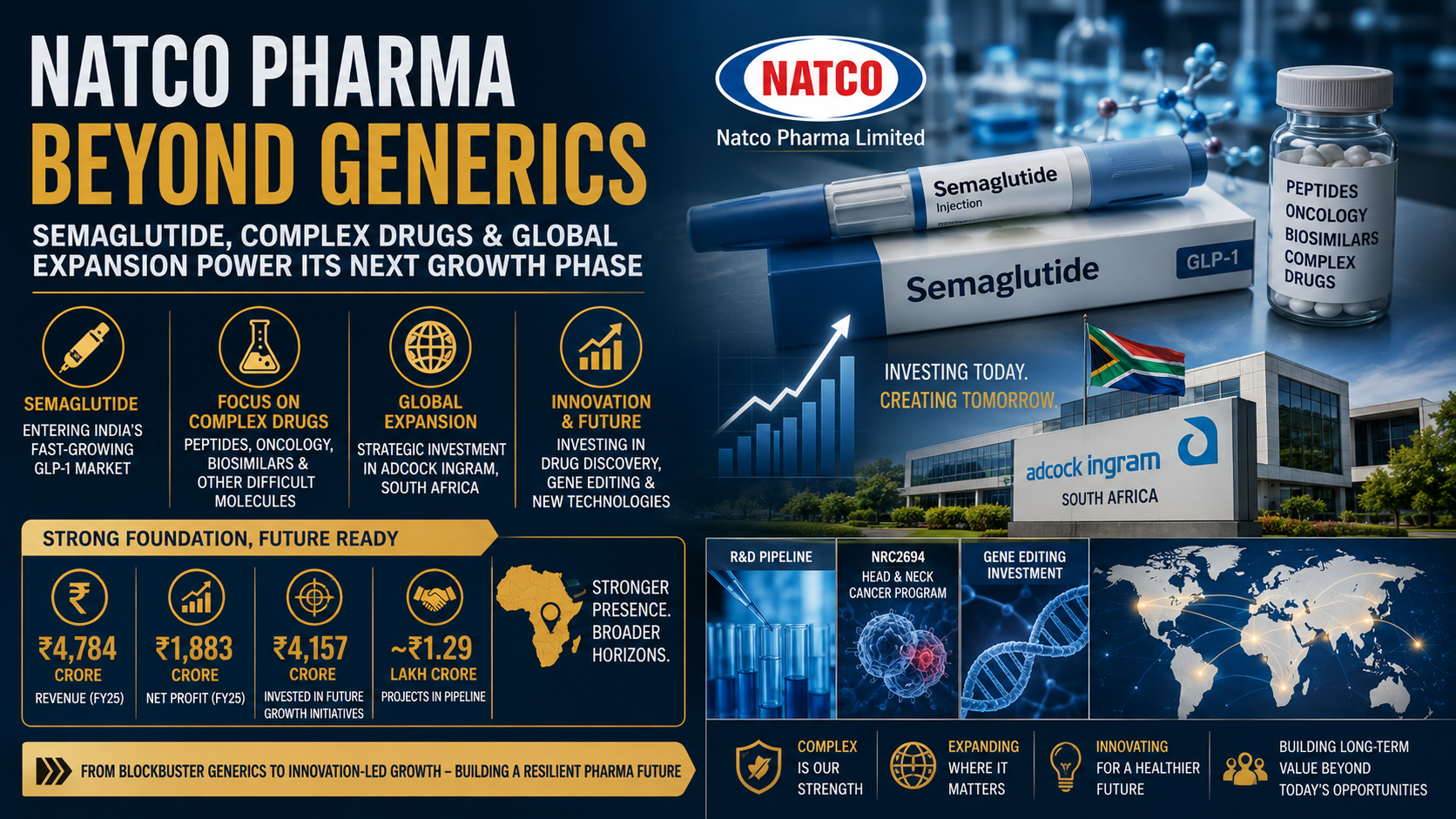
Natco Pharma is entering an important transition in its growth journey. For years, the Hyderabad-based pharmaceutical company built a highly profitable business by identifying complex generic drugs, challenging patents and entering lucrative markets where relatively few competitors could successfully manufacture the products.
That strategy produced significant rewards, particularly in the US market. However, the global generics industry is becoming increasingly competitive, while some of Natco’s biggest profit contributors are losing exclusivity.
The company is therefore building its next phase of growth around a much broader strategy—semaglutide and other complex medicines, expansion into new international markets, acquisitions, biosimilars, peptides and selective investments in innovative drug technologies.
At the centre of this transformation is chief executive and vice-chairman Rajeev Nannapaneni’s view that traditional generics can continue generating steady business, but meaningful future growth will increasingly come from difficult-to-develop products and new markets.
The Revlimid Windfall Is Fading
One of the biggest factors behind Natco’s changing strategy is the decline of generic Revlimid.
The blood cancer treatment became an enormously profitable opportunity for several Indian pharmaceutical companies after they secured arrangements allowing them to sell generic versions of the drug.
For Natco, the product contributed significantly to earnings and helped the company generate substantial cash flows.
The scale of that opportunity can be seen in Natco’s financial performance. Consolidated revenue reached ₹4,784 crore in FY25, while net profit climbed to ₹1,883.4 crore.
But extraordinary generic opportunities do not last indefinitely.
With Revlimid losing patent protection in January 2026 and competition increasing, Natco has started feeling the impact. In the first quarter of FY27, the company’s revenue declined 43% year-on-year, while net profit dropped 57%.
Rather than viewing this merely as a temporary earnings slowdown, Natco is using the transition to reposition the company for its next growth cycle.
Semaglutide Could Become an Important Domestic Growth Engine
One of the most important opportunities in Natco’s new product pipeline is semaglutide.
The GLP-1 drug class has emerged as one of the pharmaceutical industry’s biggest growth categories because of its effectiveness in treating type-2 diabetes and obesity.
Natco launched semaglutide in India in March 2026, providing the company with exposure to a rapidly expanding domestic market for GLP-1 medicines.
The launch could become particularly important as Natco attempts to reduce its historical dependence on large US generic opportunities.
Analysts expect semaglutide to help accelerate Natco’s domestic growth significantly during FY27, with India’s business potentially growing around 20%.
The opportunity is strategically attractive because obesity and diabetes represent enormous long-term healthcare markets in India.
As awareness increases, treatment becomes more accessible and generic competition brings prices down, GLP-1 medicines could potentially reach a much larger patient population.
For Natco, semaglutide therefore represents more than another generic launch. It could become an important pillar of a stronger domestic pharmaceutical franchise.
Complex Generics Remain at the Heart of Natco’s Strategy
Natco is not abandoning generics.
Instead, it wants to concentrate increasingly on areas where technical complexity creates barriers to competition.
These include peptides, oncology drugs, biosimilars and other difficult-to-manufacture medicines.
Commodity generics have become increasingly competitive globally. Many Western pharmaceutical companies have gradually reduced their presence in the segment, leaving Indian manufacturers competing aggressively against one another.
That has helped Indian pharmaceutical companies gain global market share, but it has simultaneously intensified price competition.
Natco believes the solution is to pursue products where development is difficult enough to restrict the number of competitors.
The economics of such a strategy can be unusual. A pharmaceutical company may spend years developing multiple products without generating major returns from most of them. But a handful of successful complex products can generate enough profit to compensate for numerous unsuccessful projects.
Natco’s historical success with products such as generic Revlimid demonstrates why the company continues to favour this approach.
South Africa Becomes a Major Part of Natco’s Global Expansion
Product diversification is only one part of Natco’s strategy. Geographic diversification is becoming equally important.
The company’s largest international move has been its investment in South African pharmaceutical company Adcock Ingram.
Natco initially acquired a 35.75% stake in Adcock Ingram in July 2025 in a transaction valued at approximately $226 million.
It subsequently increased its holding to 49%, taking its total investment to approximately ₹3,000 crore.
The acquisition gives Natco an established presence in a market where building an equivalent business organically could have required considerable time and investment.
More importantly, Adcock Ingram offers exposure beyond the traditional tender-driven pharmaceutical business associated with several Indian companies operating in Africa.
Its portfolio includes established branded and over-the-counter products, providing Natco with a broader commercial platform.
Natco can also introduce products from its own pipeline into Adcock’s distribution network, potentially creating additional growth opportunities over the next several years.
Adcock Could Make Natco’s Earnings More Stable
The strategic importance of Adcock Ingram extends beyond geographic expansion.
Natco’s earnings have historically been relatively volatile because successful complex generics can generate enormous profits for a limited period before competition eventually reduces their contribution.
Adcock provides Natco with a larger and potentially more predictable underlying business.
The benefits are already becoming visible. Management indicated that Adcock contributed roughly 35-40% of Natco’s earnings during the first quarter.
That creates an important counterbalance to the decline in Revlimid-related earnings.
Instead of depending excessively on occasional blockbuster generic launches, Natco wants a stronger base business capable of supporting profitability between major product opportunities.
Management believes the full benefits of combining Natco’s product pipeline with Adcock’s commercial platform could become increasingly visible over the next two to three years.
₹2,000 Crore Fundraise Signals More Acquisitions Could Follow
Natco’s international expansion may not stop with South Africa.
The company’s board approved plans in July to raise ₹2,000 crore through a Qualified Institutional Placement.
The capital is expected to support further inorganic growth opportunities.
That indicates acquisitions could become a more important component of Natco’s long-term strategy.
Rather than attempting to build every geographic market organically, the company can acquire stakes in established businesses that already possess distribution networks, brands, regulatory infrastructure and customer relationships.
The Adcock transaction provides a template for how such a strategy could work.
If Natco identifies similar opportunities in other attractive pharmaceutical markets, acquisitions could gradually transform the company from a primarily India-and-US-focused generics player into a more diversified international pharmaceutical business.
Investing Revlimid Profits Into the Next Generation of Products
One of the most important strategic decisions Natco has made is how to deploy the cash generated from successful generic products.
Instead of simply allowing the Revlimid windfall to flow through to profits, management has been directing capital toward research and development, acquisitions and future product pipelines.
This approach effectively uses profits generated from one successful pharmaceutical cycle to finance the next.
That investment is particularly important because the future opportunities Natco is pursuing are technologically more difficult.
Peptides, biosimilars and complex oncology products require greater development capabilities than conventional generic tablets.
They may also require significantly more investment before commercialisation.
The payoff, however, can be considerably larger when competition remains limited.
Natco Is Also Taking Its First Steps Beyond Generics
Perhaps the most interesting element of Natco’s long-term strategy is its cautious move into pharmaceutical innovation.
The company has started investing in areas that go beyond copying medicines originally developed by other pharmaceutical companies.
One example is NRC2694, Natco’s internally developed drug candidate targeting late-stage head and neck cancer.
Developing original medicines involves substantially greater risk than manufacturing generics. Drug candidates can require years of clinical development and significant investment, while failure rates remain extremely high.
Natco is therefore approaching innovation cautiously rather than attempting an immediate transformation into a research-driven pharmaceutical company.
The strategy appears to be one of calculated experimentation—taking enough exposure to innovative technologies to create meaningful upside without placing the company’s core business at excessive risk.
A $22 Million Bet on Gene Editing
Natco’s investments in eGenesis demonstrate how far the company is willing to explore emerging areas of biotechnology.
The company recently announced an additional $14 million investment in eGenesis, a biotechnology company working with CRISPR-Cas9 gene-editing technology.
That follows an earlier $8 million investment made in 2024, taking Natco’s cumulative investment in the company to approximately $22 million.
Gene editing sits at the frontier of modern biotechnology and represents a dramatically different opportunity from Natco’s traditional generics business.
For Natco, investments of this kind provide exposure to potentially transformative technologies without requiring the company to build every capability internally.
If successful, such investments could also provide valuable experience as Natco gradually moves further up the pharmaceutical innovation value chain.
Why India’s Pharma Industry Is Changing
Natco’s transformation reflects a broader structural shift occurring across India’s pharmaceutical industry.
Indian pharmaceutical companies became global leaders in generic medicines by combining efficient manufacturing with chemistry expertise and relatively low production costs.
That model remains valuable, but competition has intensified dramatically.
The next stage of growth increasingly requires companies to move toward more sophisticated areas such as complex generics, specialty medicines, peptides, biosimilars and eventually original drug discovery.
This transition requires a very different risk appetite.
Generic development generally provides a clearer commercial pathway because the underlying medicine has already demonstrated its effectiveness.
Innovative drug discovery is fundamentally different. Companies can invest heavily in research only to see promising candidates fail during clinical development.
For Indian pharmaceutical companies to become global innovators, companies, investors and regulators may therefore need to become more comfortable with failure as an unavoidable component of pharmaceutical research.
Natco’s Business Model Is Becoming More Diversified
The emerging Natco Pharma looks increasingly different from the company that relied heavily on a handful of highly profitable US generic opportunities.
Its future growth strategy is gradually developing across several pillars:
- Complex generics, peptides, oncology products and biosimilars where technical barriers can limit competition.
- Semaglutide and other high-potential products capable of accelerating Natco’s domestic Indian business.
- Adcock Ingram and potentially additional acquisitions that expand Natco into new international markets.
- A stronger underlying pharmaceutical business designed to reduce earnings volatility between major generic launches.
- Selective investments in original drug discovery and emerging technologies such as gene editing.
Together, these initiatives could create a considerably more balanced pharmaceutical company.
The Next Few Years Will Be Crucial
Natco Pharma is effectively moving between two growth cycles.
The extraordinary earnings generated by generic Revlimid are fading, creating an unavoidable near-term comparison problem. The sharp decline in first-quarter FY27 revenue and profit demonstrates the magnitude of that transition.
But the company has spent part of the cash generated during its strongest years preparing for what comes next.
Semaglutide provides a potentially powerful domestic growth opportunity. Adcock Ingram gives Natco a sizeable international platform and a more stable earnings base. Complex generics, peptides and biosimilars provide future high-value product opportunities, while investments in drug discovery and gene editing create longer-term optionality.
The strategy carries risks. Complex drugs can fail, acquisitions must be integrated successfully and innovative drug development can consume significant capital without producing commercial products.
However, remaining dependent on conventional generics carries its own risks as competition intensifies globally.
Natco’s challenge is therefore not simply to replace Revlimid with another blockbuster product. It is attempting something more fundamental: building a pharmaceutical business that does not need to depend so heavily on any single product.
If semaglutide gains traction, Adcock delivers stronger growth, complex products reach the market successfully and Natco’s early innovation bets begin producing results, the current earnings transition could eventually be remembered as the period when the company laid the foundations for its next phase of growth.
For Natco Pharma, the next big opportunity may still come from generics—but the company increasingly wants to make sure that its future no longer depends on them alone.
Feel free to share your experiences and insights in the comments below. Let’s continue the conversation and grow together as a community of traders and analysts.
By sharing this experience and insights, I hope to contribute to the collective knowledge of our professional community, encouraging a culture of strategic thinking and informed decision-making.
As always, thorough research and risk management are crucial. The dynamic nature of financial markets demands vigilance, agility, and a deep understanding of the tools at your disposal. Here’s to profitable trading and navigating the election season with confidence!
Ready to stay ahead of market trends and make informed investment decisions? Follow our page for more insights and updates on the latest in the financial world!
For a free online stock market training by Yogeshwar Vashishtha (M.Tech IIT) this Saturday from 11 am – 1 pm, please sign up with https://pathfinderstrainings.in/training/freetrainings.aspx
Experience profits with my winning algo strategies – get a free one-month trial with ₹15 lakh capital! – https://terminal.algofinders.com/algo-terminal
Disclaimer
This article should not be interpreted as investment advice. For any investment decisions, consult a reputable financial advisor. The author and publisher are not responsible for any losses incurred by investors or traders based on the information provided.