

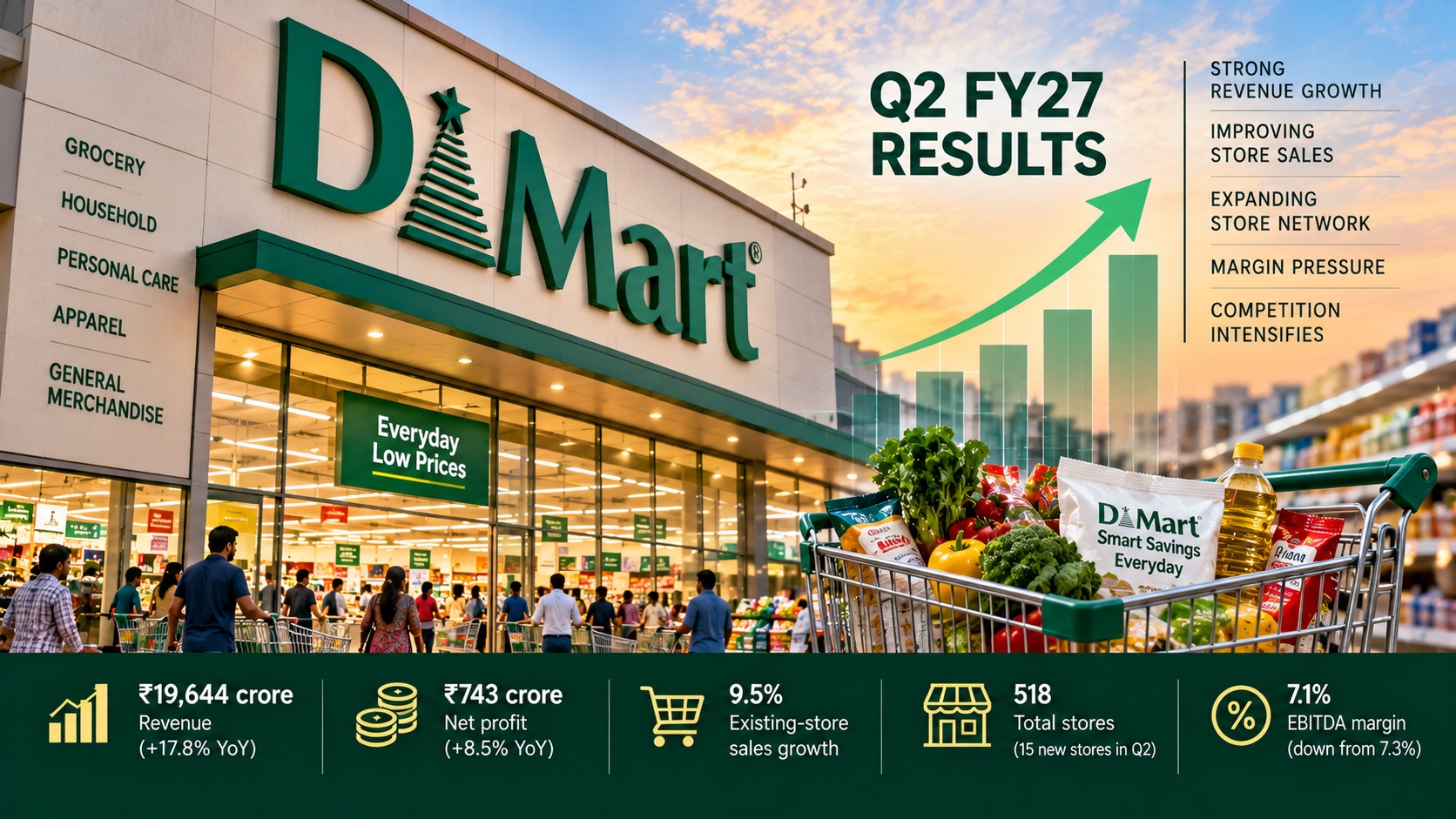
Avenue Supermarts, the operator of India’s popular DMart supermarket chain, reported strong revenue growth for the second quarter of FY27, supported by improving sales at existing stores and continued expansion of its retail network.
The company announced its financial results on Saturday, October 10, 2026, reporting consolidated revenue of ₹19,644 crore, representing a 17.8% year-on-year increase.
However, consolidated net profit increased at a considerably slower pace of 8.5% to approximately ₹743 crore, highlighting the growing pressure of operating expenses and intense competition in India’s organised retail industry.
Despite strong customer demand and an expanding store network, the company’s operating margins contracted, raising concerns about its ability to translate revenue growth into equally strong profitability.
DMart Q2 FY27 Financial Performance
DMart’s financial results demonstrated healthy business expansion, although profitability remained under pressure.
Key consolidated financial highlights included:
- Revenue: ₹19,644 crore, up 17.8% year-on-year.
- Net profit: Approximately ₹743 crore, up 8.5%.
- EBITDA: ₹1,393 crore, up 14.7%.
- EBITDA margin: 7.1%, compared with 7.3% a year earlier.
- Net profit margin: 3.8%, compared with 4.1%.
- New stores added: 15 during the quarter.
- Total store network: 518 stores as of September 30, 2026.
- Existing-store sales growth: 9.5% for stores operating for at least two years.
The company’s standalone business, which primarily reflects its physical retail operations, reported revenue of ₹19,206 crore, an increase of 18.4%.
Standalone net profit rose 7.6% to approximately ₹804 crore, while EBITDA increased 14.1% to ₹1,403 crore.
The difference between standalone and consolidated profitability reflects the inclusion of other group businesses, including its e-commerce operations.
Revenue Growth Accelerates as Customer Demand Improves
One of the most encouraging developments was the acceleration in revenue growth.
DMart’s consolidated revenue increased nearly 18% year-on-year, reflecting improving sales momentum and contributions from newly opened stores.
The company continues to benefit from its everyday-low-price strategy, which focuses on offering groceries, household products and other essential goods at competitive prices.
This positioning is particularly attractive to price-conscious Indian households.
Even during periods of inflation, consumers remain willing to purchase essential products but increasingly compare prices and seek better value.
DMart’s large-format stores, efficient procurement operations and competitive pricing help attract customers seeking savings on regular household purchases.
However, the company’s challenge is ensuring that strong sales growth translates into sustainable earnings growth.
Existing-Store Sales Growth Improves to 9.5%
A particularly important indicator was the recovery in sales growth at established stores.
DMart reported that stores operating for two years or longer recorded sales growth of 9.5% during Q2 FY27, compared with 6.8% in the corresponding quarter last year.
This improvement suggests that growth is not being driven exclusively by opening new stores.
Existing outlets are also generating higher revenue.
Same-store or like-for-like growth is closely monitored by retail investors because it provides insight into the underlying health of a retailer’s business.
A company can increase total revenue simply by opening additional stores, but improving sales at established locations indicates stronger customer demand, better product availability or increased spending.
For DMart, the recovery in this metric is particularly encouraging because it suggests that its core value-retailing proposition remains relevant despite intensifying competition.
DMart Adds 15 Stores, Taking Its Network to 518
Store expansion remained another important contributor to growth.
The company opened 15 new stores during the September quarter, taking its total network to 518 locations.
During the first half of FY27, DMart added 18 stores, reflecting a significant acceleration in the second quarter.
Its retail business area reached approximately 21.4 million square feet.
Expanding physical stores remains central to the company’s strategy because DMart generates most of its revenue through large-format supermarkets.
The company generally focuses on locations where it can achieve high customer volumes, efficient inventory movement and attractive long-term operating economics.
Unlike retailers that prioritise rapid expansion through smaller stores, DMart has traditionally emphasised operational efficiency and carefully selected locations.
The recent acceleration in store openings indicates that the company is attempting to capture growing organised retail demand while maintaining its established business model.
Operating Margins Decline Despite Higher Sales
The biggest concern in DMart’s quarterly results was the decline in profitability margins.
Consolidated EBITDA margin fell from 7.3% in Q2 FY26 to 7.1% in Q2 FY27.
Although the decline of approximately 20 basis points appears relatively modest, it is significant for a retailer operating on thin margins.
DMart’s business model depends on generating large sales volumes while maintaining tight control over procurement, staffing, logistics and store operating expenses.
Even small increases in costs can therefore have a meaningful impact on profitability.
The company experienced higher employee-related expenses, particularly due to wage inflation among entry-level workers.
Retail operations require substantial staffing for billing, inventory management, replenishment, warehousing and customer assistance.
Rising wages consequently increase operating expenses across the company’s expanding network.
This helps explain why revenue increased nearly 18%, while consolidated net profit grew only around 8.5%.
Product Mix Also Influences Profitability
DMart’s profitability is influenced not only by operating costs but also by the types of products customers purchase.
Food and grocery products account for the largest portion of its revenue.
During the quarter, food products contributed approximately 57% of sales, while non-food FMCG products accounted for nearly 20%.
The remaining revenue came largely from general merchandise and apparel.
These categories have different profitability characteristics.
Essential grocery products typically generate lower margins, while general merchandise and apparel can offer relatively higher margins.
Consequently, a shift toward lower-margin categories can pressure overall profitability even when total revenue increases.
Maintaining a balanced product mix is therefore important for DMart as it expands its network and competes with online retailers.
Quick Commerce Remains a Growing Competitive Threat
One of the most significant long-term challenges facing DMart is the rapid expansion of quick-commerce platforms.
Companies such as Blinkit, Zepto and Swiggy Instamart are increasingly competing for grocery and household-product spending, particularly in major metropolitan cities.
These platforms offer the convenience of doorstep delivery, often within minutes.
While DMart competes primarily through pricing and bulk purchases, quick-commerce companies attract customers through speed, convenience and digital accessibility.
The competitive pressure is particularly relevant in densely populated urban markets where customers have access to multiple online delivery options.
However, DMart retains several structural advantages.
Its large-format stores allow customers to purchase a wide range of products in one visit, while its procurement scale supports competitive pricing.
The company also benefits from established supplier relationships and strong recognition among value-conscious households.
The challenge is determining how much consumer spending will gradually shift from physical supermarkets to online convenience platforms.
DMart Ready Continues Its Digital Expansion
DMart operates its online grocery business through DMart Ready, which allows customers to order products digitally for delivery or collection.
The business represents the company’s attempt to participate in India’s growing online grocery market without abandoning its value-retailing philosophy.
Unlike quick-commerce platforms that emphasise extremely rapid delivery, DMart Ready has traditionally focused on competitive pricing and more structured fulfilment operations.
This approach could potentially offer better unit economics, although online grocery operations remain challenging because of delivery costs, customer acquisition expenses and intense competition.
The company’s management continues to focus on improving operational efficiency and strengthening the customer experience in existing markets.
For investors, the long-term performance of DMart Ready will remain important because digital grocery shopping is becoming an increasingly significant component of India’s retail industry.
Profitability Falls Short of Market Expectations
Although DMart reported higher revenue and profit, its earnings fell short of analyst expectations.
The company’s standalone net profit of approximately ₹804 crore was below the market estimate of around ₹879 crore.
Standalone EBITDA of ₹1,403 crore also missed expectations of approximately ₹1,468 crore.
The earnings disappointment primarily reflected weaker-than-anticipated operating margins.
Standalone EBITDA margin declined to 7.3%, compared with 7.6% in the previous year and market expectations of approximately 7.7%.
The results therefore presented a mixed picture.
Revenue growth and existing-store performance were encouraging, but higher operating expenses limited the improvement in profitability.
Brokerage Outlook Remains Cautious
Following the quarterly results, brokerage firms highlighted the contrast between improving revenue momentum and weaker profitability.
Motilal Oswal maintained its Neutral rating on Avenue Supermarts while reducing its target price from ₹4,000 to ₹3,925.
The brokerage acknowledged the recovery in like-for-like sales growth and the acceleration in store additions.
However, it remained concerned about margin pressure, free cash flow and the increasing competitive intensity of India’s grocery retail market.
The brokerage also highlighted the importance of maintaining mid-to-high single-digit existing-store growth while accelerating store expansion.
Although DMart’s long-term business fundamentals remain supported by India’s growing consumption market, the near-term outlook will depend heavily on profitability improvements.
What Investors Should Watch Next
The coming quarters will be important in determining whether DMart can sustain its improving sales momentum.
Investors will closely monitor the pace of new-store additions, particularly whether the company can maintain the expansion achieved during the September quarter.
Existing-store sales growth will be another key indicator.
Sustained growth near the current 9.5% level would suggest that demand at established locations remains healthy.
However, operating margins will likely receive even greater attention.
If wage inflation and other expenses continue rising faster than revenue, earnings growth could remain subdued.
Competition from quick-commerce platforms, changes in consumer purchasing behaviour and the performance of DMart Ready will also influence the company’s longer-term prospects.
The Bigger Picture
DMart’s Q2 FY27 results demonstrate the strength of its core retail business but also highlight the challenges associated with maintaining profitability in an increasingly competitive industry.
Consolidated revenue increased 17.8% to ₹19,644 crore, supported by improving existing-store sales and the addition of 15 new outlets.
However, net profit growth of 8.5% and the decline in operating margins indicate that higher sales are not translating proportionately into stronger earnings.
The company’s low-price strategy continues to attract consumers, while its expanding store network provides opportunities for long-term growth.
Nevertheless, rising employee costs, changing product mix and competition from quick-commerce platforms are placing greater pressure on its operating model.
For DMart, the next phase of growth will depend not only on attracting more customers and opening additional stores but also on protecting the profitability of every rupee of revenue generated.
The company remains an important participant in India’s organised retail industry, but investors will increasingly expect stronger earnings growth alongside its continued expansion.
Feel free to share your experiences and insights in the comments below. Let’s continue the conversation and grow together as a community of traders and analysts.
By sharing this experience and insights, I hope to contribute to the collective knowledge of our professional community, encouraging a culture of strategic thinking and informed decision-making.
As always, thorough research and risk management are crucial. The dynamic nature of financial markets demands vigilance, agility, and a deep understanding of the tools at your disposal. Here’s to profitable trading and navigating the election season with confidence!
Ready to stay ahead of market trends and make informed investment decisions? Follow our page for more insights and updates on the latest in the financial world!
For a free online stock market training by Yogeshwar Vashishtha (M.Tech IIT) this Saturday from 11 am – 1 pm, please sign up with https://pathfinderstrainings.in/training/freetrainings.aspx
Experience profits with my winning algo strategies – get a free one-month trial with ₹15 lakh capital! – https://terminal.algofinders.com/algo-terminal
Disclaimer
This article should not be interpreted as investment advice. For any investment decisions, consult a reputable financial advisor. The author and publisher are not responsible for any losses incurred by investors or traders based on the information provided.