

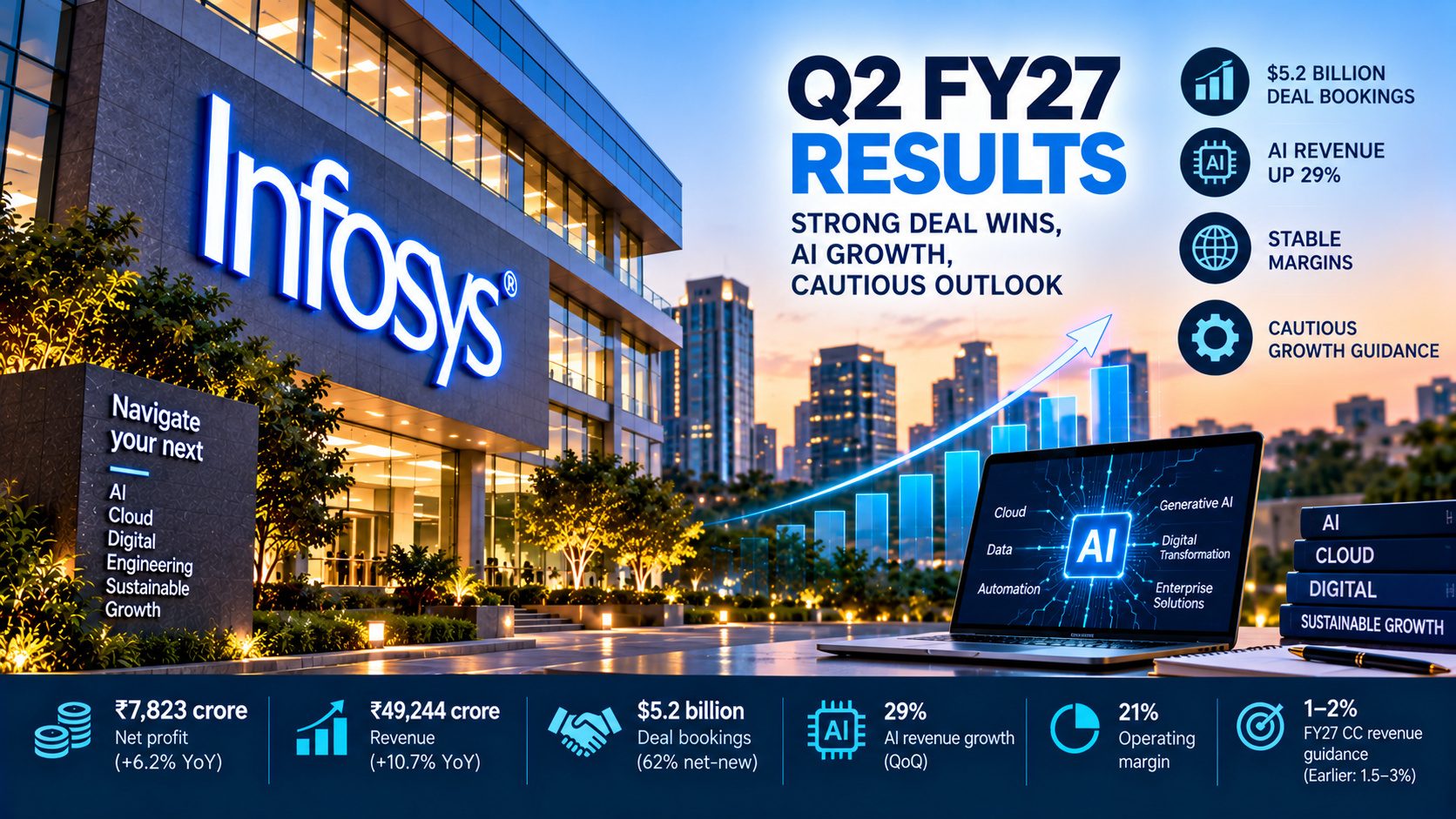
Infosys, India’s second-largest IT services company, reported a mixed financial performance for the second quarter of FY27, combining healthy rupee revenue growth, strong large-deal bookings and rapidly expanding artificial intelligence revenue with a more cautious outlook for the remainder of the financial year.
The Bengaluru-headquartered company announced its quarterly results on Friday, October 23, 2026, reporting consolidated revenue of ₹49,244 crore, representing a 10.7% year-on-year increase.
Net profit attributable to shareholders increased 6.2% to ₹7,823 crore, while operating margins remained stable at 21%.
However, the biggest development was the company’s decision to reduce its full-year constant-currency revenue growth guidance to 1–2%, compared with its previous forecast of 1.5–3%.
The revised outlook suggests that despite strong contract wins and increasing adoption of AI solutions, the broader demand environment for traditional IT services remains challenging.
Infosys Q2 FY27 Financial Performance
Infosys reported steady operating performance during the September quarter, supported by large transformation deals, improving AI revenue and disciplined cost management.
Key consolidated financial highlights included:
- Revenue: ₹49,244 crore, up 10.7% year-on-year and 2.1% sequentially.
- Net profit attributable to shareholders: ₹7,823 crore, up 6.2% year-on-year.
- Dollar revenue: $5.145 billion, up 1.3% year-on-year.
- Constant-currency revenue growth: 1.5% year-on-year and 1.2% quarter-on-quarter.
- Operating profit: ₹10,330 crore, up 10.4% year-on-year.
- Operating margin: 21%, unchanged year-on-year.
- Large deal bookings: $5.2 billion, with 62% comprising net-new business.
- Advanced AI revenue growth: 29% sequentially.
- Free cash flow: ₹8,898 crore.
- Interim dividend: ₹26 per share.
- Revised FY27 revenue guidance: 1–2% in constant currency.
The results demonstrate that Infosys continues to generate substantial cash flows and secure major contracts despite subdued global technology spending.
However, the relatively modest constant-currency growth highlights the difference between headline rupee revenue expansion and underlying business momentum.
Revenue Crosses ₹49,000 Crore, but Underlying Growth Remains Modest
Infosys reported consolidated revenue of ₹49,244 crore during Q2 FY27, compared with ₹44,490 crore in the corresponding quarter last year.
This represents growth of 10.7% in rupee terms.
Sequentially, revenue increased 2.1% from ₹48,211 crore in the June quarter.
However, the company’s constant-currency revenue growth was considerably lower at 1.5% year-on-year and 1.2% sequentially.
Constant-currency growth removes the impact of exchange-rate movements, making it a more useful indicator of underlying business performance.
The difference suggests that currency translation contributed meaningfully to the reported rupee revenue increase.
This distinction is particularly important for Indian IT companies because a substantial portion of their revenue is generated in foreign currencies, especially the US dollar.
While currency movements can influence reported financial results, sustainable long-term growth depends on winning new business, expanding existing customer relationships and increasing the value of services delivered.
Net Profit Increases 6.2% to ₹7,823 Crore
Infosys reported net profit attributable to shareholders of ₹7,823 crore, compared with ₹7,364 crore a year earlier.
This represents an increase of approximately 6.2%.
Sequentially, profit increased only 0.7% from ₹7,769 crore.
Although earnings growth was positive, it remained slower than rupee revenue growth.
The performance reflects the challenges associated with maintaining profitability amid subdued discretionary spending, changing project requirements and ongoing investments in emerging technologies.
Infosys reported operating profit of ₹10,330 crore, increasing 10.4% year-on-year.
Its operating margin remained stable at 21%, compared with 21% in the corresponding quarter last year and 21.1% in the preceding quarter.
The company’s ability to maintain margins despite a challenging demand environment suggests that its operational efficiency initiatives are helping offset cost pressures.
However, accelerating earnings growth will require stronger underlying revenue momentum or further productivity improvements.
Record $5.2 Billion Deal Wins Strengthen Revenue Visibility
One of the most encouraging developments was the company’s strong large-deal performance.
Infosys secured contracts with a total contract value of approximately $5.2 billion during the September quarter.
This compares with $3.6 billion in the preceding quarter.
Approximately 62% of the latest bookings represented net-new business, indicating that the company is attracting fresh contract opportunities rather than relying entirely on renewals.
The quarter included a mega deal valued at more than $2 billion.
Large contract wins are important because they provide greater visibility into future revenue and demonstrate customer confidence in the company’s capabilities.
Global enterprises continue to invest in technology transformation projects aimed at reducing costs, modernising infrastructure and improving operational efficiency.
Infosys is increasingly positioning itself as a partner for these complex, multi-year engagements.
However, large deal announcements do not immediately translate into equivalent revenue.
Contracts are executed over several quarters or years, and the pace of implementation depends on customer requirements, transition schedules and project milestones.
Therefore, while the $5.2 billion order inflow is encouraging, its contribution to revenue growth will emerge gradually.
Artificial Intelligence Revenue Surges 29% Sequentially
Artificial intelligence emerged as one of the most important highlights of Infosys’ quarterly results.
The company reported 29% sequential growth in advanced AI revenue, reflecting increasing enterprise demand for AI-powered solutions.
AI-related revenue has become a meaningful contributor to Infosys’ overall business as customers invest in automation, intelligent software development, data modernisation and enterprise productivity.
The company is increasingly focusing on AI-first transformation, which involves embedding artificial intelligence across business processes rather than treating it as a standalone technology offering.
This approach includes modernising legacy systems, improving customer interactions, automating routine workflows and developing intelligent applications.
Infosys is also expanding its capabilities in agentic AI, where AI systems can perform multi-step tasks with varying degrees of autonomy.
The rapid growth in AI revenue suggests that these investments are beginning to produce measurable commercial results.
However, AI also creates a challenge for traditional IT services companies.
As automation improves productivity, customers may expect faster project delivery and lower costs, potentially reducing demand for some labour-intensive services.
The long-term opportunity therefore depends on whether new AI-related business can grow sufficiently to offset pressure on conventional technology services.
FY27 Revenue Growth Guidance Cut to 1–2%
Despite the strong deal bookings and AI momentum, Infosys lowered its full-year revenue growth outlook.
The company now expects constant-currency revenue growth of 1–2% for FY27.
Previously, management had guided for growth of 1.5–3%.
Both the lower and upper ends of the guidance range were reduced, signalling a more cautious assessment of demand conditions.
The revision reflects softer business volumes, pricing pressure and weakness in selected customer segments.
Global companies remain cautious about discretionary technology expenditure amid economic uncertainty and changing business priorities.
Many customers are continuing essential technology modernisation programmes but delaying projects that do not offer immediate or measurable financial benefits.
This environment has encouraged IT services companies to focus more heavily on cost optimisation, vendor consolidation and productivity-driven transformation.
For Infosys, the challenge is converting its strong contract pipeline into faster revenue growth while managing the impact of pricing negotiations and AI-driven efficiency improvements.
The guidance reduction is particularly significant because it indicates that the company’s strong large-deal wins are not yet sufficient to accelerate overall growth in the current financial year.
Operating Margin Guidance Maintained at 20–22%
While Infosys reduced its revenue growth expectations, it maintained its full-year operating margin guidance of 20–22%.
The decision suggests that management remains confident in its ability to control costs and sustain profitability.
The company reported an operating margin of 21% during Q2 FY27, remaining within the guided range.
Operational efficiency initiatives, improved utilisation, automation and disciplined expense management continue to support margins.
However, Infosys must also invest in AI infrastructure, workforce reskilling, technology partnerships and new delivery capabilities.
These investments are necessary to remain competitive but can create short-term cost pressures.
The company’s ability to balance technology investment with profitability will remain important over the coming quarters.
Free Cash Flow Remains Strong at ₹8,898 Crore
Infosys continued to demonstrate healthy cash generation during the September quarter.
The company reported free cash flow of approximately ₹8,898 crore.
Free cash flow represents the cash generated from operations after accounting for capital expenditure.
It is an important measure of financial strength because it indicates how much cash a company can potentially use for dividends, acquisitions, investments and other corporate purposes.
Infosys reported free cash flow conversion of approximately 113.5% of net profit in rupee terms.
This suggests that the company’s earnings were supported by strong cash generation.
Healthy cash flows provide financial flexibility, particularly during periods of subdued revenue growth.
They also support the company’s ability to invest in emerging technologies and return capital to shareholders.
Infosys Announces ₹26 Interim Dividend
Alongside its quarterly results, Infosys announced an interim dividend of ₹26 per equity share.
This represents an increase from the ₹23 interim dividend declared in the corresponding period last year.
The record date has been fixed as November 3, 2026, while payment is scheduled for November 11, 2026.
The dividend increase reflects the company’s strong cash generation and continued commitment to shareholder distributions.
For investors, dividends provide a direct return on investment independent of short-term share-price movements.
However, the sustainability of future dividend growth will depend on profitability, cash generation and the company’s capital allocation requirements.
Infosys’ healthy balance sheet provides flexibility, although continued investment in AI and technology transformation remains essential.
Global IT Spending Remains Under Pressure
Infosys’ cautious guidance reflects broader challenges facing the global IT services industry.
Enterprises continue to operate in an environment characterised by uncertain economic growth, changing interest-rate expectations and evolving technology priorities.
Discretionary technology projects remain particularly sensitive to customer budgets.
Companies are increasingly demanding measurable returns on technology expenditure and prioritising projects that can reduce operating costs.
This has created a market where large transformation contracts may remain healthy even as smaller projects face delays.
For Infosys, the strong $5.2 billion deal pipeline indicates continued demand for major engagements.
However, the subdued revenue guidance suggests that smaller projects, pricing pressures and slower contract ramp-ups are limiting near-term growth.
The distinction between strong order bookings and modest revenue expansion will remain a central theme for investors.
AI Is Reshaping the Indian IT Services Industry
Artificial intelligence is becoming an increasingly important factor in the competitive positioning of Indian IT companies.
Traditional outsourcing models relied heavily on large workforces delivering software development, application maintenance and business process services.
AI is gradually changing this model by automating repetitive tasks and improving developer productivity.
This transformation creates both risks and opportunities.
On one hand, automation could reduce the amount of labour required for certain projects, placing pressure on traditional billing models.
On the other hand, enterprises require substantial assistance in integrating AI into existing technology systems, modernising data infrastructure and managing security risks.
Companies such as Infosys, TCS, HCLTech and Wipro are attempting to capture this opportunity by expanding AI-related services and partnerships.
Infosys’ 29% sequential growth in advanced AI revenue suggests that it is making progress in this transition.
Nevertheless, investors will increasingly expect AI revenue growth to translate into stronger overall business performance.
What Investors Should Watch Next
The coming quarters will be important in determining whether Infosys can convert its strong deal pipeline into sustained revenue growth.
The execution of the company’s $5.2 billion large-deal bookings will be a major focus.
Investors will assess how quickly these contracts begin contributing to revenue and whether they improve growth visibility for FY28.
Advanced AI revenue will also remain a key indicator.
Sustained growth in this segment could strengthen the company’s positioning in enterprise transformation and create new business opportunities.
However, pricing pressure and AI-driven productivity improvements could affect revenue from traditional services.
Operating margins will also attract attention.
The company’s ability to maintain profitability within its 20–22% guidance range will be important if revenue growth remains subdued.
Finally, management commentary on discretionary spending, customer budgets and the pace of project execution will influence expectations for a broader industry recovery.
The Bigger Picture
Infosys’ Q2 FY27 results present a mixed picture of improving strategic opportunities and continued near-term business challenges.
Consolidated revenue increased 10.7% to ₹49,244 crore, while net profit rose 6.2% to ₹7,823 crore.
The company maintained its operating margin at 21% and generated strong free cash flow.
Record large-deal bookings of $5.2 billion and 29% sequential growth in advanced AI revenue demonstrate its ability to attract major technology transformation opportunities.
However, the reduction in FY27 constant-currency revenue growth guidance to 1–2% highlights the continued weakness in underlying demand.
The contrast between strong contract wins and cautious growth expectations suggests that the recovery in global IT services spending remains uneven.
For Infosys, the next phase of growth will depend on converting large contract wins into revenue, scaling its AI business and protecting profitability as traditional technology services undergo structural change.
The company’s strong financial position, global customer relationships and expanding AI capabilities provide a foundation for future growth.
Nevertheless, investors will increasingly focus on whether these advantages can translate into stronger constant-currency revenue growth and sustainable earnings expansion over the coming financial years.
Feel free to share your experiences and insights in the comments below. Let’s continue the conversation and grow together as a community of traders and analysts.
By sharing this experience and insights, I hope to contribute to the collective knowledge of our professional community, encouraging a culture of strategic thinking and informed decision-making.
As always, thorough research and risk management are crucial. The dynamic nature of financial markets demands vigilance, agility, and a deep understanding of the tools at your disposal. Here’s to profitable trading and navigating the election season with confidence!
Ready to stay ahead of market trends and make informed investment decisions? Follow our page for more insights and updates on the latest in the financial world!
For a free online stock market training by Yogeshwar Vashishtha (M.Tech IIT) this Saturday from 11 am – 1 pm, please sign up with https://pathfinderstrainings.in/training/freetrainings.aspx
Experience profits with my winning algo strategies – get a free one-month trial with ₹15 lakh capital! – https://terminal.algofinders.com/algo-terminal
Disclaimer
This article should not be interpreted as investment advice. For any investment decisions, consult a reputable financial advisor. The author and publisher are not responsible for any losses incurred by investors or traders based on the information provided.