

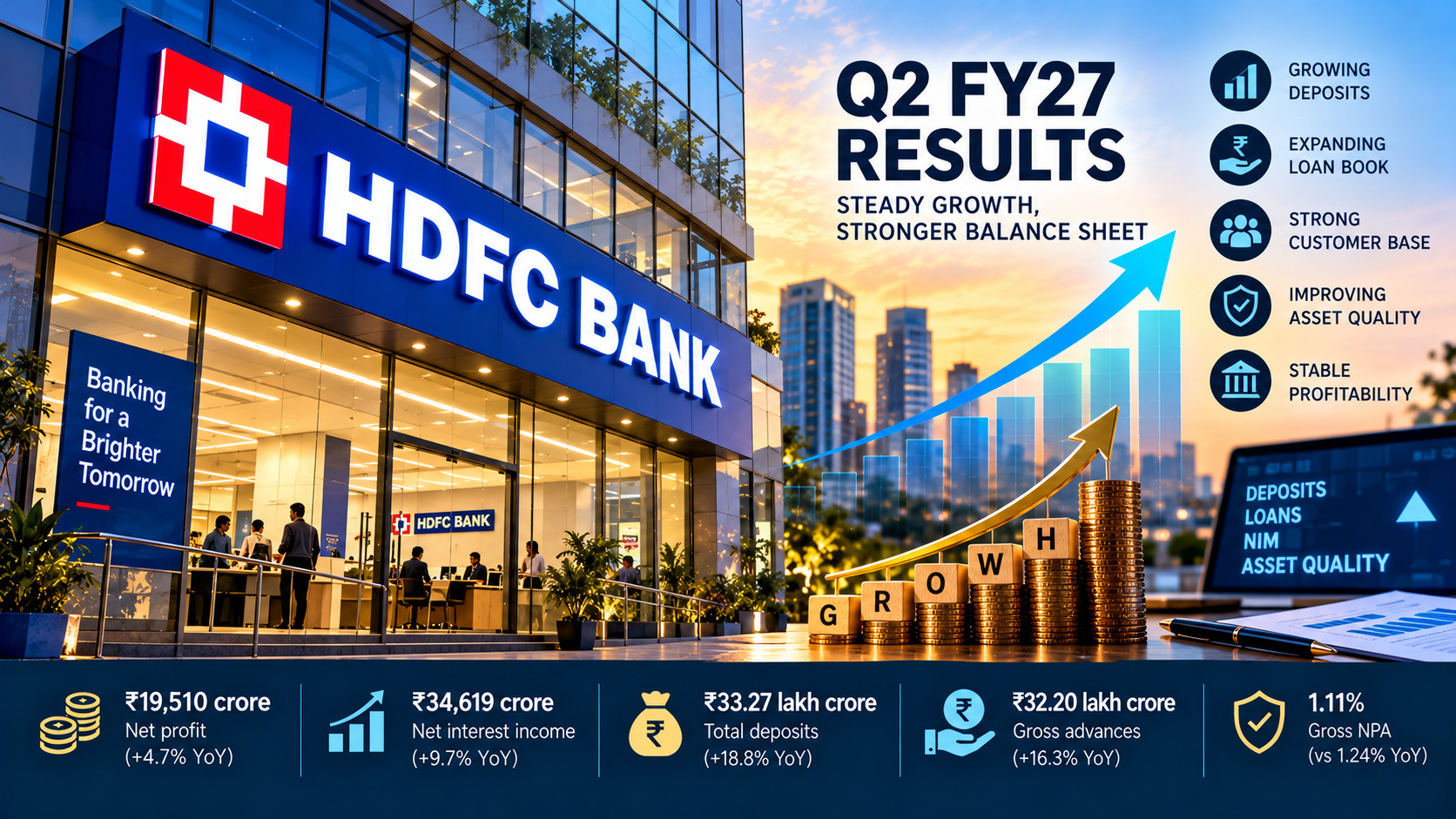
HDFC Bank, India’s largest private sector bank by assets, reported a steady financial performance for the second quarter of FY27, supported by strong deposit mobilisation, expanding lending operations and improving asset quality.
The bank announced its quarterly results on Saturday, October 17, 2026, reporting standalone net profit of ₹19,510 crore, representing a 4.7% year-on-year increase.
Net interest income rose 9.7% to ₹34,619 crore, while deposits expanded 18.8% to approximately ₹33.27 lakh crore.
The results highlighted improving balance-sheet fundamentals, although lower treasury income and continued pressure on lending margins restricted overall profitability growth.
The quarter was particularly significant because it marked the final earnings announcement under Managing Director and CEO Sashidhar Jagdishan, ahead of the leadership transition to Anup Bagchi.
HDFC Bank Q2 FY27 Financial Performance
The September quarter demonstrated healthy growth in the bank’s core lending and deposit businesses, accompanied by stable profitability and stronger asset quality.
Key financial highlights included:
- Standalone net profit: ₹19,510 crore, up 4.7% year-on-year.
- Consolidated net profit: ₹20,700 crore, up approximately 5.6%.
- Net interest income: ₹34,619 crore, up 9.7%.
- Standalone net revenue: ₹48,450 crore, up approximately 5.6%.
- Net interest margin: 3.16% on total assets.
- Total deposits: ₹33.27 lakh crore, up 18.8%.
- Gross advances: ₹32.20 lakh crore, up 16.3%.
- Gross NPA ratio: 1.11%, compared with 1.24% a year earlier.
- Net NPA ratio: 0.37%.
- Cost-to-income ratio: 39.1%.
The bank’s performance reflected a combination of strong balance-sheet expansion and relatively modest earnings growth.
While the lending and deposit businesses continued expanding, profitability was affected by weaker non-interest income, particularly lower treasury trading gains.
Net Interest Income Grows Nearly 10%
HDFC Bank reported net interest income of ₹34,619 crore during Q2 FY27, compared with ₹31,551 crore in the corresponding quarter last year.
This represents growth of approximately 9.7%.
Net interest income is the difference between interest earned on loans and investments and the interest paid on deposits and other borrowings.
For commercial banks, it is one of the most important measures of core operating performance.
The increase was primarily supported by expansion in the bank’s lending portfolio.
However, net interest income grew more slowly than advances, reflecting the impact of lending yields, funding costs and changes in the bank’s asset mix.
The bank’s net interest margin stood at 3.16% on total assets and 3.32% on interest-earning assets.
Margins remain an important focus for investors because even small changes can significantly influence profitability across HDFC Bank’s enormous balance sheet.
Deposits Surge 18.8% to ₹33.27 Lakh Crore
One of the most encouraging developments was the acceleration in deposit growth.
HDFC Bank’s total deposits reached approximately ₹33.27 lakh crore as of September 30, 2026, representing an 18.8% year-on-year increase.
Average deposits during the quarter stood at approximately ₹31.66 lakh crore, growing 16.8% year-on-year.
The strong deposit performance is particularly significant because deposit mobilisation has remained an important priority for HDFC Bank following its merger with HDFC Limited in 2023.
The merger substantially expanded the bank’s loan portfolio, creating a need to strengthen its deposit base and maintain an appropriate balance between lending and funding.
Deposits are essential for banks because they provide a relatively stable source of funding for lending activities.
A stronger deposit franchise can reduce dependence on wholesale borrowing and support sustainable balance-sheet growth.
HDFC Bank’s latest performance suggests that its efforts to attract deposits through its branch network, customer relationships and banking products are producing results.
CASA Deposits Remain an Important Challenge
Despite strong overall deposit growth, the composition of deposits remains important.
HDFC Bank’s current account and savings account deposits, commonly known as CASA deposits, grew 10.8% year-on-year.
However, CASA deposits accounted for approximately 31.6% of total deposits at the end of September 2026.
Term deposits increased more rapidly, growing 22.8% year-on-year.
This distinction matters because CASA deposits generally represent a lower-cost source of funding than fixed deposits.
A higher proportion of low-cost deposits can improve a bank’s profitability by reducing its overall cost of funds.
Conversely, faster growth in term deposits may increase funding expenses, particularly when competition for deposits remains intense.
For HDFC Bank, improving the proportion of low-cost deposits will be an important part of strengthening net interest margins over the coming quarters.
Loan Book Expands 16.3% to ₹32.20 Lakh Crore
HDFC Bank continued expanding its lending operations during the September quarter.
Gross advances reached approximately ₹32.20 lakh crore, representing 16.3% year-on-year growth.
Average advances under management stood at approximately ₹31.87 lakh crore, increasing 14.1% year-on-year.
The bank recorded growth across several lending categories.
Retail loans increased 11.7%, while loans to small and mid-market enterprises grew 23.5%.
Corporate and other wholesale loans expanded 16.4%.
The particularly strong growth in small and medium enterprise lending reflects increasing opportunities in India’s business financing market.
Businesses require financing for working capital, inventory purchases, equipment investments and expansion projects.
For HDFC Bank, the SME segment provides opportunities to diversify lending operations and deepen relationships with commercial customers.
However, maintaining appropriate credit standards remains essential as the loan portfolio expands.
Credit-to-Deposit Ratio Shows Improvement
Another important development was the improvement in HDFC Bank’s credit-to-deposit ratio.
The ratio stood at approximately 96% at the end of September 2026.
The credit-to-deposit ratio measures how much of a bank’s deposit base has been deployed into loans.
A high ratio indicates that a substantial proportion of deposits is being used for lending.
Although this can support interest income, an excessively high ratio may reduce funding flexibility and increase liquidity-management requirements.
Following the HDFC merger, the bank has been working to improve the balance between loans and deposits.
With deposit growth of 18.8% exceeding gross advance growth of 16.3%, the bank is gradually strengthening its funding position.
This is an encouraging development because it creates greater flexibility for future lending expansion.
However, further improvement would help reduce balance-sheet pressure and potentially support profitability over the longer term.
Asset Quality Improves as Bad Loans Decline
HDFC Bank reported an improvement in asset quality during the quarter.
Its gross non-performing asset ratio declined to 1.11% as of September 30, 2026.
This compares with 1.17% in the preceding quarter and 1.24% in the corresponding period last year.
The net NPA ratio stood at 0.37%, compared with 0.41% in the previous quarter.
Non-performing assets represent loans where borrowers have failed to make scheduled repayments beyond the prescribed period.
Lower NPA ratios generally indicate stronger credit quality and reduced stress within the loan portfolio.
The improvement suggests that HDFC Bank continues to maintain relatively disciplined lending standards despite expanding its advances.
However, investors should also consider the absolute level of stressed loans and provisions, particularly because rapid loan growth can influence percentage-based asset-quality ratios.
Maintaining stable asset quality will remain essential as the bank expands its retail, corporate and business lending portfolios.
Provisions Increase to ₹3,574 Crore
Although asset-quality ratios improved, HDFC Bank recorded higher provisions during the quarter.
Provisions and contingencies stood at approximately ₹3,574 crore, compared with ₹3,059 crore in the preceding quarter and approximately ₹3,500 crore a year earlier.
Provisions represent amounts set aside to cover expected loan losses and other potential financial obligations.
The bank reported a total credit cost ratio of approximately 0.44%.
This indicates that credit costs remain relatively contained in relation to the overall loan portfolio.
Nevertheless, provisioning trends deserve attention because changes in credit costs can significantly influence bank profitability.
A sustained increase in provisions could offset the benefits of higher interest income.
For now, the improvement in gross and net NPA ratios provides a relatively reassuring picture of the bank’s underlying credit quality.
Lower Treasury Income Restricts Profit Growth
One of the biggest reasons behind the relatively modest increase in net profit was the sharp decline in treasury trading gains.
HDFC Bank reported treasury trading gains of approximately ₹780 crore during the September quarter.
This compares with approximately ₹2,390 crore in the corresponding quarter last year.
The substantial decline reduced non-interest income and restricted overall earnings growth.
Total non-interest income stood at approximately ₹13,831 crore, compared with ₹14,350 crore a year earlier.
However, the performance of fee-based income was more encouraging.
Fees and commissions increased to approximately ₹9,690 crore from ₹8,840 crore.
This indicates that the bank’s underlying customer-related income continued expanding.
Importantly, management reported that net profit excluding treasury trading gains increased approximately 12.6% year-on-year.
This suggests that the bank’s core earnings performance was stronger than the headline profit growth of 4.7% indicates.
Operating Expenses Rise as the Bank Expands
HDFC Bank reported operating expenses of approximately ₹18,970 crore during Q2 FY27, compared with ₹17,980 crore a year earlier.
The increase reflects ongoing spending associated with technology, infrastructure, distribution and banking operations.
The bank’s cost-to-income ratio stood at 39.1%.
Cost efficiency remains important because the bank operates one of India’s largest private banking networks.
Technology investments, branch operations, employee expenses and regulatory compliance all contribute to operating costs.
However, investments in digital banking and automation can also improve efficiency over time.
For HDFC Bank, maintaining a balance between customer acquisition, service quality and operating expenses will be important for sustaining profitability.
HDFC Bank’s Branch Network Continues Expanding
The bank maintained its extensive physical distribution network during the quarter.
As of September 30, 2026, HDFC Bank operated 9,706 branches and 20,881 ATMs across 4,177 cities and towns.
Approximately 50% of its branches were located in semi-urban and rural areas.
The bank also operated through more than 14,000 business correspondents, supporting financial services in locations where traditional branch infrastructure may be limited.
Its distribution network provides a significant competitive advantage.
Branches help attract deposits, originate loans, provide financial advice and establish long-term customer relationships.
The expansion into semi-urban and rural markets also creates opportunities to participate in India’s increasing financial inclusion and formal credit adoption.
However, physical expansion requires capital and operating expenditure.
The bank must therefore ensure that new locations generate sufficient business volumes to justify their costs.
Leadership Transition Marks an Important Milestone
The quarterly results arrived at a significant moment in HDFC Bank’s corporate history.
Sashidhar Jagdishan’s tenure as Managing Director and CEO is scheduled to conclude on October 26, 2026.
Anup Bagchi, a senior banking executive with extensive experience at ICICI Bank, is expected to assume the role from October 27 for a three-year term.
The appointment represents an important leadership transition for one of India’s most systemically significant private sector banks.
The incoming management will inherit a large and diversified financial institution that has undergone considerable transformation following the HDFC merger.
Key priorities are likely to include strengthening deposit mobilisation, improving lending margins, maintaining asset quality and increasing operational efficiency.
The bank also announced that Deputy Managing Director Kaizad Bharucha would step down at the end of December 2026.
Investors will closely monitor how the leadership changes influence business strategy, capital allocation and execution over the coming years.
HDFC Bank’s Financial Services Ecosystem Adds Strength
HDFC Bank’s consolidated operations extend beyond traditional banking.
The group has interests in insurance, asset management, securities and non-banking financial services.
Its major subsidiaries and associated businesses include HDFC Life, HDFC ERGO, HDFC Asset Management Company, HDFC Securities and HDB Financial Services.
These businesses provide diversified sources of revenue and exposure to different segments of India’s financial services industry.
For the September quarter, HDFC Bank reported consolidated net profit of approximately ₹20,700 crore, representing growth of around 5.6% year-on-year.
The financial services ecosystem creates opportunities for cross-selling products such as insurance, investments, loans and wealth management solutions.
However, consolidated profitability also depends on the performance of individual businesses, each of which operates in a competitive and regulated environment.
What Investors Should Watch Next
The coming quarters will be important in determining whether HDFC Bank can translate its improving balance-sheet position into stronger earnings growth.
Deposit mobilisation will remain a key indicator.
Sustained deposit growth above loan growth could help improve the credit-to-deposit ratio and provide greater flexibility for future expansion.
Net interest margins will also attract attention.
A recovery in margins would strengthen core profitability, particularly if funding costs begin moderating.
The performance of CASA deposits will be equally important because a higher share of low-cost deposits can improve the bank’s funding economics.
Investors will also monitor asset quality, provisioning requirements and the performance of SME and retail lending portfolios.
Finally, the leadership transition will be an important factor in shaping expectations for the bank’s medium-term strategy.
The Bigger Picture
HDFC Bank’s Q2 FY27 results present a picture of steady operational progress rather than a dramatic earnings acceleration.
Standalone net profit increased 4.7% to ₹19,510 crore, while net interest income grew 9.7% to ₹34,619 crore.
Deposits expanded 18.8% to ₹33.27 lakh crore, outpacing gross advance growth of 16.3%.
This improvement in the funding profile is particularly important following the HDFC merger.
Asset quality also strengthened, with the gross NPA ratio declining to 1.11%.
However, lower treasury income, modest net interest margins and the continued need to improve the deposit mix remain important challenges.
The upcoming leadership transition introduces another significant development as the bank prepares for its next phase of growth.
For HDFC Bank, the next stage of performance will depend on strengthening its deposit franchise, improving lending margins and converting balance-sheet growth into sustained earnings expansion.
The bank’s extensive distribution network, diversified financial services ecosystem and improving asset quality provide a strong foundation.
Nevertheless, investors will increasingly look for evidence that these strengths can translate into faster profitability growth and improved shareholder returns.
Feel free to share your experiences and insights in the comments below. Let’s continue the conversation and grow together as a community of traders and analysts.
By sharing this experience and insights, I hope to contribute to the collective knowledge of our professional community, encouraging a culture of strategic thinking and informed decision-making.
As always, thorough research and risk management are crucial. The dynamic nature of financial markets demands vigilance, agility, and a deep understanding of the tools at your disposal. Here’s to profitable trading and navigating the election season with confidence!
Ready to stay ahead of market trends and make informed investment decisions? Follow our page for more insights and updates on the latest in the financial world!
For a free online stock market training by Yogeshwar Vashishtha (M.Tech IIT) this Saturday from 11 am – 1 pm, please sign up with https://pathfinderstrainings.in/training/freetrainings.aspx
Experience profits with my winning algo strategies – get a free one-month trial with ₹15 lakh capital! – https://terminal.algofinders.com/algo-terminal
Disclaimer
This article should not be interpreted as investment advice. For any investment decisions, consult a reputable financial advisor. The author and publisher are not responsible for any losses incurred by investors or traders based on the information provided.