

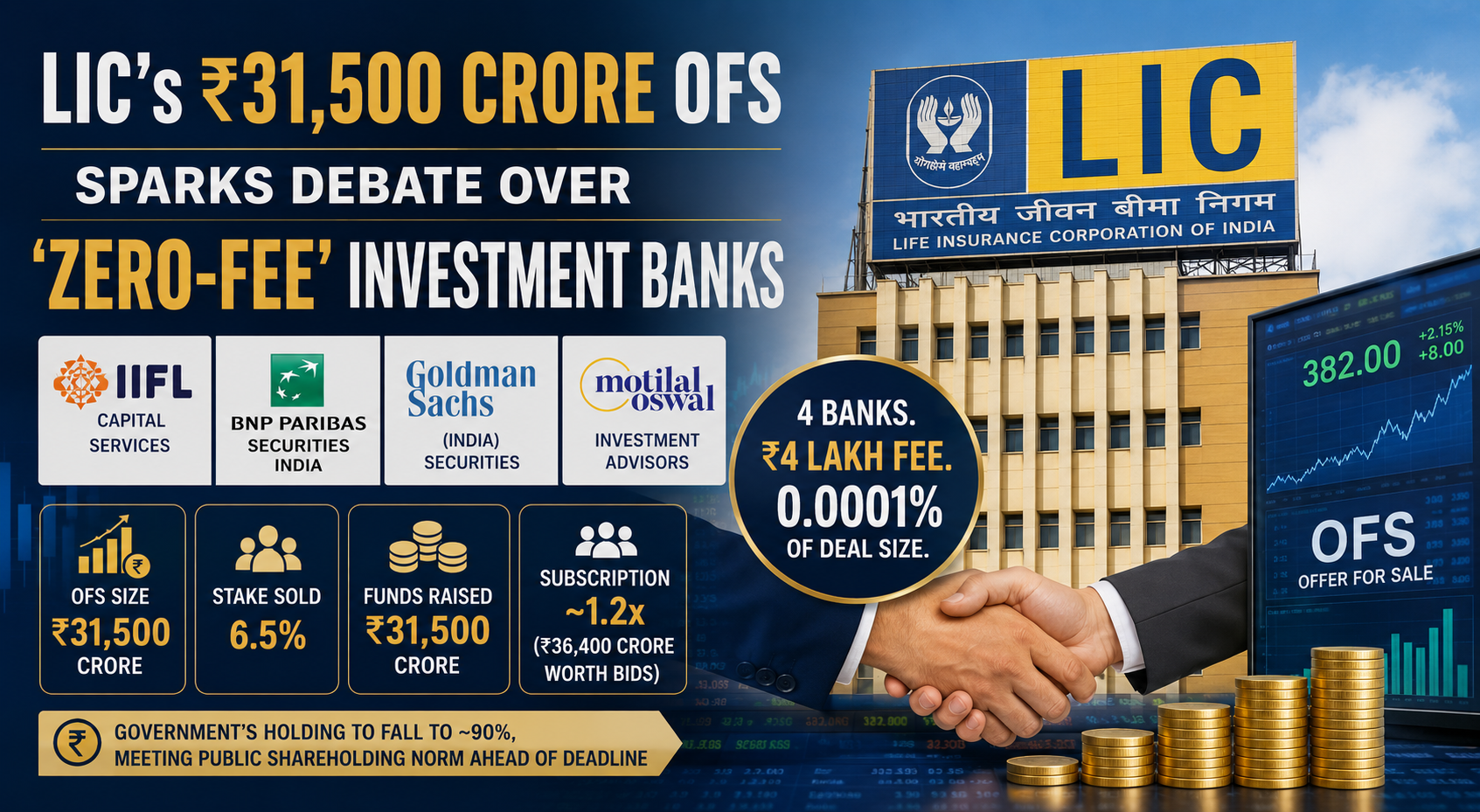
Life Insurance Corporation of India’s (LIC) massive ₹31,500 crore Offer for Sale (OFS) has achieved more than just a significant milestone for the government’s disinvestment programme. The transaction has also brought an unusual aspect of India’s investment banking industry into focus: the extremely low fees charged by the banks that managed the deal.
The government’s sale of a 6.5% stake in LIC was one of the largest secondary share sales in India. The OFS was conducted at a floor price of ₹382 per share and was subscribed around 1.2 times, with institutional investors submitting bids worth approximately ₹36,400 crore. Following the transaction, the government’s holding in LIC is expected to fall to around 90%, helping the insurer meet its public-shareholding requirement ahead of the regulatory deadline.
Four investment banks, just ₹4 lakh in fees
The most striking feature of the transaction is the amount paid to the four investment banks that managed the OFS.
IIFL Capital Services, BNP Paribas Securities India, Goldman Sachs (India) Securities and Motilal Oswal Investment Advisors are understood to have collectively earned only around ₹4 lakh for managing the ₹31,500 crore transaction.
That translates into approximately 0.0001% of the deal value—an exceptionally small fee for a transaction involving one of India’s largest listed companies and requiring extensive regulatory, legal, due-diligence and execution work. IIFL also served as the settlement broker.
The economics become even more striking when the fee is divided among the four banks. Each institution would receive roughly ₹1 lakh, an amount that could potentially be lower than the administrative and compliance costs associated with executing a transaction of this scale.
This has revived the debate over so-called “zero-fee” or “near-zero-fee” investment banking mandates.
Why would banks work for almost nothing?
At first glance, accepting such a mandate appears commercially irrational. Investment banking is generally a fee-based business, with merchant bankers charging clients for advisory, underwriting, distribution and transaction execution services.
However, large marquee transactions can provide benefits that extend well beyond the immediate fee.
For global and domestic investment banks, managing a landmark transaction such as LIC’s OFS can enhance visibility among institutional investors, sovereign wealth funds, corporations and government-linked entities.
A successful execution can also strengthen a bank’s credentials when competing for future mandates involving public-sector companies, private-sector fundraising, mergers and acquisitions, qualified institutional placements and other capital-market transactions.
In other words, the LIC mandate can be viewed as a strategic investment in reputation and future business rather than a transaction designed to generate immediate revenue.
Bankers involved in the transaction have reportedly defended the aggressive pricing on precisely these grounds, arguing that the visibility and credibility generated by a marquee government transaction can translate into more lucrative mandates later.
The prestige battle in investment banking
The LIC transaction highlights the increasingly competitive nature of India’s investment banking industry.
When a major government transaction is announced, banks compete aggressively to secure positions as lead managers. Being associated with a high-profile transaction can improve league-table rankings and provide a valuable credential when pitching to future clients.
The result can be a situation in which banks are willing to sacrifice short-term profitability for strategic positioning.
The LIC OFS appears to be an extreme example of this phenomenon. With four banks participating and total fees reportedly amounting to only ₹4 lakh, the transaction demonstrates how far competition can push pricing.
For the participating banks, the calculation appears to be that the reputational benefits of managing LIC’s massive stake sale outweigh the negligible direct revenue from the assignment.
Smaller investment banks face a difficult environment
While large investment banks may be able to absorb the economics of a near-zero-fee mandate, smaller advisers face a different challenge.
A large transaction requires considerable resources, including legal work, regulatory compliance, due diligence, documentation, investor communication, roadshows and transaction management.
If fees fall too low, smaller investment banks may simply be unable to participate.
This creates a potential concentration problem in the investment banking industry. Large banks with stronger balance sheets and broader international businesses can use marquee mandates as loss-leading opportunities, while smaller firms may find it increasingly difficult to compete.
The concern is not necessarily about whether such pricing is legal. Rather, it is about whether sustained undercutting could gradually reduce competition and make major government mandates accessible primarily to a small group of large institutions.
LIC is not the first example
The practice of banks accepting nominal fees for major transactions is not new in India.
A similar situation emerged during State Bank of India’s ₹25,000 crore qualified institutional placement in 2025, when six banks reportedly agreed to manage the transaction for a token fee of ₹1.
SBI’s earlier ₹15,000 crore QIP in 2017 also involved extremely low merchant-banking fees.
Coal India’s ₹15,000 crore IPO in 2010 provides another historical example, with bankers reportedly quoting just ₹1 for every ₹1 crore raised.
The ₹64 billion HDFC-HDFC Bank merger in 2023 also generated a very small advisory fee relative to the size of the transaction.
These examples suggest that nominal-fee mandates are not isolated incidents but part of a broader competitive dynamic in India’s capital-markets industry.
What the LIC OFS achieved for the government
Despite the debate over banking fees, the primary objective of the transaction was the government’s stake reduction in LIC.
The government sold approximately 6.5% of LIC at ₹382 per share, raising around ₹31,500 crore.
The transaction also helped LIC move closer to a broader public-shareholding structure. Following the stake sale, the government’s holding is around 90%, allowing LIC to satisfy the applicable public-shareholding requirement well ahead of the May 2027 deadline.
For the government, the transaction therefore achieved two objectives: raising substantial disinvestment proceeds and completing the required dilution in one of India’s most important public-sector companies.
A larger question for India’s capital markets
The LIC OFS has consequently opened a broader discussion about the economics of investment banking in India.
Competition is healthy when it produces better pricing for issuers. However, there is a point at which fees become so low that they no longer adequately compensate advisers for the resources and risks involved in executing complex transactions.
For government transactions, the issue becomes even more relevant because public-sector mandates involve taxpayer-owned institutions and large sums of public capital.
A transparent selection process based not only on fee quotations but also on execution capability, distribution strength, investor reach and quality of advice could potentially create a more balanced competitive environment.
The challenge is finding the right balance between cost efficiency for government entities and sustainable economics for investment banks.
The bigger takeaway
LIC’s ₹31,500 crore OFS will be remembered primarily as a landmark government disinvestment transaction, but the unusual fee structure has created an equally interesting story behind the deal.
Four major investment banks reportedly managed one of India’s largest secondary share sales for a combined fee of only around ₹4 lakh. While such pricing may appear uneconomical, banks view marquee government mandates as opportunities to strengthen their market standing, improve institutional visibility and position themselves for future business.
The controversy ultimately reflects the changing nature of India’s investment banking industry. As competition intensifies and large transactions become increasingly valuable for reputation and league-table positioning, banks may continue to accept exceptionally low fees to win strategically important mandates.
For the government, the immediate outcome is clear: a successful ₹31,500 crore stake sale and faster compliance with LIC’s public-shareholding requirement. For the investment banking industry, however, the deal raises a more fundamental question—how low can fees go before prestige stops being worth the price?
Feel free to share your experiences and insights in the comments below. Let’s continue the conversation and grow together as a community of traders and analysts.
By sharing this experience and insights, I hope to contribute to the collective knowledge of our professional community, encouraging a culture of strategic thinking and informed decision-making.
As always, thorough research and risk management are crucial. The dynamic nature of financial markets demands vigilance, agility, and a deep understanding of the tools at your disposal. Here’s to profitable trading and navigating the election season with confidence!
Ready to stay ahead of market trends and make informed investment decisions? Follow our page for more insights and updates on the latest in the financial world!
For a free online stock market training by Yogeshwar Vashishtha (M.Tech IIT) this Saturday from 11 am – 1 pm, please sign up with https://pathfinderstrainings.in/training/freetrainings.aspx
Experience profits with my winning algo strategies – get a free one-month trial with ₹15 lakh capital! – https://terminal.algofinders.com/algo-terminal
Disclaimer
This article should not be interpreted as investment advice. For any investment decisions, consult a reputable financial advisor. The author and publisher are not responsible for any losses incurred by investors or traders based on the information provided.