

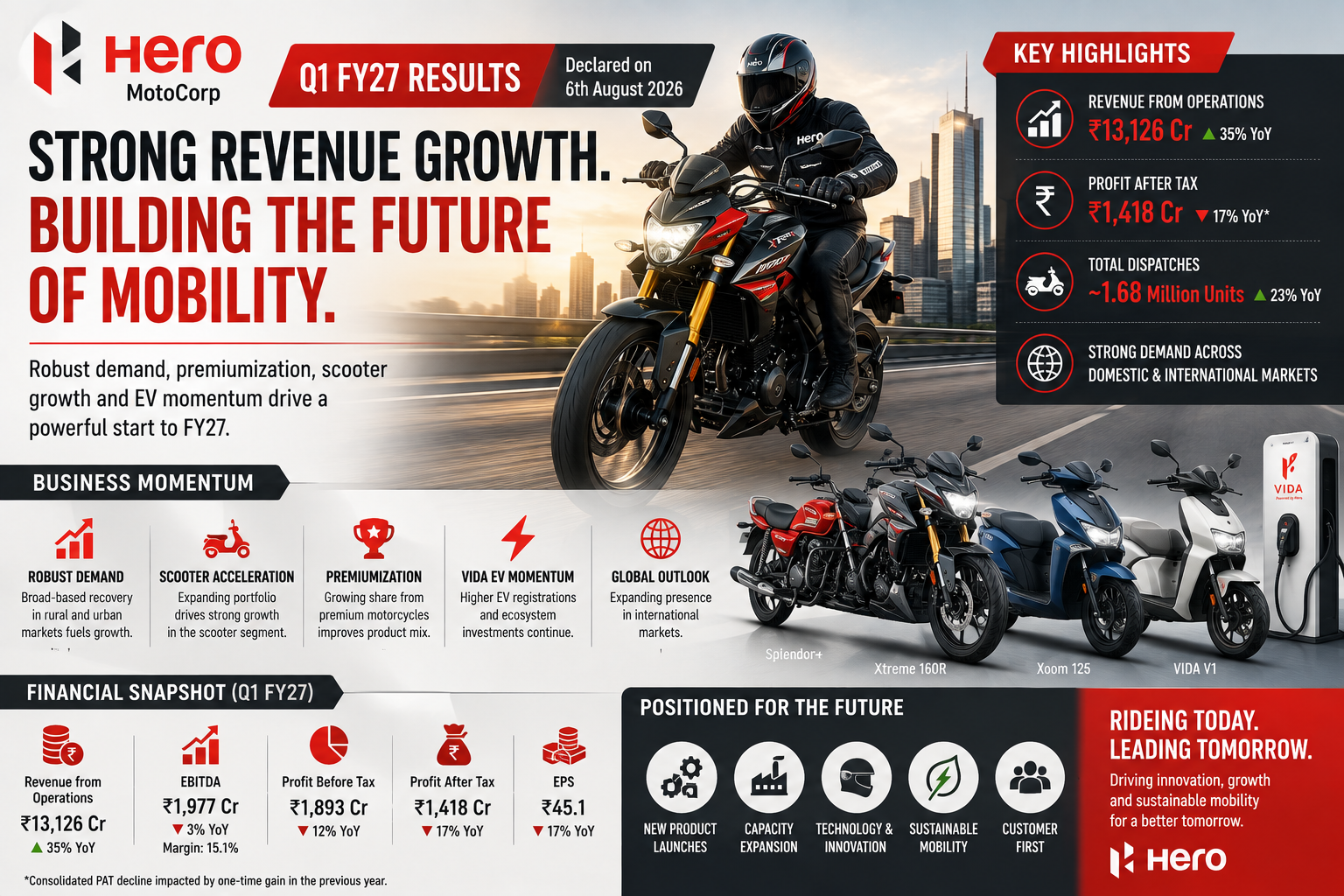
Hero MotoCorp has kicked off FY27 with a strong improvement in revenue, reflecting robust demand across its motorcycle and scooter portfolio and a broad-based recovery in India’s two-wheeler market. However, the company’s latest quarterly performance also highlights an important challenge: the sharp increase in revenue has not translated into similar growth in consolidated profit.
The Q1 FY27 results, declared on 6 August 2026, show a company benefiting from stronger volumes, premiumization, scooter growth and improving electric-vehicle momentum, while simultaneously navigating higher input costs and continued investments in new products and technology.
The quarter therefore presents an interesting mix of strong operating momentum and near-term profitability challenges.
Revenue Growth Stands Out
Hero MotoCorp reported consolidated revenue from operations of approximately ₹13,126 crore in Q1 FY27, representing growth of nearly 35% year-on-year.
The significant increase in revenue reflects the combination of higher two-wheeler volumes, improved product mix and stronger contribution from premium motorcycles, scooters, electric vehicles and international markets.
The performance is particularly notable because the company entered FY27 with a clear objective of growing faster than the overall two-wheeler industry.
The latest numbers indicate that Hero MotoCorp is making meaningful progress toward that objective.
Consolidated Profit Declines Despite Strong Revenue Growth
The most important weakness in the results comes from the bottom line.
Consolidated profit after tax stood at around ₹1,418 crore, compared with approximately ₹1,706 crore in the corresponding quarter last year.
This represents a decline of roughly 17%.
At first glance, the profit decline appears disappointing against the backdrop of 35% revenue growth. However, the comparison needs some context.
The previous year’s consolidated profit benefited from a substantial one-time gain associated with the dilution of Hero MotoCorp’s stake in an associate following a public issue and private placement.
Consequently, the year-on-year consolidated PAT comparison is distorted by this exceptional item.
The underlying operating performance is considerably stronger than the headline consolidated profit number suggests.
Stronger Domestic Two-Wheeler Demand
Hero MotoCorp’s core motorcycle business continues to benefit from improving consumer demand.
The Indian two-wheeler market has been showing signs of recovery, particularly in rural and semi-urban markets.
Several factors are supporting this trend:
- Better rural economic conditions.
- Improving consumer sentiment.
- Stronger agricultural activity.
- Higher disposable income.
- Replacement demand.
- New model launches.
- Financing availability.
Hero MotoCorp’s extensive dealership network gives it a significant advantage in capturing this recovery.
The company continues to dominate the mass-market motorcycle segment while simultaneously trying to build a stronger presence in premium motorcycles and scooters.
Q1 Volume Performance Provides Confidence
Hero MotoCorp’s Q1 FY27 dispatches were around 1.68 million units, representing growth of approximately 23% year-on-year.
Domestic retail registrations also showed healthy improvement, with the company benefiting from stronger demand across both motorcycles and scooters.
The volume performance is particularly encouraging because it suggests that the company’s revenue growth is not solely dependent on price increases.
Higher volumes, better product mix and premiumization are increasingly becoming important contributors to revenue expansion.
Scooters Are Becoming a Bigger Growth Engine
One of the most interesting developments in Hero MotoCorp’s business is the increasing contribution from scooters.
Historically, Hero’s biggest strength has been motorcycles, particularly in the commuter segment.
However, the company has been aggressively expanding its scooter portfolio with products such as:
- Destini
- Xoom
- Pleasure
- Xoom 125
- Xoom 160
The scooter market is becoming increasingly important because consumers are shifting toward more convenient and feature-rich personal mobility options.
Hero MotoCorp expects scooter growth to outperform motorcycle growth during FY27, making this segment an important contributor to future volume expansion.
Premium Motorcycles Continue to Gain Importance
Hero MotoCorp is also working to reduce its dependence on entry-level commuter motorcycles by expanding into premium segments.
The company has been investing heavily in products under the Xtreme, Karizma and XPulse families.
The premium motorcycle strategy is important for two reasons.
First, premium products typically generate higher realizations.
Second, building a stronger premium portfolio can improve Hero’s brand perception among younger consumers.
The company is therefore attempting to create a more balanced product portfolio spanning entry-level motorcycles, premium motorcycles, scooters and electric vehicles.
VIDA EV Business Continues to Scale
Electric mobility remains another major focus area.
Hero MotoCorp’s VIDA electric scooter business has been gaining traction, with EV registrations showing strong year-on-year growth.
The company is investing in:
- EV manufacturing capacity.
- Battery technology.
- Product development.
- Charging infrastructure.
- New VIDA models.
- Software and connected technology.
The EV business remains strategically important even though it continues to require investment.
Hero MotoCorp has indicated that losses per EV unit are improving, while increasing volumes and higher localization should help the business move toward greater profitability over time.
EV Strategy Is Moving Beyond Just One Product
Hero MotoCorp’s EV strategy is increasingly becoming broader than simply selling electric scooters.
The company is building an ecosystem around electric mobility through investments in technology and partnerships.
Its investment in Ather Energy is particularly significant.
Hero has been increasing its strategic exposure to the electric two-wheeler ecosystem, allowing it to participate in the industry’s growth beyond its own VIDA brand.
This could provide Hero with additional technological and market advantages as EV adoption accelerates.
Margins Remain a Key Area to Watch
While revenue growth was impressive, investors will be watching profitability closely.
Commodity prices, particularly metals and other raw materials, remain a key factor influencing Hero MotoCorp’s margins.
The company has already implemented price increases and cost-saving measures to partially offset higher input costs.
However, there can be a time lag between increases in input costs and the company’s ability to pass those costs on to consumers.
Hero MotoCorp continues to target a medium-term EBITDA margin range of approximately 14–16%.
Maintaining that margin band while simultaneously investing heavily in EVs, premium products and capacity expansion will be one of management’s most important challenges.
Premiumization Could Protect Future Margins
A stronger product mix provides Hero MotoCorp with another potential solution to rising costs.
Premium motorcycles and scooters generally generate better realizations than entry-level commuter products.
As consumers upgrade to higher-priced models, Hero can potentially improve its average revenue per vehicle.
This is why products such as the Xtreme 125R, Xtreme 160R, Xpulse and premium scooter portfolio are strategically important.
A successful premiumization strategy could help offset some of the pressure from commodity inflation.
Strong Growth Outlook for FY27
Hero MotoCorp expects the overall two-wheeler industry to grow at a high-single-digit rate during FY27.
The company aims to outperform the industry.
Its growth strategy is built around several pillars:
- New motorcycle launches.
- Faster scooter growth.
- Premiumization.
- Rural demand recovery.
- VIDA EV expansion.
- International market growth.
- Capacity expansion.
- Technology investments.
Management expects the first half of FY27 to show stronger growth than the second half because of base effects.
This makes the next few quarters particularly important for determining whether the current volume momentum can be sustained.
Capital Expenditure to Support Future Growth
Hero MotoCorp is also increasing investments in its future capacity.
The company has planned significant capital expenditure for FY27, with spending directed toward:
- Scooter capacity.
- EV manufacturing.
- New products.
- Technology.
- Supply-chain infrastructure.
- Global parts distribution.
- Manufacturing modernization.
The company is also working to increase manufacturing capacity for several high-demand scooter models.
While higher capex can put pressure on free cash flow in the short term, it should strengthen Hero’s ability to participate in the next phase of two-wheeler industry growth.
International Markets Provide Another Opportunity
Hero MotoCorp continues to expand its international presence.
The company has been entering new markets while strengthening its presence across existing overseas markets.
Its expansion into Europe is particularly noteworthy as Hero continues to build a more global identity.
International markets remain relatively small compared with India, but they provide an opportunity to diversify revenue and establish Hero as a global motorcycle brand.
What Investors Should Watch Going Forward
The Q1 FY27 results leave investors with several important indicators to monitor during the remainder of the year.
1. Volume growth
Hero needs to continue outperforming industry growth.
2. EBITDA margins
The ability to maintain the 14–16% medium-term margin target will be critical.
3. Commodity prices
Higher steel and other raw material costs could continue to affect profitability.
4. Premium motorcycle performance
The success of higher-margin products will determine whether premiumization can materially improve the product mix.
5. Scooter market share
Hero’s ability to gain share in scooters could become a major earnings catalyst.
6. VIDA profitability
EV volumes are growing, but investors will increasingly want to see the business move toward sustainable profitability.
7. Rural recovery
A sustained recovery in rural demand could provide a significant boost to Hero’s core motorcycle business.
Risks to the Outlook
Despite the encouraging revenue and volume growth, several risks remain.
These include:
- Commodity inflation.
- Intense competition from TVS Motor, Bajaj Auto and other manufacturers.
- Faster-than-expected EV adoption.
- EV price competition.
- Margin pressure from new product investments.
- Weakening rural demand.
- Regulatory changes.
- Higher promotional spending.
The EV transition is particularly important.
Hero has a strong legacy in internal-combustion motorcycles, but the company must simultaneously defend its existing market share while building a competitive EV business.
The Bigger Picture
Hero MotoCorp is going through an important transformation.
For decades, the company’s strength was built around affordable commuter motorcycles and its enormous rural distribution network.
The next phase is considerably broader.
Hero wants to become a company with strong positions across:
Commuter motorcycles → Premium motorcycles → Scooters → EVs → Connected mobility → Global markets
This transformation requires substantial investment, but it also creates opportunities for the company to expand its addressable market and improve its product mix.
Conclusion
Hero MotoCorp’s Q1 FY27 earnings provide a largely encouraging picture of the company’s underlying business momentum.
Revenue surged nearly 35% year-on-year to approximately ₹13,126 crore, while two-wheeler volumes grew strongly. The company’s scooter portfolio, premium motorcycles and VIDA EV business are becoming increasingly important growth drivers.
The headline consolidated PAT decline of around 17% to ₹1,418 crore needs to be viewed in the context of the previous year’s one-time gain. More importantly, investors will be watching whether Hero can protect margins against commodity inflation while continuing to invest in EVs, premium products and capacity expansion.
The company’s strategy is clearly moving beyond its traditional commuter motorcycle franchise.
With rural demand improving, scooters gaining momentum, premiumization accelerating and EV investments scaling up, Hero MotoCorp is attempting to build a more diversified and technologically advanced two-wheeler business.
For FY27, the central question is no longer simply whether Hero can sell more motorcycles. It is whether the company can convert its strong volume growth into sustainable margin expansion and long-term earnings growth while successfully executing its transition toward premium and electric mobility.
Feel free to share your experiences and insights in the comments below. Let’s continue the conversation and grow together as a community of traders and analysts.
By sharing this experience and insights, I hope to contribute to the collective knowledge of our professional community, encouraging a culture of strategic thinking and informed decision-making.
As always, thorough research and risk management are crucial. The dynamic nature of financial markets demands vigilance, agility, and a deep understanding of the tools at your disposal. Here’s to profitable trading and navigating the election season with confidence!
Ready to stay ahead of market trends and make informed investment decisions? Follow our page for more insights and updates on the latest in the financial world!
For a free online stock market training by Yogeshwar Vashishtha (M.Tech IIT) this Saturday from 11 am – 1 pm, please sign up with https://pathfinderstrainings.in/training/freetrainings.aspx
Experience profits with my winning algo strategies – get a free one-month trial with ₹15 lakh capital! – https://terminal.algofinders.com/algo-terminal
Disclaimer
This article should not be interpreted as investment advice. For any investment decisions, consult a reputable financial advisor. The author and publisher are not responsible for any losses incurred by investors or traders based on the information provided.