

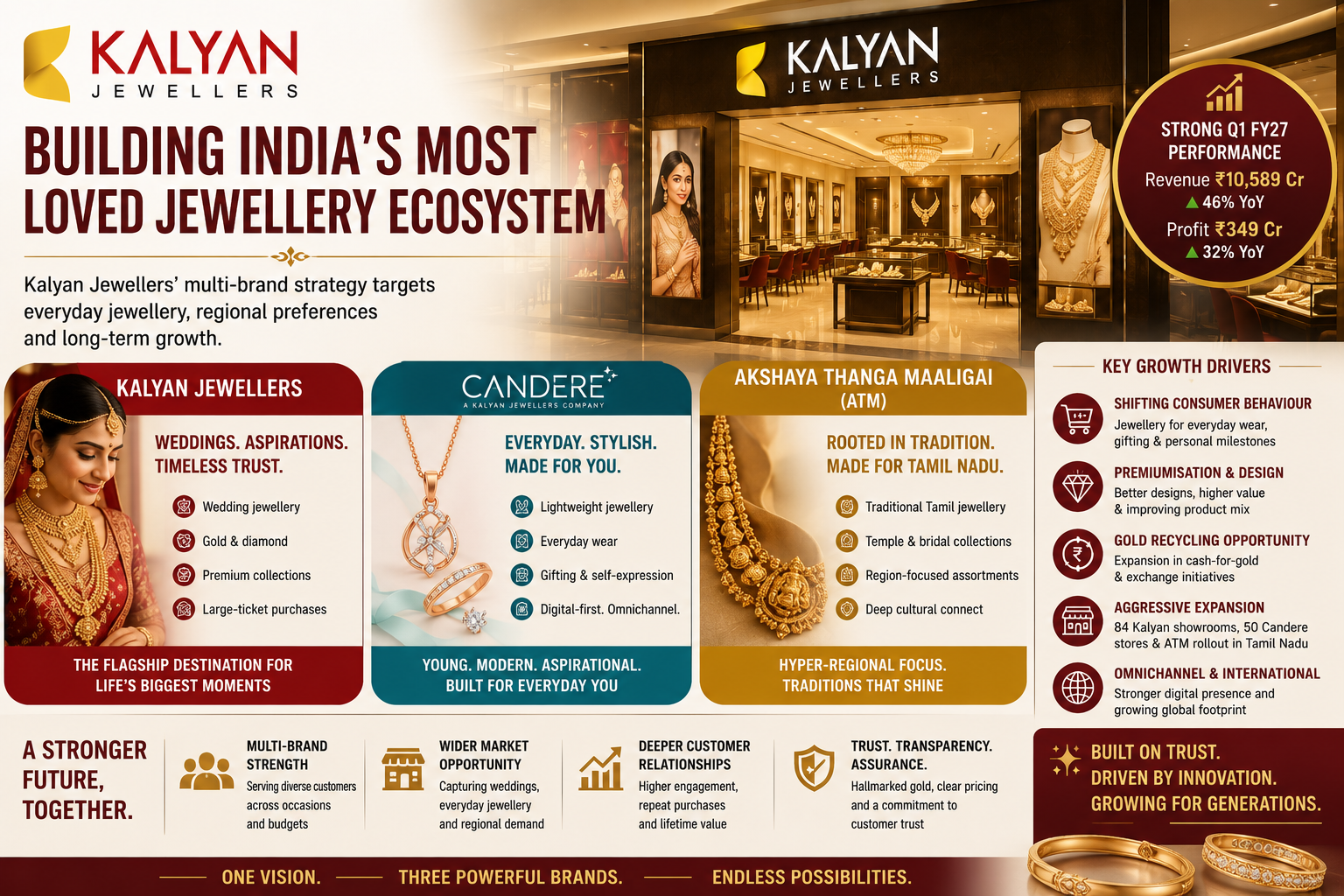
Kalyan Jewellers is entering an important new phase of growth as India’s jewellery market undergoes a significant shift in consumer behaviour.
For decades, jewellery purchases in India were strongly associated with weddings, festivals and major family occasions. But changing lifestyles, younger consumers and the growing popularity of organised retail are creating a much broader market. Jewellery is increasingly becoming an everyday fashion and lifestyle product rather than something purchased only for special occasions.
Kalyan Jewellers is responding to this transformation with a multi-brand strategy designed to capture customers across different occasions, price points and regional preferences.
The company is positioning Kalyan Jewellers, Candere and its upcoming Akshaya Thanga Maaligai (ATM) brand as distinct propositions rather than competing brands under the same umbrella.
Kalyan Jewellers Wants to Capture More Than Wedding Spending
Kalyan Jewellers has traditionally built its brand around wedding jewellery, gold ornaments and aspirational purchases.
That market remains extremely important, but the company increasingly sees an opportunity beyond weddings.
Consumers today are buying jewellery for:
- Daily wear
- Office wear
- Gifting
- Parties and social occasions
- Festivals
- Personal milestones
- Fashion and self-expression
This represents a fundamental change in purchasing behaviour.
Instead of buying a few expensive pieces and wearing them for many years, younger consumers are increasingly purchasing multiple pieces suited to different occasions.
For Kalyan, this creates an opportunity to increase purchase frequency and build a deeper relationship with customers.
Three Brands, Three Different Consumer Segments
The company’s strategy revolves around giving each brand a specific role.
Kalyan Jewellers: Weddings and Aspirational Jewellery
The flagship Kalyan Jewellers brand will continue focusing on its traditional strengths.
Its proposition revolves around:
- Wedding jewellery
- Gold jewellery
- Diamond jewellery
- Premium collections
- Large-ticket purchases
- Aspirational designs
The brand is intended to remain the company’s flagship destination for customers making significant jewellery purchases.
Candere: Lightweight, Everyday and Gifting Jewellery
Candere occupies a very different position.
Originally established as a digital-first jewellery platform, Candere has increasingly evolved into an omnichannel business with physical stores complementing its online presence.
Its focus is on:
- Lightweight jewellery
- Everyday wear
- Gifting
- Contemporary designs
- Younger consumers
- Digital-first shopping
This makes Candere particularly relevant to the changing consumption habits of India’s younger population.
The business has expanded rapidly, reaching 129 showrooms by the end of June 2026, compared with only two stores in FY23. More importantly, Candere moved into profitability during the latest quarter, reporting a profit of about ₹2.1 crore after recording a ₹10 crore loss in Q1 FY26.
That transition from a loss-making digital business toward profitability could become an important milestone for Kalyan’s overall multi-brand strategy.
The Rise of Akshaya Thanga Maaligai
The most interesting element of Kalyan’s new strategy is perhaps its upcoming regional brand, Akshaya Thanga Maaligai, or ATM.
The concept is different from the company’s existing hyperlocal strategy.
Kalyan currently customises a portion of its inventory based on local preferences while maintaining a broader national assortment.
ATM takes regionalisation much further.
The new chain is being designed specifically around traditional Tamil jewellery preferences, with the entire assortment focused on regional designs.
The first ATM showroom is planned for Chennai, followed by four additional stores in Tamil Nadu over the following months.
This approach could allow Kalyan to compete more directly with strong regional jewellery retailers that have developed deep customer relationships and highly specialised product offerings.
Why Regional Jewellery Matters
India’s jewellery market is not homogeneous.
Jewellery preferences can vary dramatically between regions.
A customer in Tamil Nadu may have different preferences for:
- Gold designs
- Wedding jewellery
- Temple jewellery
- Chains
- Bangles
- Traditional motifs
- Bridal collections
These preferences are often deeply connected with culture and family traditions.
A national brand can provide scale and trust, but a regional brand can potentially create a much stronger emotional connection.
ATM’s strategy is therefore an attempt to combine Kalyan’s organised retail expertise with highly localised merchandising.
India’s Jewellery Market Is Becoming More Organised
Another major opportunity for Kalyan is the continued formalisation of India’s jewellery industry.
Consumers are increasingly looking for:
- Transparency
- Hallmarked gold
- Clear pricing
- Reliable purity
- Branded products
- Wider design choices
- Better after-sales service
Large organised jewellery retailers can benefit from these preferences.
Kalyan’s established brand and extensive showroom network give it an advantage as consumers shift away from smaller unorganised retailers.
This structural formalisation could provide a long-term growth runway for the company even if gold prices remain volatile.
High Gold Prices Are Changing Consumer Behaviour
Gold prices have risen substantially, and this is changing how consumers approach jewellery purchases.
When gold prices were lower, customers could focus more heavily on quantity.
At elevated prices, consumers increasingly appear to focus on a fixed spending budget.
Rather than deciding to buy a specific quantity of gold, a customer may enter a showroom with a predetermined budget and seek the best design possible within that amount.
This has important implications for jewellery companies.
The industry may experience lower physical volumes when gold prices rise, but retailers can partially offset that impact through:
- Better designs
- Higher-value products
- Premiumisation
- Improved customer conversion
- Higher average ticket sizes
Kalyan’s multi-brand strategy could help it cater to customers across multiple budgets without diluting the positioning of its flagship brand.
Gold Recycling Creates Another Opportunity
High gold prices are also encouraging consumers to exchange or sell old jewellery.
Kalyan is responding by expanding its gold recycling and “cash for gold” initiatives.
The economics of gold exchange and direct cash purchases are different.
Exchange transactions can carry lower margins because retailers do not receive the same sourcing advantage that comes with purchasing fresh gold through conventional channels.
However, direct cash-for-gold transactions can be more margin-accretive.
Kalyan expects growth in the cash-for-gold business to help offset some of the margin pressure associated with increased jewellery exchange activity.
Strong Q1 Growth Provides a Positive Base
The company’s latest quarterly performance provides additional confidence behind its expansion strategy.
Kalyan Jewellers reported consolidated revenue of approximately ₹10,589 crore in the June quarter, representing a 46% year-on-year increase.
Consolidated net profit rose approximately 32% to ₹349 crore.
Strong demand in India and healthy same-store sales growth were important contributors to the performance.
The results demonstrate that the company is not simply expanding its store network—it is also experiencing strong underlying demand.
Expansion Remains a Major Growth Driver
Kalyan is pursuing an aggressive showroom expansion strategy across its brands.
The company’s plans include:
- Around 84 new Kalyan Jewellers showrooms in India
- Approximately 50 additional Candere stores
- International expansion
- New ATM stores in Tamil Nadu
The strategy allows the company to simultaneously increase geographical reach and segment its customer base.
The Kalyan brand can target larger purchases, Candere can address everyday and gifting demand, while ATM can focus on deeply regional preferences.
This creates a potentially powerful ecosystem.
Candere Could Become an Important Growth Engine
Candere deserves particular attention.
The business has undergone a dramatic transformation from an online jewellery startup into an omnichannel brand.
Kalyan acquired a majority stake in Candere in 2017 and has since integrated the business into its broader retail ecosystem.
The rapid increase in store count combined with the move into profitability suggests that Kalyan may finally be reaching an important inflection point with the brand.
If Candere can successfully build a scalable model around lightweight jewellery and younger consumers, it could become a significant contributor to Kalyan’s future growth.
Why Kalyan Is Not Chasing Every Trend
Interestingly, the company does not currently appear interested in entering the lab-grown diamond segment.
While lab-grown diamonds have gained popularity among younger consumers, Kalyan believes its core customer base remains more focused on traditional value propositions.
This highlights an important aspect of the company’s strategy.
Kalyan is not attempting to participate in every jewellery trend. Instead, it is concentrating on segments where it believes it has a stronger competitive advantage.
A Multi-Brand Model Can Increase Customer Lifetime Value
The biggest strategic benefit of this approach could be customer lifetime value.
Consider a consumer who interacts with different Kalyan brands at different stages of life:
Candere → Everyday jewellery
↓
ATM → Traditional regional jewellery
↓
Kalyan Jewellers → Wedding jewellery
This allows the company to capture multiple transactions from the same consumer over time.
The objective is therefore not simply to sell more jewellery.
It is to become a larger part of the customer’s overall jewellery journey.
Competition Remains Intense
Kalyan is operating in a highly competitive industry.
The company faces competition from national players as well as strong regional jewellery chains.
Large organised competitors are also adopting multi-brand strategies, while regional players possess deep local knowledge and strong customer loyalty.
The challenge for Kalyan will be to expand rapidly without losing the local relevance that gives regional jewellery businesses their competitive advantage.
What Investors Should Watch
Several factors will determine whether Kalyan’s strategy delivers sustainable shareholder value.
Candere profitability
The move into profitability is encouraging, but investors will want to see whether it can be sustained while the store network continues to expand.
ATM rollout
The performance of the Tamil Nadu-focused ATM brand will provide an early indication of whether Kalyan can successfully build highly regionalised brands.
Same-store sales
Strong store productivity will be essential as the company continues adding locations.
Gold prices
Persistently high gold prices could affect physical volumes, although higher ticket sizes and recycling can provide some offset.
Margins
The balance between gold exchange, cash-for-gold transactions, premiumisation and operating costs will influence profitability.
Store expansion
Kalyan needs to maintain strong growth without allowing aggressive expansion to compromise return on capital.
The Bigger Picture
Kalyan Jewellers is gradually evolving from a single-brand jewellery retailer into a multi-brand jewellery platform.
That transformation could be one of the most important aspects of its long-term growth story.
The company’s traditional Kalyan brand provides scale and trust.
Candere provides access to younger consumers and the everyday jewellery market.
ATM provides a potential route into deeply regionalised jewellery consumption.
Together, these brands could allow Kalyan to address a much wider portion of India’s jewellery market.
Conclusion
Kalyan Jewellers is betting that the future of India’s jewellery market will be much broader than weddings and festivals.
Consumers are buying more frequently, shopping according to budgets and looking for jewellery that fits different occasions and lifestyles. At the same time, regional preferences remain extremely important.
The company’s multi-brand strategy attempts to capture all of these trends.
Kalyan Jewellers remains focused on weddings and aspirational purchases, Candere is being developed around lightweight, everyday and gifting jewellery, while Akshaya Thanga Maaligai is being positioned as a highly regional Tamil Nadu-focused brand.
With strong recent financial performance, rapid Candere expansion and a new regional format on the way, Kalyan is positioning itself for the next stage of India’s organised jewellery boom.
The real test will be whether the company can turn this aggressive expansion into higher store productivity, sustainable margins and stronger customer loyalty.
If successful, Kalyan Jewellers could move from being simply one of India’s leading jewellery retailers to becoming a multi-brand jewellery powerhouse capable of capturing customers across occasions, budgets, generations and regions.
Feel free to share your experiences and insights in the comments below. Let’s continue the conversation and grow together as a community of traders and analysts.
By sharing this experience and insights, I hope to contribute to the collective knowledge of our professional community, encouraging a culture of strategic thinking and informed decision-making.
As always, thorough research and risk management are crucial. The dynamic nature of financial markets demands vigilance, agility, and a deep understanding of the tools at your disposal. Here’s to profitable trading and navigating the election season with confidence!
Ready to stay ahead of market trends and make informed investment decisions? Follow our page for more insights and updates on the latest in the financial world!
For a free online stock market training by Yogeshwar Vashishtha (M.Tech IIT) this Saturday from 11 am – 1 pm, please sign up with https://pathfinderstrainings.in/training/freetrainings.aspx
Experience profits with my winning algo strategies – get a free one-month trial with ₹15 lakh capital! – https://terminal.algofinders.com/algo-terminal
Disclaimer
This article should not be interpreted as investment advice. For any investment decisions, consult a reputable financial advisor. The author and publisher are not responsible for any losses incurred by investors or traders based on the information provided.