

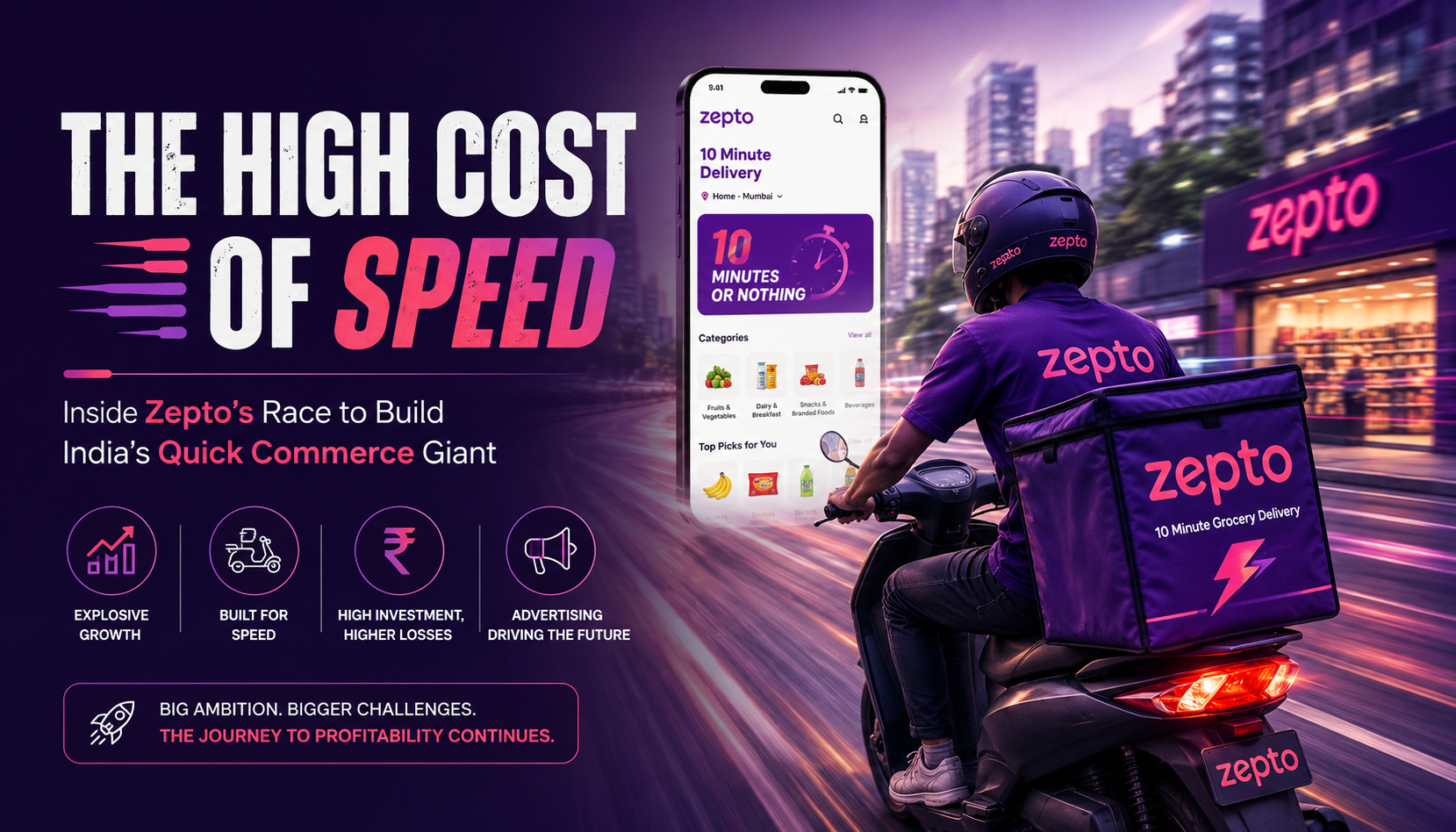
In the fiercely competitive world of quick commerce, speed has become the ultimate differentiator. Consumers increasingly expect groceries, household essentials, and daily necessities to arrive at their doorstep within minutes rather than hours. Companies operating in this space have responded by investing heavily in technology, logistics networks, warehousing infrastructure, and customer acquisition. Among the companies leading this transformation, Zepto has emerged as one of the most aggressive players, building a business designed around convenience, rapid delivery, and scale.
Recent financial disclosures reveal both the extraordinary opportunities and the immense challenges associated with this business model. While Zepto has achieved remarkable growth in revenue and order volumes, it has also demonstrated how expensive it is to build a nationwide quick-commerce platform capable of fulfilling millions of orders at lightning speed.
Growth at an Extraordinary Pace
Zepto’s expansion over the past few years reflects the explosive demand for instant delivery services across urban India. The company has significantly increased its customer base, expanded its delivery network, and processed hundreds of millions of orders annually.
Revenue growth has been particularly impressive. As more consumers embrace the convenience of quick commerce, the company has managed to more than double its operational revenue within a short period. Order volumes have surged as customers increasingly rely on the platform not only for groceries but also for a growing range of everyday products.
The company’s dark store network—small fulfillment centers strategically located close to residential neighborhoods—has expanded rapidly. These facilities form the backbone of the quick-commerce model, allowing products to be picked, packed, and delivered within minutes.
Importantly, demand appears to be growing alongside infrastructure expansion. Even as the company adds new fulfillment centers, order density across existing locations remains strong, suggesting that consumer adoption continues to deepen.
The Reality Behind Rapid Expansion
However, rapid growth comes at a significant cost.
Building a quick-commerce network requires substantial spending on warehousing, inventory management, delivery operations, technology systems, and employee recruitment. Every new city and neighborhood expansion demands additional investment before profitability can be achieved.
As a result, losses have continued to remain substantial despite soaring revenue. The company’s financial performance highlights a fundamental challenge faced by many high-growth technology businesses: scaling operations quickly often requires spending far ahead of current earnings.
The quick-commerce industry is particularly capital-intensive because companies compete not only on pricing but also on delivery speed, assortment availability, and customer experience. Maintaining these advantages requires continuous investment in infrastructure and operational capabilities.
The Economics of Convenience
The promise of delivering products within ten minutes sounds simple from a customer’s perspective, but it involves a highly complex and expensive operational ecosystem.
A quick-commerce company must maintain inventory close to customers, employ delivery partners across densely populated regions, optimize routing algorithms, manage real-time demand fluctuations, and ensure products remain available at all times.
Unlike traditional e-commerce, where delivery may take several days and inventory can be centralized, quick commerce depends on decentralized networks that naturally increase operating costs.
The result is a constant balancing act between growth, service quality, and profitability.
Advertising Emerges as a Powerful Revenue Engine
One of the most interesting developments in Zepto’s business model is the rapid growth of its advertising business.
As the platform attracts millions of active customers, consumer brands are increasingly willing to pay for visibility and preferred placement within the app. Sponsored listings, promotional campaigns, and targeted advertisements have become an important source of revenue.
Advertising offers significantly higher margins than product sales and delivery operations. As a result, it is increasingly viewed as a critical component of the path toward long-term profitability.
This strategy mirrors successful global digital commerce platforms that have transformed advertising into a major earnings driver. By monetizing consumer attention alongside product transactions, companies can improve economics without relying solely on delivery fees or merchant commissions.
Competition Continues to Intensify
Zepto’s journey is unfolding in one of the most competitive sectors in India’s startup ecosystem.
Major players are investing aggressively to capture market share in the rapidly growing quick-commerce segment. New fulfillment centers are opening across cities, delivery promises are becoming faster, and customer acquisition efforts remain intense.
This competitive environment creates pressure on pricing, promotions, and customer incentives. Companies often prioritize growth and market share over immediate profitability, believing that scale will eventually unlock stronger economics.
For Zepto, maintaining growth while improving operational efficiency will be essential as investors increasingly focus on sustainable business performance.
Investor Focus Shifts Toward Profitability
While revenue growth remains impressive, investors are beginning to pay closer attention to profitability metrics and operational efficiency.
Questions surrounding long-term sustainability have become more important as the company prepares for the next stage of its corporate journey. Investors want evidence that rapid growth can eventually translate into consistent earnings and positive cash flows.
Management’s challenge is to demonstrate that the business can continue expanding while gradually reducing losses through better scale, higher order density, stronger advertising income, and improved operational efficiencies.
The company has already shown signs of progress in certain areas, including improvements in quarterly performance and enhanced monetization capabilities. However, the broader path to profitability remains a key topic of discussion.
The Future of Quick Commerce
Zepto’s story reflects a larger transformation taking place across India’s retail landscape. Consumers are increasingly prioritizing convenience, speed, and digital-first shopping experiences. Quick commerce has evolved from an experimental service into a mainstream retail channel serving millions of households.
The industry’s future will likely be shaped by a combination of operational excellence, technology innovation, and financial discipline. Companies that successfully balance growth with profitability will be best positioned to emerge as long-term winners.
For Zepto, the journey illustrates a fundamental reality of modern commerce: building a platform capable of delivering near-instant gratification at scale requires enormous investment. The company has proven that demand exists. The next challenge is proving that such speed can eventually generate sustainable profits.
As India’s quick-commerce market continues to mature, Zepto’s experience offers a valuable case study in the opportunities, risks, and economics of building one of the country’s fastest-growing consumer technology businesses.
Feel free to share your experiences and insights in the comments below. Let’s continue the conversation and grow together as a community of traders and analysts.
By sharing this experience and insights, I hope to contribute to the collective knowledge of our professional community, encouraging a culture of strategic thinking and informed decision-making.
As always, thorough research and risk management are crucial. The dynamic nature of financial markets demands vigilance, agility, and a deep understanding of the tools at your disposal. Here’s to profitable trading and navigating the election season with confidence!
Ready to stay ahead of market trends and make informed investment decisions? Follow our page for more insights and updates on the latest in the financial world!
For a free online stock market training by Yogeshwar Vashishtha (M.Tech IIT) this Saturday from 11 am – 1 pm, please sign up with https://pathfinderstrainings.in/training/freetrainings.aspx
Experience profits with my winning algo strategies – get a free one-month trial with ₹15 lakh capital! – https://terminal.algofinders.com/algo-terminal
Disclaimer
This article should not be interpreted as investment advice. For any investment decisions, consult a reputable financial advisor. The author and publisher are not responsible for any losses incurred by investors or traders based on the information provided.