

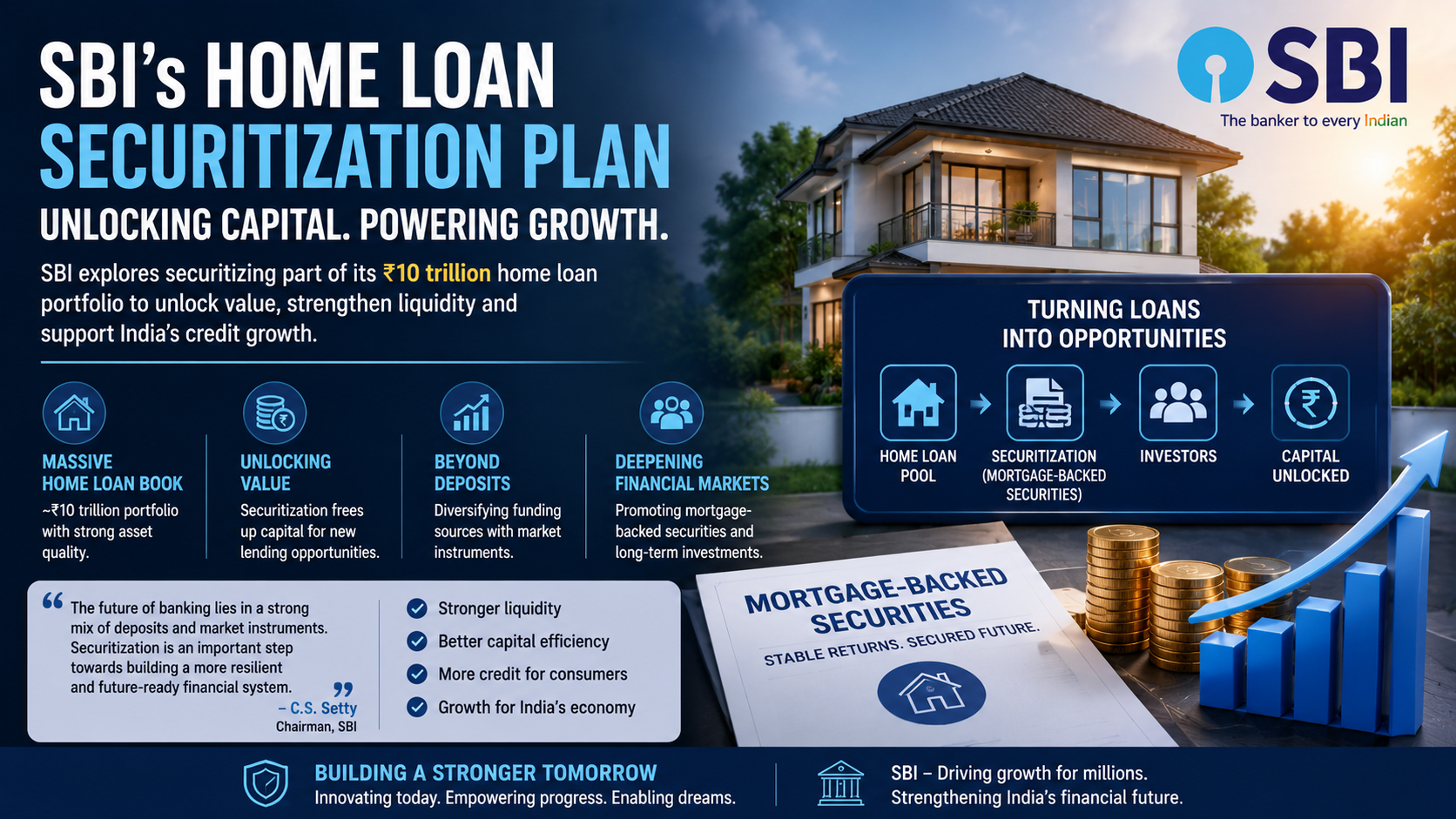
India’s banking sector is entering a new phase where traditional deposit-based lending models are being complemented by newer forms of market-based funding. As credit demand continues to grow faster than deposits, banks are exploring innovative ways to unlock capital from existing assets and maintain lending momentum.
At the center of this shift is the State Bank of India (SBI), India’s largest lender, which is considering securitizing a portion of its massive home loan portfolio. The move could mark an important development for India’s mortgage-backed securities market and change how banks manage their balance sheets in the future.
Unlocking Value From a Massive Home Loan Portfolio
SBI has built one of the largest housing finance businesses in India. The bank’s home loan portfolio is close to ₹10 trillion, making it one of the most valuable retail asset pools in the country.
However, home loans are long-term assets. While they generate stable cash flows over many years, they also remain locked on a bank’s balance sheet for extended periods.
Securitization offers a way to unlock this value.
Under this process, a bank pools together a group of loans and creates securities backed by the repayment streams from those loans. These securities can then be sold to investors, allowing the bank to receive funds upfront while transferring ownership of future cash flows.
For SBI, this could create additional liquidity that can be deployed toward new lending opportunities.
Why SBI Is Looking Beyond Deposits
Banks traditionally rely heavily on deposits to fund loan growth. Customers deposit money with banks, and banks use those funds to provide loans.
However, India’s banking system has been experiencing a structural challenge: credit growth has been outpacing deposit growth.
The demand for loans from consumers and businesses remains strong, while competition for deposits has increased due to alternative investment options such as mutual funds and equity markets.
According to banking data, overall system loans have been growing faster than deposits, creating pressure on banks to diversify funding sources. SBI itself has seen loan growth ahead of deposit growth, encouraging the bank to explore alternative liquidity channels.
This changing environment is pushing banks to think beyond traditional deposit-based models.
The Rise of Market-Based Banking
SBI chairman C.S. Setty has highlighted that the future liability structure of banks may include more market instruments alongside deposits. This could include bonds, securitized assets, and other funding mechanisms.
This represents a broader transformation in banking.
Globally, large financial institutions use multiple funding sources to manage growth and liquidity. Securitization is already an established mechanism in many developed markets, particularly for mortgages and consumer loans.
For India, greater adoption of such instruments could deepen financial markets and create new investment opportunities for institutions.
How Mortgage-Backed Securities Work
Mortgage-backed securities are financial instruments created by pooling home loans together.
The process generally involves:
- A bank creates a pool of home loans
- The repayment streams from these loans are packaged into securities
- Investors purchase these securities
- Investors receive returns from the underlying loan repayments
For investors, these products provide access to secured credit assets.
For banks, they provide liquidity and allow better capital management.
In SBI’s case, the strength of its home loan book could make such securities attractive because of the bank’s scale, brand reputation, and historically strong asset quality.
Why SBI’s Move Could Be Important for India’s Financial Markets
India’s securitization market remains relatively small compared with global markets.
The entry of a lender as large as SBI could significantly improve confidence among investors and encourage more participation in mortgage-backed securities.
A large transaction from SBI could help:
- Increase investor awareness
- Create a deeper secondary market
- Encourage more banks to explore securitization
- Provide alternative investment opportunities for institutions
The move could also support the development of long-term investors such as insurance companies and pension funds that require stable income-generating assets.
The Advantage of SBI’s Home Loan Portfolio
One of the biggest strengths behind SBI’s plan is the quality and scale of its mortgage business.
Home loans are generally considered among the more stable retail lending products because they are secured by property and usually have predictable repayment patterns.
SBI’s home loan portfolio has maintained strong asset quality, with low levels of bad loans compared with many other lending segments.
This could make the underlying securities attractive to investors looking for relatively stable returns.
Challenges in Creating a Large Mortgage Securities Market
Despite the opportunity, building a successful securitization ecosystem is not simple.
India’s mortgage-backed securities market faces several challenges:
Limited investor base
Institutional investors need to become more comfortable with these products and understand their risk-return characteristics.
Pricing challenges
Because home loans often have relatively low yields, investors may demand attractive pricing before buying these securities.
Prepayment risk
Borrowers often repay loans early through refinancing or prepayments, affecting expected returns for investors.
Market development
A deeper ecosystem of arrangers, investors, rating agencies, and intermediaries is required for large-scale growth.
Experts have highlighted that while SBI’s move could strengthen the market, implementation and investor appetite will determine the outcome.
Impact on India’s Banking Future
SBI’s initiative reflects a larger change taking place in Indian banking.
The future of lending may not depend only on collecting deposits and issuing loans. Banks may increasingly use capital markets to recycle assets, improve liquidity, and support growth.
This could make banking more flexible and efficient.
For customers, this may indirectly support continued availability of credit as banks gain additional capacity to lend.
For investors, it could open a new category of fixed-income opportunities.
Conclusion: SBI’s Move Could Reshape Housing Finance
SBI’s plan to securitize part of its home loan portfolio represents a significant step toward modernizing India’s financial system.
The initiative is not just about raising funds — it reflects a broader shift in how banks think about assets, liquidity, and growth.
As India’s economy expands and credit demand rises, traditional banking models will continue to evolve.
If SBI successfully creates a large mortgage-backed securities market, it could become a landmark moment for India’s housing finance industry and accelerate the transition toward a more sophisticated financial ecosystem.
Feel free to share your experiences and insights in the comments below. Let’s continue the conversation and grow together as a community of traders and analysts.
By sharing this experience and insights, I hope to contribute to the collective knowledge of our professional community, encouraging a culture of strategic thinking and informed decision-making.
As always, thorough research and risk management are crucial. The dynamic nature of financial markets demands vigilance, agility, and a deep understanding of the tools at your disposal. Here’s to profitable trading and navigating the election season with confidence!
Ready to stay ahead of market trends and make informed investment decisions? Follow our page for more insights and updates on the latest in the financial world!
For a free online stock market training by Yogeshwar Vashishtha (M.Tech IIT) this Saturday from 11 am – 1 pm, please sign up with https://pathfinderstrainings.in/training/freetrainings.aspx
Experience profits with my winning algo strategies – get a free one-month trial with ₹15 lakh capital! – https://terminal.algofinders.com/algo-terminal
Disclaimer
This article should not be interpreted as investment advice. For any investment decisions, consult a reputable financial advisor. The author and publisher are not responsible for any losses incurred by investors or traders based on the information provided.