

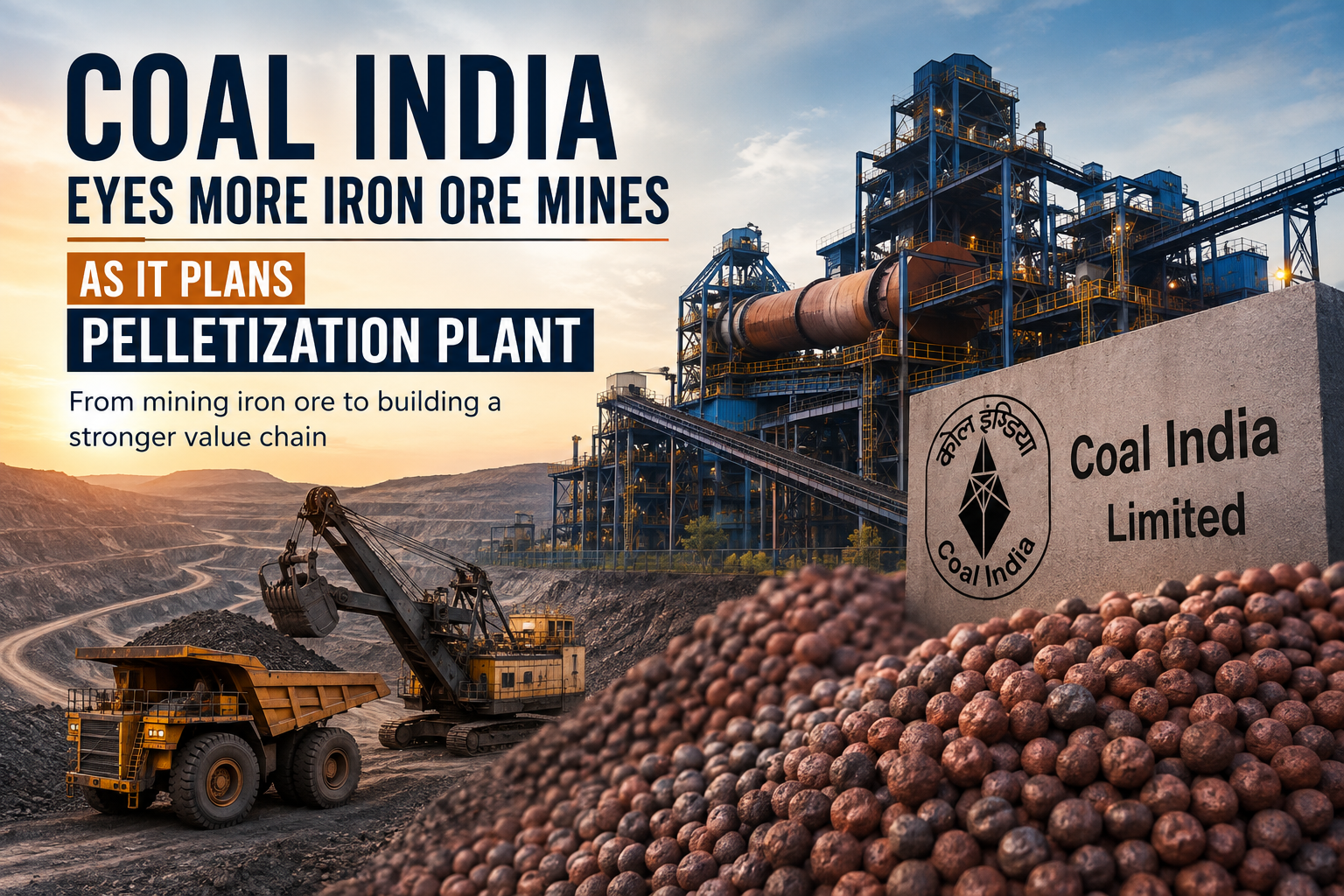
Coal India Ltd is taking a significant step beyond its traditional coal-mining business as it evaluates opportunities to acquire additional iron ore mines and develops plans for a pelletization plant. The move marks a broader diversification strategy for the state-owned mining giant and could gradually expand its presence across India’s metals and mining value chain.
The company’s strategy follows its recent success in the auction of the Gadadharpur iron ore block in Odisha, its first major entry into iron ore mining. Coal India emerged as the highest bidder for the block after offering a premium of 114.05% of the value of minerals dispatched from the mine.
The Gadadharpur block, located in Odisha’s mineral-rich Keonjhar district, covers approximately 265 hectares and has estimated iron ore resources of around 258 million tonnes. The sizeable resource base provides Coal India with a foundation for establishing a presence in iron ore, while also supporting its plans to move into downstream processing.
From Coal Mining to Iron Ore and Pelletization
Coal India’s proposed pelletization plant is an important part of the diversification strategy. Pelletization involves converting fine iron ore into small, stronger pellets that can be used efficiently as a raw material in steel production.
Rather than limiting itself to mining and selling raw materials, Coal India appears to be looking at a more integrated business model. Securing iron ore resources and subsequently processing them into pellets could allow the company to capture greater value from the mineral supply chain.
The strategy also explains why Coal India is considering additional iron ore auctions. A single mine may not provide sufficient or consistent feedstock for a downstream pelletization facility. Building a larger portfolio of iron ore assets could therefore provide greater supply security and improve the utilization of the proposed plant.
Gadadharpur Becomes the Starting Point
The Gadadharpur acquisition represents a major strategic shift for Coal India.
For decades, the company has been synonymous with India’s coal industry. Its move into iron ore indicates that the company is looking beyond its traditional business and attempting to participate in other minerals that are strategically important to India’s industrial development.
The block’s location in Keonjhar is also significant. Odisha is one of India’s most important mineral-producing states and has a well-established ecosystem of mining, transportation and steelmaking activities.
However, the high premium paid for the asset has also raised questions about the project’s economics. A 114.05% premium is substantial, meaning Coal India will need to achieve strong operating efficiency and carefully manage mining, logistics and processing costs to generate attractive returns.
Why India Needs More Iron Ore
Coal India’s diversification comes at a time when India’s steel industry is preparing for substantial capacity expansion.
India’s long-term steel ambitions are expected to translate into significantly higher demand for iron ore. As steel production increases, the availability of reliable domestic iron ore supplies will become increasingly important.
This creates a potentially attractive long-term opportunity for mining companies capable of developing new resources and supplying steelmakers efficiently.
Coal India’s entry could also strengthen domestic raw-material security. As a government-owned company, its participation in iron ore mining could contribute to a more stable supply chain for India’s steel industry.
The Economics Will Be the Key Test
While the strategic rationale is clear, the financial viability of Coal India’s iron ore ambitions will be closely watched.
The biggest challenge is the cost of acquiring and developing mines. Competitive auctions can result in very high premiums, and the economics become more demanding when mining costs, transportation expenses, royalties and downstream processing investments are taken into account.
The proposed pelletization plant will require additional capital expenditure. Industry estimates suggest that a pellet plant with capacity of around one million tonnes per year could require investment of roughly ₹350 crore.
For Coal India, therefore, the success of this strategy will depend not simply on acquiring iron ore resources but on creating an economically efficient mining-to-pelletization chain.
A Potentially Important Diversification Story
Coal India’s move into iron ore reflects a broader transformation taking place across India’s mining sector. Traditional resource companies are increasingly looking at diversification, downstream processing and value-added products rather than remaining dependent on a single commodity.
For Coal India, iron ore offers an opportunity to build another long-term revenue stream while leveraging its experience in large-scale mining, infrastructure development and resource management.
The company’s decision to evaluate additional iron ore blocks selectively is also important. Rather than aggressively pursuing every available auction, the focus appears to be on whether individual assets make commercial sense.
That disciplined approach could become crucial given the high premiums being witnessed in India’s mineral auctions.
What Lies Ahead for Coal India
Coal India’s iron ore journey is still in its early stages, but the direction is becoming increasingly clear.
The company is moving from being predominantly a coal producer toward becoming a more diversified mining and minerals enterprise. The Gadadharpur block provides the initial platform, while additional iron ore acquisitions could potentially supply the proposed pelletization facility.
If Coal India can successfully control its mining costs, develop efficient logistics and integrate iron ore production with pelletization, the new business could become a meaningful contributor over the long term.
However, investors will need to watch capital allocation and project economics carefully. The high premium paid for Gadadharpur means execution will be particularly important.
Conclusion
Coal India’s planned expansion into iron ore mining and pelletization represents one of the company’s most significant diversification initiatives in recent years. The Gadadharpur acquisition gives it an entry point into the iron ore industry, while potential purchases of additional blocks could provide the raw-material base required for downstream processing.
The opportunity is significant, particularly as India’s steel industry prepares for higher production and greater iron ore consumption. But the financial challenge is equally substantial, with high acquisition premiums and large capital requirements placing pressure on future project returns.
Ultimately, Coal India’s success in this new venture will depend on whether it can convert its mining scale and financial strength into an efficient, integrated iron ore and pelletization business. If executed well, the strategy could gradually reshape Coal India from a pure-play coal giant into a broader diversified mining company.
Feel free to share your experiences and insights in the comments below. Let’s continue the conversation and grow together as a community of traders and analysts.
By sharing this experience and insights, I hope to contribute to the collective knowledge of our professional community, encouraging a culture of strategic thinking and informed decision-making.
As always, thorough research and risk management are crucial. The dynamic nature of financial markets demands vigilance, agility, and a deep understanding of the tools at your disposal. Here’s to profitable trading and navigating the election season with confidence!
Ready to stay ahead of market trends and make informed investment decisions? Follow our page for more insights and updates on the latest in the financial world!
For a free online stock market training by Yogeshwar Vashishtha (M.Tech IIT) this Saturday from 11 am – 1 pm, please sign up with https://pathfinderstrainings.in/training/freetrainings.aspx
Experience profits with my winning algo strategies – get a free one-month trial with ₹15 lakh capital! – https://terminal.algofinders.com/algo-terminal
Disclaimer
This article should not be interpreted as investment advice. For any investment decisions, consult a reputable financial advisor. The author and publisher are not responsible for any losses incurred by investors or traders based on the information provided.