

India’s steel industry is entering another major phase of expansion, but the next leg of growth may not simply be about producing more tonnes. Increasingly, the focus is shifting towards higher-value, specialised steel, greater raw-material security and the ability to manufacture grades that India still imports.
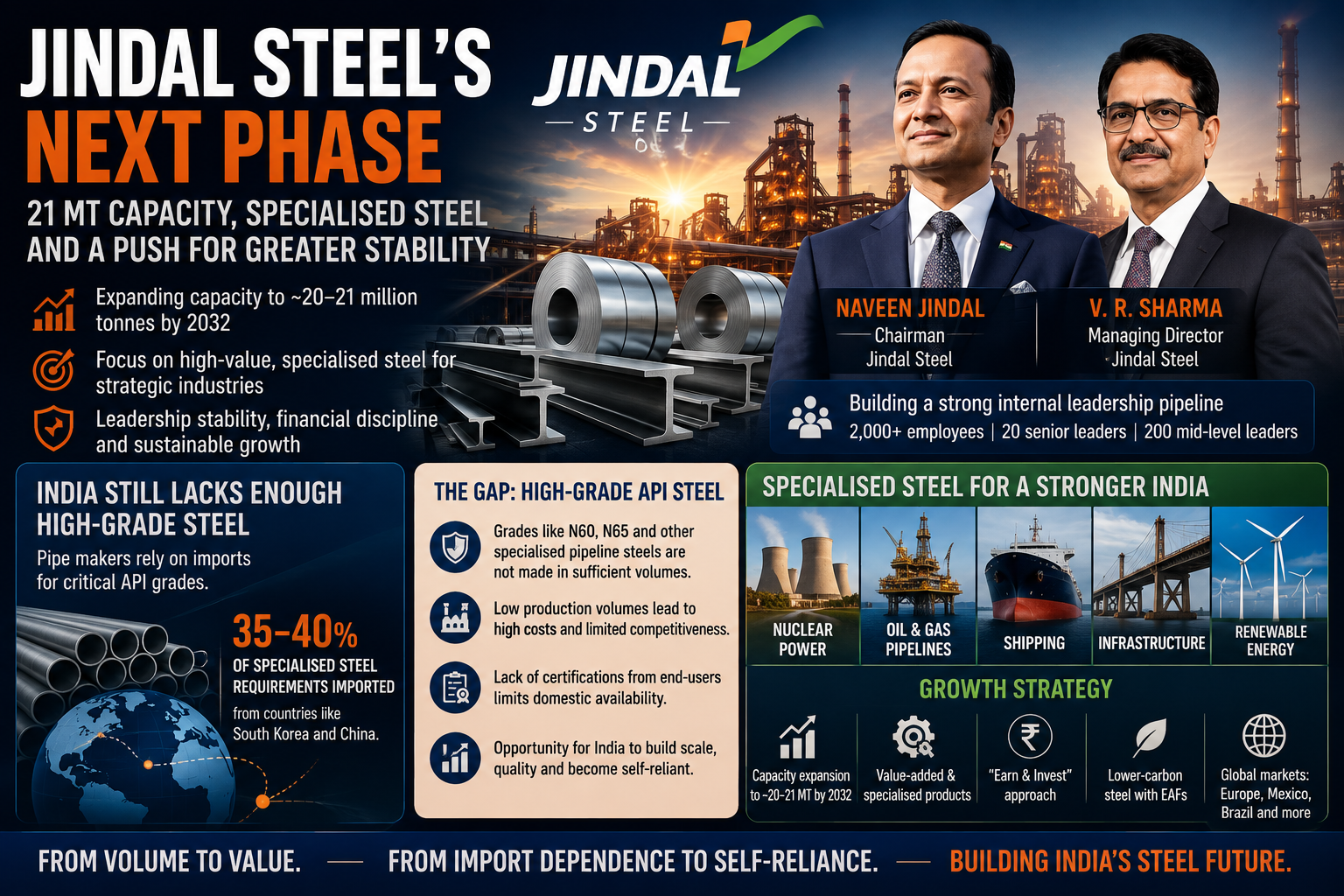
Against this backdrop, Jindal Steel is taking a measured approach to expansion. Led by Naveen Jindal and with V.R. Sharma returning as managing director, the company plans to increase its steelmaking capacity to around 20–21 million tonnes by 2032.
At the same time, a related challenge within the broader Jindal ecosystem highlights an important gap in India’s steel industry: the country still does not produce enough of the specialised, high-grade steel required for critical applications such as oil and gas pipelines.
Together, these developments point to a larger opportunity for India’s steel sector—moving beyond volume and towards technology-intensive, value-added steel production.
Jindal Steel Targets 21 Million Tonnes by 2032
Jindal Steel currently has total steelmaking capacity of around 15.6 million tonnes per annum, although approximately 12 million tonnes is currently operational.
The company intends to take this capacity to around 20–21 million tonnes by 2032.
However, the strategy is notably different from a traditional volume-led expansion.
Rather than attempting to become the largest producer purely by adding capacity, Jindal Steel wants its incremental capacity to be directed towards specialised and higher-value products.
The philosophy is straightforward:
Grow, but make sure every additional tonne creates value.
This is particularly important at a time when India’s steel industry is preparing for a major capacity expansion cycle.
The Jindal Brothers Are Building Steel Scale
The broader Jindal business story is also becoming increasingly significant for India’s steel industry.
Naveen Jindal and Sajjan Jindal together control steelmaking capacity of approximately 51 million tonnes, representing nearly one-fourth of India’s current installed steel capacity.
Their ambitions extend much further.
By 2030, the two brothers are targeting combined annual capacity of at least 100 million tonnes, potentially accounting for around one-third of India’s planned 300 million tonne steel capacity.
Sajjan Jindal-led JSW Steel has much more aggressive capacity ambitions, targeting approximately 80 million tonnes.
Jindal Steel, meanwhile, is deliberately choosing a more measured expansion path.
The company’s strategy is not to win the steel race through sheer volume.
Instead, it wants to build a business where capacity, profitability and product quality grow together.
V.R. Sharma Returns With a Focus on Stability
Leadership stability has become another important part of Jindal Steel’s strategy.
V.R. Sharma has returned as managing director after previously holding the position, and his immediate focus appears to be on establishing a more stable management structure.
Rather than relying heavily on external recruitment for senior positions, the company intends to develop its internal leadership pipeline.
Jindal Steel has identified approximately 2,000 employees between the assistant general manager and vice-president levels as its core leadership pool.
From this group, the company intends to develop around:
- 20 senior leaders for top management positions
- Around 200 leaders for middle-management roles
This approach could become increasingly important as the company expands.
A steelmaker moving from roughly 12 million tonnes of operational capacity toward 20–21 million tonnes will need a much deeper management and operational talent pool.
Specialised Steel Could Become the Real Growth Driver
The most interesting part of Jindal Steel’s expansion strategy is its emphasis on specialised grades.
The company is looking at steel for applications including:
- Nuclear power plants
- Shipping
- Advanced engineering
- Infrastructure
- Other strategic industries
The company has already been working on developing specialised grades, collaborating with IITs, research scientists and overseas professionals.
The Angul plant in Odisha is expected to play an important role in this strategy.
This could allow Jindal Steel to gradually move up the value chain.
Instead of competing primarily in commoditised steel markets where price competition is intense, specialised steel can offer higher barriers to entry and potentially better margins.
India Has a High-Grade Steel Problem
The issue becomes even clearer when looking at India’s pipe industry.
Jindal SAW, which manufactures pipes for applications including water, oil and gas, still imports a significant portion of the specialised steel required for its products.
Around 35–40% of its specialised steel requirements are sourced from countries such as South Korea and China, depending on pricing and availability.
The problem isn’t that India lacks steelmaking capacity in general.
India produces enormous quantities of steel.
The issue is that it does not yet produce enough of the specific grades and specifications required for highly demanding applications.
That distinction is crucial.
Producing ordinary structural steel and producing certified steel capable of being used in high-pressure oil and gas pipelines are two very different propositions.
The Missing Link: High-Grade API Steel
Pipeline manufacturers require specialised grades that meet demanding API specifications.
Some of these grades are either not manufactured domestically in sufficient quantities or do not yet have the necessary certifications from end users.
Grades such as N60, N65 and other specialised pipeline grades remain difficult to source domestically.
This forces companies such as Jindal SAW to look overseas.
For India, this represents both a challenge and an opportunity.
The challenge is that domestic manufacturers remain dependent on international supply chains for critical industrial inputs.
The opportunity is that steelmakers capable of successfully developing and commercialising these grades could capture a valuable and strategically important market.
Why Volume Matters
One of the biggest obstacles to domestic production is scale.
Specialised steel is generally more expensive to manufacture when production volumes are low.
If a steelmaker produces only a small quantity of a particular grade, fixed costs, research expenses and certification costs have to be spread over fewer tonnes.
That increases the final price.
This creates a difficult cycle:
Low demand → low production volumes → high cost → limited competitiveness → continued imports
Breaking this cycle will require Indian steelmakers to develop sufficient scale and consistent quality.
That is where Jindal Steel’s strategy of investing in specialised steel could become particularly relevant.
The Opportunity for Indian Steelmakers
India’s steel industry has already undergone a massive transformation in terms of scale.
The next opportunity could be quality.
Instead of importing specialised steel and exporting finished products, India could increasingly manufacture the entire value chain domestically.
This would create benefits across multiple industries.
For example:
Domestic steel production → specialised pipe manufacturing → oil & gas infrastructure → higher domestic value addition
The same concept can apply to nuclear energy, shipping, defence, heavy engineering and renewable-energy infrastructure.
India’s Steel Imports Are Also Rising
The need for specialised domestic capacity becomes more important because India has recently turned into a net importer of finished steel.
Finished steel imports rose sharply during the first quarter of FY27, while exports also increased but remained lower than imports.
This is significant for an industry that has invested heavily in expanding domestic capacity.
The issue is not necessarily a shortage of total steel.
Instead, India’s trade position increasingly highlights a mismatch between the grades being produced domestically and the grades demanded by industry.
Bridging that gap could become an important policy and investment priority.
Jindal SAW Illustrates the Problem
Jindal SAW provides an interesting example of the opportunity.
The company has manufacturing capacity of more than 3.5 million tonnes per annum across:
- SAW pipes
- Ductile iron pipes and fittings
- Carbon and alloy steel seamless pipes
- Stainless-steel seamless and welded pipes and tubes
It also operates a 1.65 million tonne per annum pelletisation facility in Rajasthan.
Yet a substantial proportion of specialised steel still has to be imported.
This demonstrates that India’s manufacturing capabilities can be advanced in one part of the value chain while remaining dependent on imports in another.
Why Importing Can Still Make Economic Sense
For Jindal SAW, importing specialised steel can sometimes be economically preferable to buying domestic material.
If the required grade is not available in sufficient volume or is significantly more expensive domestically, imports can improve competitiveness.
There can also be duty-related advantages depending on the final product and supply chain.
Therefore, the company’s import dependence isn’t simply a matter of preference.
It is largely a function of availability, price and certification.
That is why increasing domestic production of specialised grades could benefit both steelmakers and downstream manufacturers.
Oil and Gas Could Become a Major Demand Driver
The oil and gas industry represents an important potential growth market for high-grade steel.
Pipeline infrastructure requires specialised materials capable of handling demanding operating conditions.
As India expands its energy infrastructure and as global energy companies continue investing in pipelines, transportation networks and related infrastructure, demand for specialised steel products could increase.
Jindal SAW currently generates approximately 60% of its business from water-related applications and around 40% from oil and gas.
That mix could gradually change if oil and gas infrastructure spending increases in India.
West Asia Creates Both Challenges and Opportunities
The geopolitical situation in West Asia has created short-term challenges for pipe manufacturers.
Shipping disruptions and logistical uncertainty have delayed some international projects.
For companies with significant overseas exposure, this can create working-capital and project-execution challenges.
However, there is another side to the story.
If countries in West Asia accelerate investment in alternative transportation routes and rebuild or strengthen their oil and gas infrastructure, demand for pipes could increase substantially.
The disruption therefore creates a difficult near-term environment but could also generate a significant infrastructure opportunity over the longer term.
Global Pipe Demand Could Outpace Economic Growth
The outlook for the global pipe industry remains relatively constructive.
Demand from oil, gas and water infrastructure could grow faster than overall global economic growth.
This is important because pipeline demand isn’t driven solely by GDP.
It is also influenced by:
- Energy security
- Urbanisation
- Water infrastructure
- Gas transportation
- Oil production
- Infrastructure replacement
- New pipeline networks
As countries invest in infrastructure, specialised pipe manufacturers could benefit.
Jindal Steel Is Taking a Conservative Approach to Raw Materials
Another important part of Jindal Steel’s strategy involves iron ore.
The company currently sources around 70% of its raw materials from state-run Odisha Mining Corporation and NMDC, with roughly 30% coming from its own mines.
Unlike some competitors, the company is not willing to aggressively bid for captive mines if auction premiums make the economics unattractive.
This is a significant strategic choice.
Captive mines can provide raw-material security, but acquiring them at extremely high premiums can also place pressure on the balance sheet.
Jindal Steel appears willing to maintain greater flexibility and source raw materials from the open market when that makes more economic sense.
“Earn and Invest” Could Limit Balance-Sheet Risk
The company’s expansion philosophy is also relatively conservative from a financial perspective.
Rather than aggressively borrowing to fund every expansion project, the strategy is to generate earnings and use internal accruals to fund growth wherever possible.
This approach can reduce financial risk during commodity cycles.
Steel is inherently cyclical.
Prices can rise sharply during strong demand periods and decline just as quickly when supply increases.
A highly leveraged expansion programme can therefore become risky if steel prices weaken.
A more measured investment strategy could provide greater resilience.
Green Steel Provides Another Advantage
Jindal Steel also has an interesting position when it comes to lower-carbon steel production.
The company operates four electric arc furnaces—three in Raigarh and one in Angul.
These furnaces use electricity to melt recycled scrap or direct-reduced iron and can significantly reduce carbon emissions compared with traditional blast-furnace-based production.
This could become increasingly important as international markets introduce stricter carbon regulations.
The European Union’s Carbon Border Adjustment Mechanism is one such development.
For exporters, carbon intensity is increasingly becoming a competitive factor.
Jindal Steel’s electric-arc-furnace footprint could therefore provide a strategic advantage in certain export markets.
Mexico and Brazil Could Become New Export Markets
While Europe remains an important market, Jindal Steel is also looking at opportunities in Latin America.
Mexico and Brazil could offer attractive markets as infrastructure investment expands.
Diversifying export destinations can reduce dependence on any single region and potentially help the company navigate geopolitical and trade-related disruptions.
This could become increasingly important as global steel trade becomes more fragmented.
The Bigger Picture for Jindal Steel
Jindal Steel’s strategy can be summarised through four major pillars:
1. Measured capacity expansion
Increase capacity to 20–21 million tonnes by 2032 without pursuing growth at any cost.
2. Specialised steel
Use incremental capacity to produce higher-value grades for strategic industries.
3. Financial discipline
Fund expansion through internal accruals wherever possible and avoid excessive debt.
4. Leadership stability
Develop a strong internal management pipeline to support the next stage of growth.
This is a very different strategy from simply becoming India’s largest steel producer.
What This Means for India’s Steel Industry
The developments surrounding Jindal Steel and Jindal SAW highlight a larger structural opportunity for India.
The country has already built enormous steelmaking capacity.
The next challenge is to produce the right kind of steel.
India needs high-grade materials for:
- Oil and gas pipelines
- Nuclear power
- Defence
- Shipbuilding
- Renewable energy
- Advanced engineering
- High-end infrastructure
If domestic steelmakers successfully develop these grades at commercial scale, India could reduce its dependence on imports while increasing the value of its steel exports.
That would represent a much more meaningful transformation than simply increasing total steel production.
Conclusion
Jindal Steel is entering a new phase of growth under V.R. Sharma’s leadership, with a target of approximately 20–21 million tonnes of steel capacity by 2032.
But the company’s strategy is not based purely on scale.
The emphasis is increasingly on specialised steel, profitability, financial discipline and sustainable expansion.
At the same time, the challenges faced by Jindal SAW demonstrate why this strategy could be strategically important.
India has abundant steelmaking capacity, but it still lacks sufficient production of several specialised grades required for critical applications. As a result, downstream manufacturers continue to depend on imports from countries such as China and South Korea.
This gap represents a major opportunity for domestic steelmakers.
If companies like Jindal Steel can successfully commercialise high-grade specialised steel at competitive prices, India could gradually move from being merely a large steel producer to becoming a global supplier of high-value steel products.
The next decade of India’s steel story may therefore not be about who produces the most tonnes.
It could be about who produces the most valuable tonnes.
Feel free to share your experiences and insights in the comments below. Let’s continue the conversation and grow together as a community of traders and analysts.
By sharing this experience and insights, I hope to contribute to the collective knowledge of our professional community, encouraging a culture of strategic thinking and informed decision-making.
As always, thorough research and risk management are crucial. The dynamic nature of financial markets demands vigilance, agility, and a deep understanding of the tools at your disposal. Here’s to profitable trading and navigating the election season with confidence!
Ready to stay ahead of market trends and make informed investment decisions? Follow our page for more insights and updates on the latest in the financial world!
For a free online stock market training by Yogeshwar Vashishtha (M.Tech IIT) this Saturday from 11 am – 1 pm, please sign up with https://pathfinderstrainings.in/training/freetrainings.aspx
Experience profits with my winning algo strategies – get a free one-month trial with ₹15 lakh capital! – https://terminal.algofinders.com/algo-terminal
Disclaimer
This article should not be interpreted as investment advice. For any investment decisions, consult a reputable financial advisor. The author and publisher are not responsible for any losses incurred by investors or traders based on the information provided.