

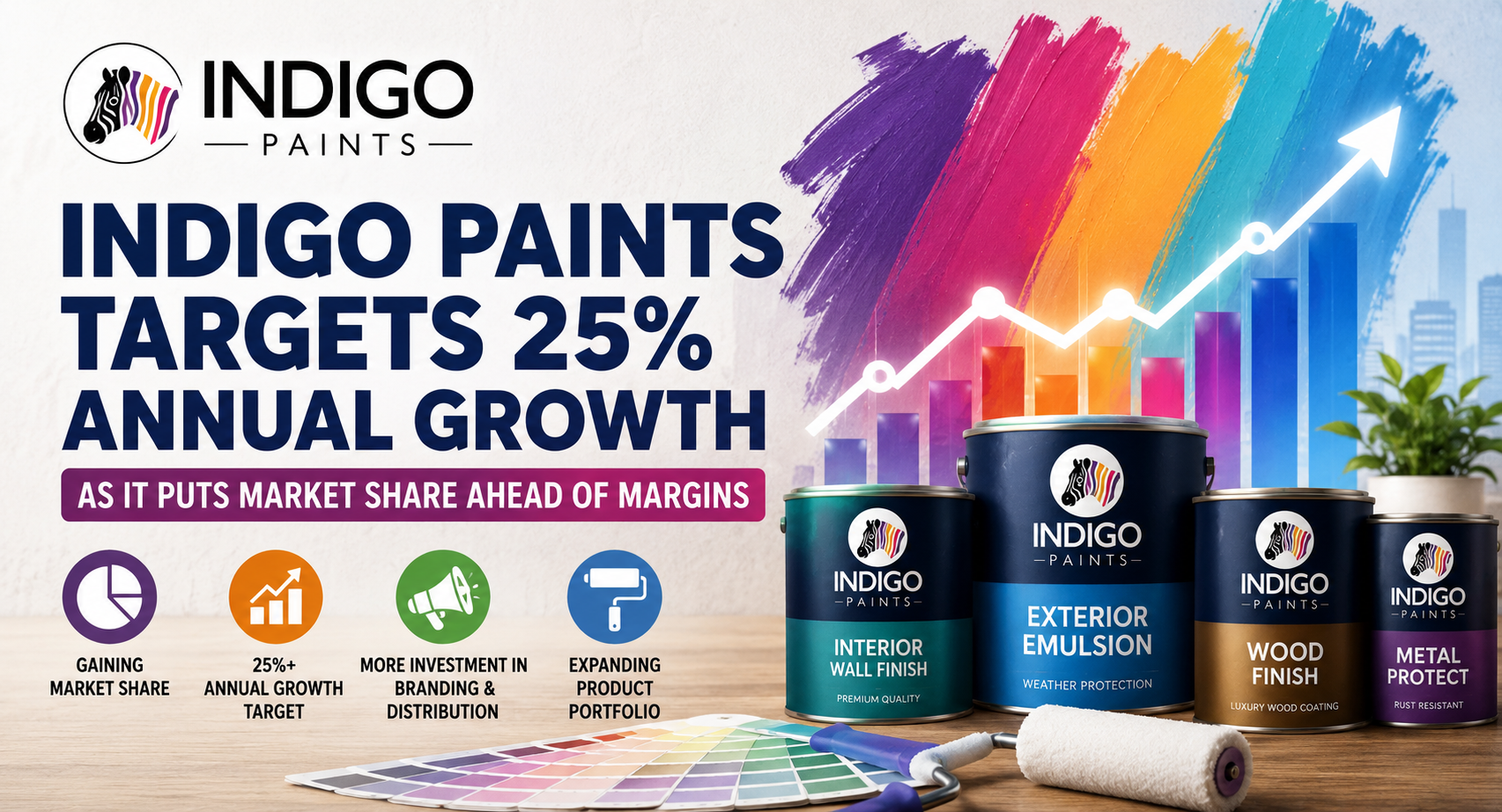
Indigo Paints is entering a new phase of aggressive expansion, with the company willing to sacrifice some near-term margin comfort in exchange for faster revenue growth and a larger share of India’s highly competitive decorative paints market.
The company’s management is targeting annual revenue growth of more than 25% if the overall paints industry grows at around 13–14%. With Indigo currently holding roughly 3% of India’s decorative paints market, the strategy is straightforward: grow substantially faster than the industry and use that outperformance to steadily capture market share.
For a company that remains significantly smaller than established leaders such as Asian Paints and Berger Paints, management believes scale is now the more important objective.
Growth Comes Before Margins
Indigo Paints’ strategy represents a deliberate shift in priorities.
Instead of attempting to maximise margins in every quarter, the company is prepared to spend more on advertising, trade promotions and influencer-led marketing to strengthen its presence among consumers and retailers.
The philosophy is particularly relevant for a relatively young brand competing against companies that have spent decades building distribution networks and brand recognition.
Indigo’s gross margin stood at 44.6% in the April-June quarter of FY27, still above the industry’s reported average of around 41.5%. This gives the company some cushion to reinvest part of its profitability into growth initiatives.
The management’s approach suggests that a modest movement in gross margins is acceptable if it results in substantially stronger revenue growth and market-share gains.
Aiming to Outgrow the Industry
The company’s ambition is not based on a specific market-share number. Instead, Indigo Paints wants to consistently grow at least 10 percentage points faster than the overall industry.
If the industry expands by 13–14%, this would translate into growth of more than 25% for Indigo.
Such an aggressive target could potentially allow the company to compound its market share over several years.
However, sustaining this differential will require continued investment in distribution, brand building and product innovation. It also means Indigo will have to compete effectively in an environment where larger players have considerably deeper pockets.
Marketing Spending Set to Rise
Indigo Paints temporarily reduced its advertising and promotional spending during the June quarter as raw-material prices remained volatile and supply conditions created uncertainty.
Advertising and promotion expenditure fell to about 4.3% of revenue from 6.8% in the corresponding period a year earlier.
The reduction, however, appears to have been tactical rather than a permanent change in strategy.
Management plans to reinvest the money saved during the quarter, with full-year advertising and promotion spending expected to exceed the previous year’s level.
This could make marketing expenditure an important driver of Indigo’s growth over the coming quarters.
The company is effectively choosing to deploy capital toward strengthening its market position rather than protecting every percentage point of short-term profitability.
Expanding Beyond Decorative Paints
Indigo Paints is also widening its product portfolio to create additional growth opportunities.
The company is strengthening its presence in wood coatings and evaluating opportunities in auto refinish products. It is also open to entering the industrial coatings segment, although management has indicated that such an entry would likely be pursued through an acquisition rather than by building the business entirely from scratch.
Waterproofing and construction chemicals represent another important growth avenue.
Indigo entered this space through its acquisition of a 51% stake in Apple Chemie India. It has now increased its holding to 62%, strengthening its position in the business.
The expansion into adjacent categories could reduce Indigo’s dependence on conventional decorative paints while giving its distribution network additional products to sell.
Differentiated Products Provide Margin Support
Despite its willingness to accept some margin pressure, Indigo Paints is not abandoning profitability.
Approximately 30% of the company’s sales come from differentiated products in categories where Indigo has created a distinct market position. These products typically command higher margins and provide support to the company’s overall profitability.
This differentiation could become increasingly important as the company spends more aggressively on market expansion.
The challenge will be to balance the cost of acquiring market share with the profitability generated by these differentiated products.
If revenue growth accelerates without a disproportionate increase in promotional costs, Indigo could potentially achieve both higher scale and improving profitability over the longer term.
Competition Remains Intense
The Indian paints industry is undergoing a major competitive transformation.
New entrants and aggressive discounting have increased pressure on established players, while raw-material prices have experienced significant fluctuations.
Birla Opus remains an important competitive factor, particularly because of its aggressive pricing strategy. Indigo’s management believes the impact of the new entrant may be stabilising, with its sales growth appearing to have plateaued.
However, the competitive environment means Indigo cannot rely solely on pricing or traditional advertising.
Distribution reach, dealer relationships, product differentiation and brand recall will all play a critical role in determining which companies can gain market share.
Scale Remains Indigo’s Biggest Challenge
One of Indigo Paints’ biggest disadvantages is its relatively smaller scale.
Asian Paints and Berger Paints have decades of brand-building experience and extensive distribution networks. Indigo, by comparison, has been around for roughly 25 years, with serious brand-building efforts accelerating only during the past decade or so.
This historical difference matters because paints are a distribution- and brand-intensive business.
A consumer may be familiar with Indigo Paints, but larger competitors continue to benefit from stronger brand equity and deeper relationships across the dealer ecosystem.
Indigo’s decision to prioritise growth can therefore be viewed as an attempt to close this scale gap.
The company needs to become large enough to achieve greater operating leverage, improve distribution economics and strengthen its bargaining position across the value chain.
Margins Could Normalise
The recent pressure on profitability also needs to be viewed in the context of raw-material volatility.
Paint manufacturers are particularly sensitive to fluctuations in crude-linked and other chemical inputs. Changes in input prices can have a meaningful impact on gross margins, especially when companies are carrying higher-cost inventory.
Management expects margins to normalise once the impact of expensive inventory works through the system.
This means investors may need to look beyond individual quarterly margin movements and instead focus on the company’s longer-term balance between revenue growth, gross margins and operating expenses.
No Immediate Equity Dilution Planned
Despite its ambitious growth plans, Indigo Paints does not currently intend to raise equity to fund its expansion.
That is significant because the company is planning to increase spending on marketing, distribution and new categories while simultaneously exploring inorganic opportunities.
Avoiding an equity raise would allow existing shareholders to retain their ownership percentage, although it also places greater emphasis on the company’s ability to fund expansion through internal resources and operating cash flows.
Future acquisitions, particularly in industrial coatings or other adjacent businesses, could nevertheless alter the capital-allocation picture.
Leadership Transition on the Horizon
Another important development is the company’s succession planning.
Managing Director Hemant Jalan, 68, has already stepped back from day-to-day operations and is focusing primarily on strategy. Indigo Paints is developing its next layer of leadership and could formally appoint a chief executive officer within the next 12–18 months.
The transition will be closely watched because Jalan has been central to Indigo’s development and strategic direction.
His continued involvement in strategy should provide some continuity, but building a strong professional management team will be important as the company moves into its next stage of expansion.
What This Means for Indigo Paints
Indigo Paints is essentially making a strategic bet on scale.
The company is willing to accept modest margin volatility today in exchange for the possibility of substantially higher revenue and market share tomorrow.
Its target of more than 25% annual revenue growth is ambitious, particularly when the broader paints industry is expected to grow in the low-to-mid teens. But if Indigo can consistently maintain a 10-percentage-point growth advantage, the impact on its competitive position could be significant.
The expansion into waterproofing, wood coatings, auto refinish and potentially industrial coatings adds further avenues for growth.
At the same time, investors will need to monitor marketing expenditure, raw-material costs, competitive pricing, cash generation and the effectiveness of the company’s distribution expansion.
Conclusion
Indigo Paints is entering an important stage of its growth journey.
Rather than protecting margins at all costs, the company is prioritising revenue growth and market-share expansion. Its objective of growing more than 25% annually, assuming industry growth of 13–14%, reflects the confidence management has in its ability to gain ground against larger competitors.
The strategy carries risks. Higher advertising and trade spending could pressure margins, aggressive competition could increase customer-acquisition costs, and raw-material volatility could complicate profitability.
But the potential reward is significant.
If Indigo can successfully combine its differentiated products, expanding distribution network, stronger marketing investments and growing presence in adjacent categories, it could emerge as a much larger player in India’s paints and coatings industry.
For Indigo Paints, the message is clear: the next phase is about building scale first and optimising margins later.
Feel free to share your experiences and insights in the comments below. Let’s continue the conversation and grow together as a community of traders and analysts.
By sharing this experience and insights, I hope to contribute to the collective knowledge of our professional community, encouraging a culture of strategic thinking and informed decision-making.
As always, thorough research and risk management are crucial. The dynamic nature of financial markets demands vigilance, agility, and a deep understanding of the tools at your disposal. Here’s to profitable trading and navigating the election season with confidence!
Ready to stay ahead of market trends and make informed investment decisions? Follow our page for more insights and updates on the latest in the financial world!
For a free online stock market training by Yogeshwar Vashishtha (M.Tech IIT) this Saturday from 11 am – 1 pm, please sign up with https://pathfinderstrainings.in/training/freetrainings.aspx
Experience profits with my winning algo strategies – get a free one-month trial with ₹15 lakh capital! – https://terminal.algofinders.com/algo-terminal
Disclaimer
This article should not be interpreted as investment advice. For any investment decisions, consult a reputable financial advisor. The author and publisher are not responsible for any losses incurred by investors or traders based on the information provided.