

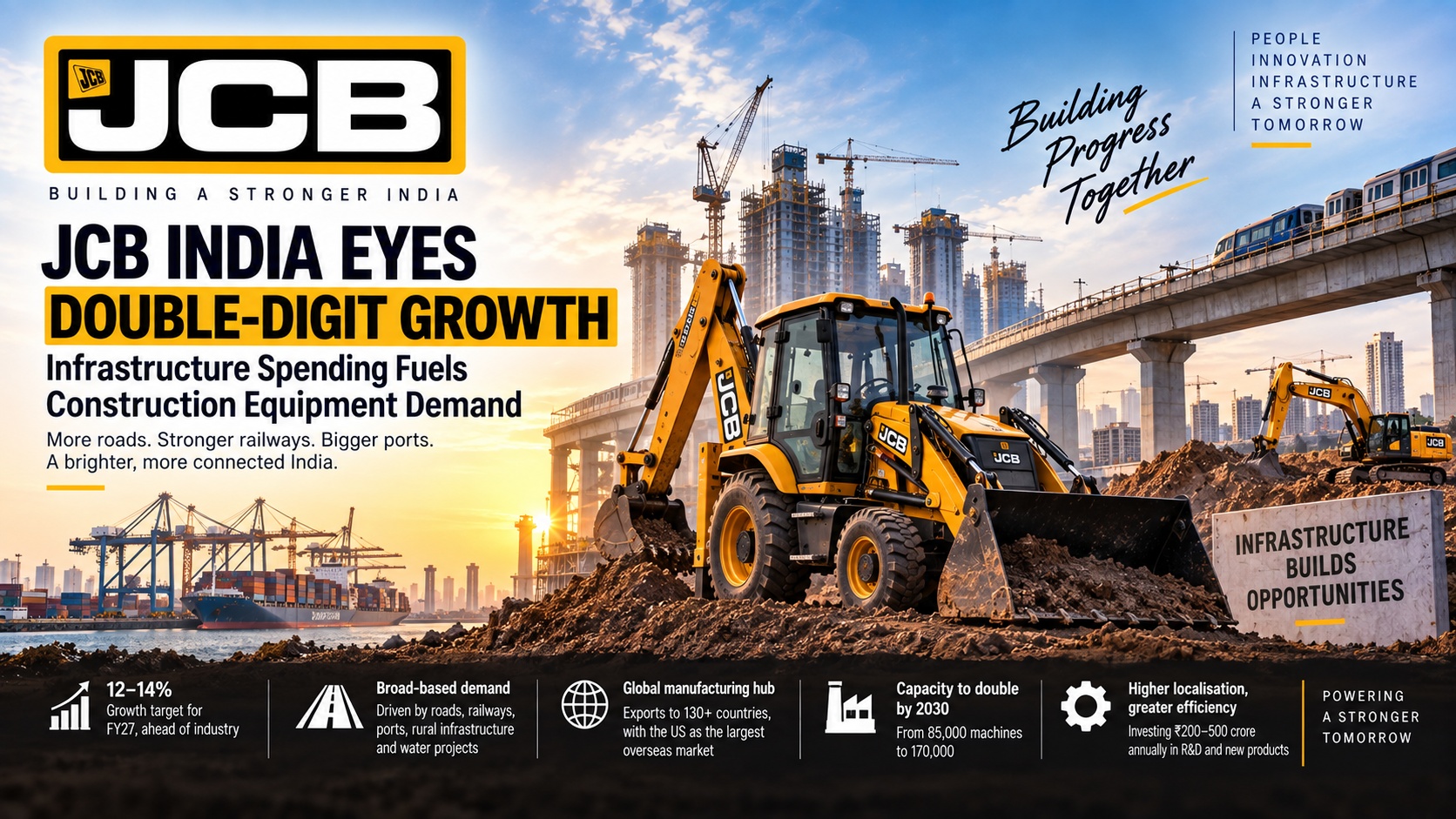
JCB India is expecting another strong year as India’s infrastructure investment continues to create demand for construction equipment across roads, railways, ports, rural connectivity and water infrastructure.
The construction-equipment manufacturer expects its business to grow around 12-14% in FY27, ahead of the broader industry’s projected growth of approximately 9-10%.
More importantly, JCB believes India’s construction-equipment demand could potentially double over the next five years as infrastructure development expands into new areas.
The company is simultaneously strengthening India as an export and manufacturing hub, increasing localisation, improving fuel efficiency and preparing to significantly expand production capacity.
JCB Targets 12-14% Growth in FY27
JCB India’s managing director and chief executive Deepak Shetty expects the company to outperform the overall construction-equipment industry during the current financial year.
While the broader market is projected to grow around 9-10%, JCB is targeting approximately 12-14% growth.
The outlook remains positive despite geopolitical uncertainty, higher logistics expenses, volatile input costs and disruption to global trade.
The primary reason is the continued strength of India’s infrastructure investment cycle.
Construction equipment is required across practically every major infrastructure category, meaning sustained government and private-sector capital expenditure can translate directly into demand for excavators, backhoe loaders, wheel loaders and other machines.
Infrastructure Growth Is Moving Beyond Roads
Road construction has traditionally been one of the biggest drivers of construction-equipment demand in India, but JCB sees the opportunity becoming considerably broader.
Railways, ports, rural infrastructure and water projects are creating additional applications for mechanised equipment.
Railways could become particularly important.
Expanding railway networks requires clearing and levelling land, preparing soil, moving materials and laying tracks. JCB is working with the railway ministry to modify existing equipment for these applications.
Rather than developing completely new machines, the company is creating attachments and modifications that could allow some equipment to operate on both conventional roads and railway tracks.
JCB is also developing equipment for railway maintenance as India’s network modernises and train speeds increase.
Ports Offer Another Growth Opportunity
India’s expanding ports and logistics infrastructure provide another source of demand.
JCB is seeing increased use of wheel loaders for material-handling operations at ports.
As cargo volumes rise and India develops additional port capacity, mechanised handling equipment should become increasingly important for improving productivity.
This diversification matters because it reduces the construction-equipment industry’s dependence on a single infrastructure segment.
Instead of relying predominantly on highway construction, manufacturers can participate in several large investment cycles simultaneously.
India Is Becoming a Global Manufacturing Base for JCB
JCB’s Indian operations are also becoming increasingly important to its global business.
The company currently supplies machines and components from India to more than 130 countries.
The United States is JCB India’s largest overseas market, while Indian facilities also supply engines, transmissions and other components to markets including the UK and Brazil.
Its Vadodara plant has been developed with a particularly strong export orientation.
This means India’s construction-equipment opportunity is developing along two parallel tracks: rising domestic infrastructure demand and increasing exports.
Manufacturing Capacity Could Double by 2030
JCB India currently has annual manufacturing capacity of approximately 85,000 machines.
The company expects that capacity to double by 2030.
Such an expansion would position India even more strongly within JCB’s worldwide manufacturing network.
Domestic infrastructure spending can support one side of this expansion, while exports provide another growth engine.
This also creates a natural hedge against fluctuations in individual markets. When domestic demand moderates, export opportunities can help utilise manufacturing capacity.
Tariffs and Chinese Competition Remain Risks
The international opportunity is not without challenges.
Tariff uncertainty remains particularly important because the United States is JCB India’s largest export market.
Higher tariffs can reduce the competitiveness of Indian-manufactured equipment and components.
Chinese manufacturers represent another major challenge.
China has developed enormous construction-equipment manufacturing capacity, allowing its companies to compete aggressively in international markets.
For Indian manufacturers to compete effectively, costs, technology, localisation and manufacturing efficiency will therefore become increasingly important.
Localisation Could Become JCB’s Competitive Weapon
JCB has already made significant progress in sourcing components domestically.
Approximately 96% of its backhoe loaders are localised.
Excavators currently have localisation levels of around 65-75%, leaving considerably more room for improvement.
Greater localisation can reduce dependence on imported components while lowering exposure to currency movements, freight costs and international supply-chain disruptions.
JCB believes a proposed production-linked incentive scheme for the construction-equipment industry could accelerate this process by encouraging global component suppliers to manufacture more products in India.
Excavators could particularly benefit because their localisation levels remain below those of backhoe loaders.
JCB Absorbs Part of the Cost Inflation
Rising input costs have already forced JCB to increase prices.
The company has implemented cumulative price increases of approximately 3-4% across different periods this year.
However, management has attempted to avoid passing the entire cost increase on to customers.
Localisation and operational efficiencies have helped absorb some of the pressure.
This is important because construction equipment is fundamentally an income-generating asset for its owner.
Customers evaluate machines based not simply on their purchase price but on whether the equipment can generate enough rental or operating income to justify its cost.
Excessive price increases could therefore affect affordability and demand.
Fuel Efficiency Becomes Increasingly Important
JCB is also using engineering improvements to lower the total cost of owning its machines.
Its latest backhoe loader provides approximately 8% additional fuel-efficiency improvement after an earlier improvement of around 14% introduced approximately 18 months ago.
Fuel represents one of the largest operating expenses for construction equipment.
Even relatively small improvements in fuel consumption can therefore generate substantial savings over thousands of operating hours.
Better efficiency can also help JCB differentiate its products when customers compare the lifetime economics of competing machines.
300,000 Connected Machines
Technology is becoming another important component of JCB’s strategy.
The company currently uses Internet of Things technology to monitor approximately 300,000 machines.
Connected equipment allows JCB to track machine health, fuel consumption and operator behaviour.
This information can help identify maintenance requirements before breakdowns occur, improve utilisation and reduce downtime.
For customers whose income depends on keeping machines operational, greater uptime can directly improve profitability.
Construction equipment is consequently evolving from primarily mechanical machinery into increasingly connected industrial assets.
₹200-500 Crore Invested Every Year
JCB continues to invest heavily in both research and manufacturing.
The company spends approximately ₹200-500 crore annually on research and development and capacity expansion.
It also introduces around 10-12 new products each year.
Those investments will become increasingly important as the company expands beyond traditional construction applications.
Railway equipment, material handling, connected technologies, fuel-efficient machines and more localised excavators all require continued engineering development.
Construction Equipment Demand Could Double
The most important element of JCB India’s outlook is the scale of the long-term opportunity.
Management believes construction-equipment demand could potentially double over the next five years.
That expectation is supported by India’s enormous infrastructure requirements.
Highways still require expansion and maintenance, but the opportunity increasingly extends to railways, ports, rural roads, water infrastructure and urban development.
At the same time, India’s manufacturing capabilities are improving sufficiently for the country to become a larger export base.
The Bigger Picture
JCB India’s expected 12-14% FY27 growth is therefore only one part of a much larger story.
The company is preparing for an environment in which India’s construction-equipment market could become substantially larger while Indian factories play a greater role in supplying JCB’s international operations.
With more than 130 export markets, annual manufacturing capacity of approximately 85,000 machines, 96% localisation in backhoe loaders and plans to potentially double capacity by 2030, JCB already has much of the foundation required for that expansion.
There are still risks from tariffs, Chinese competition and higher input costs. But localisation, fuel efficiency, connected equipment and India’s continued infrastructure spending provide powerful counterweights.
If infrastructure investment remains strong and demand approaches JCB’s expectations over the next five years, India could become important to the company not only as one of its biggest construction-equipment markets, but also as one of the most strategically important manufacturing and export hubs in its global network.
Feel free to share your experiences and insights in the comments below. Let’s continue the conversation and grow together as a community of traders and analysts.
By sharing this experience and insights, I hope to contribute to the collective knowledge of our professional community, encouraging a culture of strategic thinking and informed decision-making.
As always, thorough research and risk management are crucial. The dynamic nature of financial markets demands vigilance, agility, and a deep understanding of the tools at your disposal. Here’s to profitable trading and navigating the election season with confidence!
Ready to stay ahead of market trends and make informed investment decisions? Follow our page for more insights and updates on the latest in the financial world!
For a free online stock market training by Yogeshwar Vashishtha (M.Tech IIT) this Saturday from 11 am – 1 pm, please sign up with https://pathfinderstrainings.in/training/freetrainings.aspx
Experience profits with my winning algo strategies – get a free one-month trial with ₹15 lakh capital! – https://terminal.algofinders.com/algo-terminal
Disclaimer
This article should not be interpreted as investment advice. For any investment decisions, consult a reputable financial advisor. The author and publisher are not responsible for any losses incurred by investors or traders based on the information provided.