

HDFC Bank has long been regarded as one of India’s most consistent and dependable banking franchises. For years, investors have rewarded the lender with premium valuations, driven by its strong asset quality, disciplined lending practices, and industry-leading profitability. However, the bank’s latest quarterly earnings served as a reminder that even market favorites are not immune to investor disappointment.
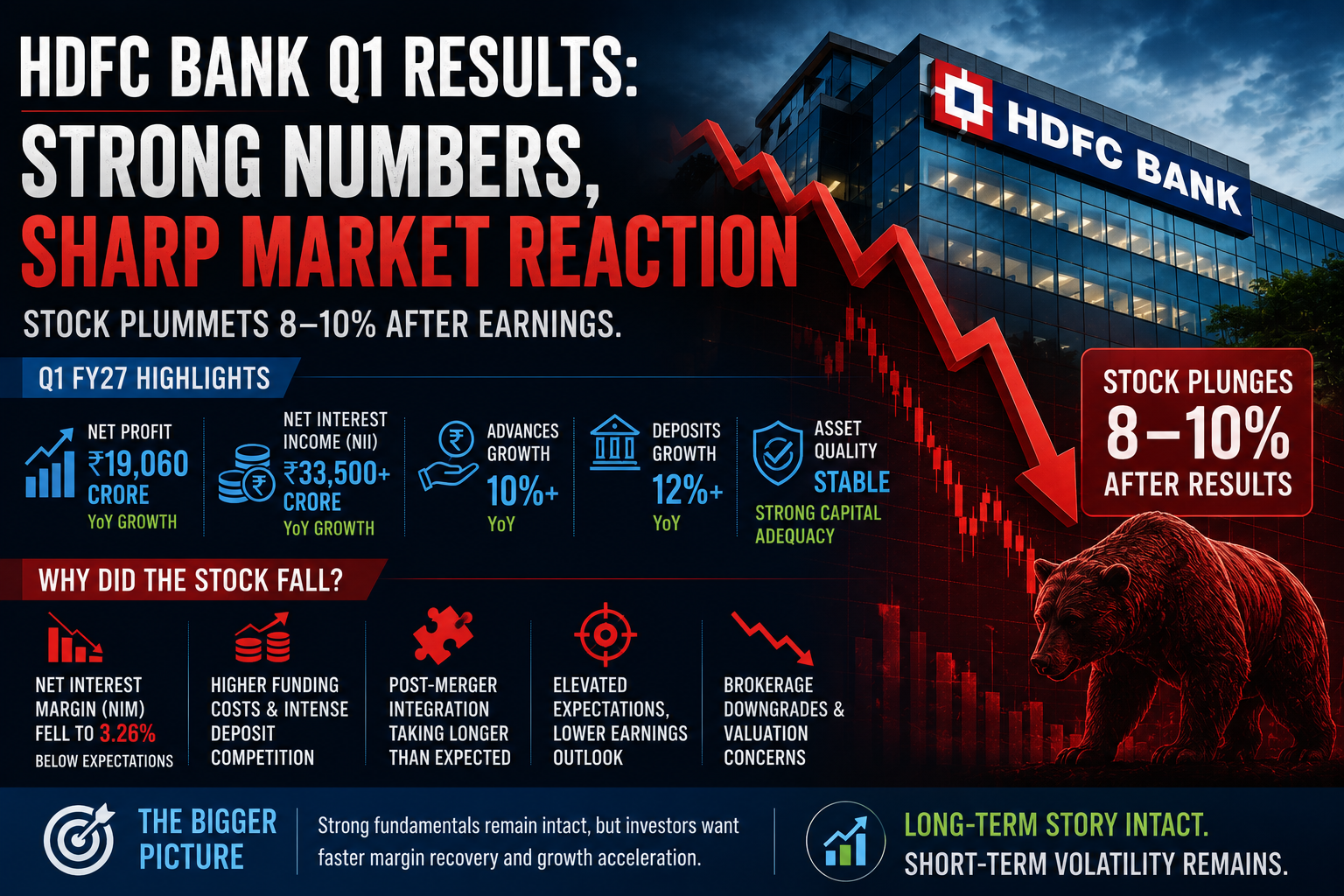
Following the announcement of its Q1 FY27 results, HDFC Bank witnessed a sharp correction in its share price, with the stock plunging nearly 8–10% in a single trading session. The decline erased billions in market capitalization and sparked debate across Dalal Street regarding the bank’s near-term growth prospects.
While the quarterly numbers remained healthy by industry standards, the market’s reaction underscored an important reality: expectations for HDFC Bank are exceptionally high.
Earnings That Failed to Impress
At first glance, HDFC Bank’s quarterly performance appeared respectable. The bank continued to report profitability, maintained healthy capital ratios, and demonstrated resilience across key operating metrics.
However, investors were particularly concerned about several factors:
- Moderation in net interest margins.
- Slower loan growth compared to historical trends.
- Pressure on deposit mobilization.
- Softness in treasury income.
- Elevated expectations following the merger integration.
- Concerns surrounding future earnings momentum.
Markets typically reward companies that exceed expectations rather than simply delivering good numbers. In HDFC Bank’s case, investors were looking for stronger signs of accelerated growth following the merger with Housing Development Finance Corporation.
Instead, the results suggested that the integration process continues to influence profitability and operational metrics.
The Weight of Expectations
HDFC Bank’s biggest strength has also become its biggest challenge—consistency.
Investors have become accustomed to:
- Double-digit earnings growth.
- Superior return ratios.
- Stable asset quality.
- Strong deposit franchise.
- Premium valuations.
- Market leadership.
Consequently, even a minor deviation from expectations can trigger significant market reactions.
Unlike many companies that receive credit for incremental improvements, HDFC Bank is judged against its own exceptionally high standards. When growth slows or margins compress, markets tend to respond swiftly.
The recent decline reflects less about a crisis within the bank and more about the market recalibrating its expectations.
Margin Pressure Remains a Concern
One of the key themes emerging from the quarterly results was pressure on net interest margins (NIMs).
Banks generate a significant portion of their earnings from the difference between lending rates and deposit costs. Over the past several quarters, competition for deposits has intensified across the banking industry, forcing lenders to offer higher interest rates to attract and retain customers.
As a result:
- Funding costs have increased.
- Margin expansion has become difficult.
- Profitability growth has moderated.
- Competition among banks has intensified.
For HDFC Bank, maintaining healthy margins remains critical given its size and valuation premium.
Investors are increasingly focused on whether the bank can return to its historical levels of profitability over the next few quarters.
Loan Growth Under the Spotlight
Another major concern was loan growth.
Historically, HDFC Bank has consistently delivered industry-leading growth rates. However, the bank has adopted a relatively cautious approach following the merger, prioritizing balance sheet optimization and deposit growth.
While management has repeatedly emphasized long-term sustainability, markets often prefer visible growth catalysts in the short term.
Investors are asking important questions:
- When will loan growth accelerate?
- Can the bank regain its historical momentum?
- How quickly will merger-related synergies materialize?
- Will profitability improve over the next financial year?
These uncertainties contributed significantly to the sharp decline in the stock price.
Merger Integration Continues
The merger between HDFC Ltd. and HDFC Bank was one of the largest transactions in India’s financial sector.
While the combination created a banking giant with an unmatched scale, integration of businesses of this size inevitably takes time.
Key challenges include:
- Aligning balance sheet structures.
- Optimizing funding costs.
- Managing regulatory requirements.
- Improving deposit-to-loan ratios.
- Realizing operational synergies.
Management has consistently maintained that the merger benefits will become more visible over the medium term. However, equity markets tend to be impatient, particularly when premium valuations are involved.
The latest earnings suggest that investors may need to wait longer before the full benefits of the merger become evident.
Why the Stock Fell So Sharply
The nearly 8–10% correction was driven by a combination of factors rather than a single negative development.
The selloff appears to reflect:
- Lower-than-expected earnings momentum.
- Margin concerns.
- Slower growth expectations.
- Valuation adjustments.
- Profit booking by institutional investors.
- Short-term uncertainty regarding merger synergies.
Importantly, there has been no indication of any fundamental deterioration in the bank’s asset quality or capital position.
The market reaction highlights the difference between a company performing poorly and a company failing to exceed expectations.
Is This a Buying Opportunity?
Long-term investors are likely to view the correction differently from short-term traders.
Several factors continue to support HDFC Bank’s investment case:
- Strong brand equity.
- Industry-leading deposit franchise.
- Healthy balance sheet.
- Robust risk management practices.
- Significant cross-selling opportunities.
- Potential merger-related synergies.
Historically, periods of temporary weakness in high-quality businesses have often attracted long-term investors seeking attractive entry points.
That said, markets may continue to remain volatile until there is greater visibility on margin recovery and loan growth acceleration.
What Investors Should Watch
Going forward, investors will closely monitor several metrics:
- Net interest margin trends.
- Deposit growth.
- Loan growth acceleration.
- Return on assets.
- Cost efficiencies post-merger.
- Management commentary on future guidance.
The next few quarters could prove crucial in determining whether HDFC Bank returns to its historical growth trajectory.
The Bigger Picture
Despite the sharp decline, HDFC Bank remains one of India’s strongest financial institutions.
The bank continues to benefit from:
- A massive customer base.
- Extensive distribution network.
- Strong corporate relationships.
- Technology leadership.
- Consistent governance standards.
- Long-term growth opportunities within India’s banking sector.
India’s financial services industry is expected to grow significantly over the coming decade, driven by rising incomes, increasing financial inclusion, and expanding credit demand.
As the country’s largest private sector lender, HDFC Bank remains well-positioned to capitalize on these opportunities.
Conclusion
HDFC Bank’s Q1 earnings may have disappointed investors, but they do not fundamentally alter the bank’s long-term story. The nearly 8–10% decline in the stock price reflects elevated market expectations, concerns regarding margins, and questions surrounding the pace of post-merger growth.
While the short-term outlook may remain challenging, the bank’s underlying strengths continue to remain intact. For investors, the coming quarters will be less about whether HDFC Bank can survive and more about how quickly it can return to the levels of growth and profitability that made it India’s most admired private lender.
In the stock market, expectations often matter as much as performance. HDFC Bank’s latest results serve as a powerful reminder that even the strongest companies can face sharp corrections when they fail to keep pace with investor expectations.
Feel free to share your experiences and insights in the comments below. Let’s continue the conversation and grow together as a community of traders and analysts.
By sharing this experience and insights, I hope to contribute to the collective knowledge of our professional community, encouraging a culture of strategic thinking and informed decision-making.
As always, thorough research and risk management are crucial. The dynamic nature of financial markets demands vigilance, agility, and a deep understanding of the tools at your disposal. Here’s to profitable trading and navigating the election season with confidence!
Ready to stay ahead of market trends and make informed investment decisions? Follow our page for more insights and updates on the latest in the financial world!
For a free online stock market training by Yogeshwar Vashishtha (M.Tech IIT) this Saturday from 11 am – 1 pm, please sign up with https://pathfinderstrainings.in/training/freetrainings.aspx
Experience profits with my winning algo strategies – get a free one-month trial with ₹15 lakh capital! – https://terminal.algofinders.com/algo-terminal
Disclaimer
This article should not be interpreted as investment advice. For any investment decisions, consult a reputable financial advisor. The author and publisher are not responsible for any losses incurred by investors or traders based on the information provided.