

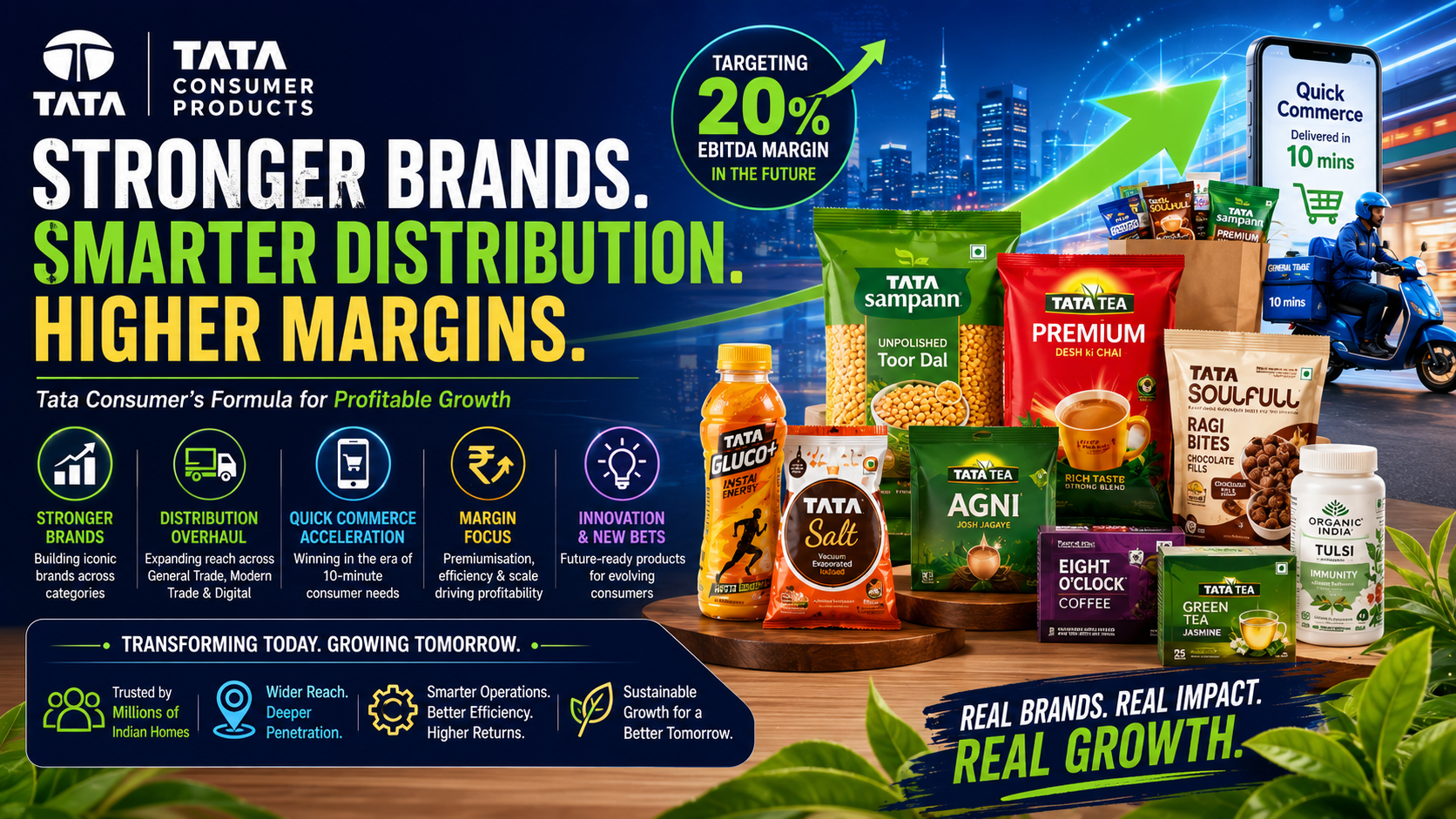
India’s fast-moving consumer goods (FMCG) industry is undergoing a major transformation. Consumer habits are changing, digital commerce is expanding rapidly, and traditional distribution models are being challenged by new-age retail channels such as quick commerce.
For Tata Consumer Products, the company behind iconic brands like Tata Tea and Tata Salt, the next phase of growth is not only about increasing sales but also improving profitability.
The company is focusing on a combination of distribution expansion, premium product growth, operational efficiency, and digital-first channels to improve its margins and strengthen its position in India’s highly competitive FMCG market. Tata Consumer has outlined a long-term ambition to significantly improve EBITDA margins through better product mix, scale benefits, innovation, and growth of newer businesses.
From Traditional FMCG Player to Consumer Products Powerhouse
Tata Consumer has evolved significantly over the years.
Historically known primarily for tea and salt, the company has been expanding into a broader consumer products company with categories including:
- Packaged foods
- Pulses and staples
- Beverages
- Wellness products
- Ready-to-eat offerings
- Premium consumer brands
The company’s strategy has been focused on building a diversified portfolio where growth is driven not only by established brands but also by emerging categories with higher growth potential.
Brands and businesses such as Tata Sampann, Tata Soulfull, Capital Foods, and Organic India represent the company’s ambition to become a larger player across multiple consumer categories. These newer businesses are expected to contribute meaningfully as they scale.
The Margin Expansion Challenge
In FMCG, revenue growth alone is not enough. Investors closely track profitability because input costs, distribution expenses, and competitive pricing can significantly impact margins.
Tata Consumer’s focus is shifting toward improving EBITDA margins through:
- Higher-margin product categories
- Premiumisation
- Better supply chain efficiency
- Stronger distribution network
- Increased contribution from newer businesses
The company has indicated a roadmap to gradually improve margins, with an aspiration to move toward higher profitability levels as its portfolio becomes more diversified.
This represents a major strategic shift. Instead of relying heavily on price increases, the company is focusing on volume growth and operational improvements.
Distribution: The Biggest Battleground in FMCG
In India’s FMCG industry, distribution remains one of the strongest competitive advantages.
A strong distribution network determines how quickly products reach consumers, how much shelf space brands receive, and how effectively companies can enter new markets.
Tata Consumer has been strengthening its presence across:
- General trade stores
- Modern retail
- E-commerce platforms
- Quick commerce channels
The company is attempting to build a wider consumer reach while improving efficiency across its supply chain.
The traditional kirana ecosystem remains extremely important in India, but digital channels are changing how brands reach consumers.
Quick Commerce Changes the FMCG Playbook
The rise of quick commerce has become one of the biggest disruptions in consumer goods.
Platforms offering rapid delivery have changed consumer expectations. Customers increasingly purchase daily essentials, snacks, beverages, and household products through digital platforms instead of traditional shopping trips.
For FMCG companies, quick commerce creates both opportunities and challenges.
Opportunities:
- Faster access to consumers
- Better visibility of premium products
- Digital consumer insights
- New product discovery
Challenges:
- Higher promotional spending
- Pressure on pricing
- Need for faster inventory movement
- Changing distribution economics
Tata Consumer has been increasing its focus on quick commerce as a growth channel, recognizing that future FMCG growth will increasingly come from a combination of physical and digital retail networks.
Innovation Becomes a Growth Engine
Innovation is becoming increasingly important as FMCG companies compete for consumer attention.
Consumers are looking for:
- Healthier alternatives
- Convenient food solutions
- Premium beverages
- Regional flavours
- Functional products
Tata Consumer has been increasing its focus on innovation to create new growth opportunities. New product launches and category expansion are expected to help improve the company’s product mix and profitability over time.
The company is also leveraging technology and data to improve demand forecasting, product development, and supply chain management.
Acquisitions as a Strategic Growth Tool
Tata Consumer has used acquisitions to accelerate its expansion beyond traditional categories.
The company’s approach has been to acquire businesses with strong consumer potential and integrate them into its larger ecosystem.
This strategy allows Tata Consumer to enter new categories faster rather than building every segment organically.
However, acquisitions also require successful integration. The company must ensure that new businesses achieve scale while maintaining profitability.
Competing in a Crowded FMCG Market
India’s FMCG sector remains highly competitive.
Tata Consumer competes with established multinational and domestic companies across beverages, food, and household categories.
The competitive environment is becoming even more intense as new players enter with aggressive pricing, private labels expand, and retail platforms gain more influence.
The companies that succeed will likely be those that combine:
- Strong brands
- Efficient distribution
- Product innovation
- Digital capabilities
- Cost discipline
The Road Ahead: Building a Higher-Margin FMCG Business
Tata Consumer’s transformation is focused on moving beyond being a traditional staples company and becoming a diversified consumer products leader.
The company’s growth strategy is built around three major pillars:
Scale
Expanding distribution and increasing consumer reach.
Premiumisation
Moving toward categories with stronger margins and higher consumer value.
Digital Transformation
Using technology and new retail channels to adapt to changing shopping behaviour.
The challenge will be maintaining growth while improving profitability in a market where competition remains intense.
Conclusion: Tata Consumer’s Next Phase of Growth
Tata Consumer’s journey reflects the broader evolution of India’s FMCG industry.
The future of consumer businesses will not be defined only by iconic brands but by the ability to adapt to changing consumer behaviour, build efficient distribution networks, and use technology to improve decision-making.
With a stronger focus on margins, innovation, acquisitions, and quick commerce, Tata Consumer is attempting to create a more profitable and diversified FMCG business.
The company’s next growth phase will depend on whether it can successfully convert its scale and brand strength into sustainable margin expansion.
Feel free to share your experiences and insights in the comments below. Let’s continue the conversation and grow together as a community of traders and analysts.
By sharing this experience and insights, I hope to contribute to the collective knowledge of our professional community, encouraging a culture of strategic thinking and informed decision-making.
As always, thorough research and risk management are crucial. The dynamic nature of financial markets demands vigilance, agility, and a deep understanding of the tools at your disposal. Here’s to profitable trading and navigating the election season with confidence!
Ready to stay ahead of market trends and make informed investment decisions? Follow our page for more insights and updates on the latest in the financial world!
For a free online stock market training by Yogeshwar Vashishtha (M.Tech IIT) this Saturday from 11 am – 1 pm, please sign up with https://pathfinderstrainings.in/training/freetrainings.aspx
Experience profits with my winning algo strategies – get a free one-month trial with ₹15 lakh capital! – https://terminal.algofinders.com/algo-terminal
Disclaimer
This article should not be interpreted as investment advice. For any investment decisions, consult a reputable financial advisor. The author and publisher are not responsible for any losses incurred by investors or traders based on the information provided.