

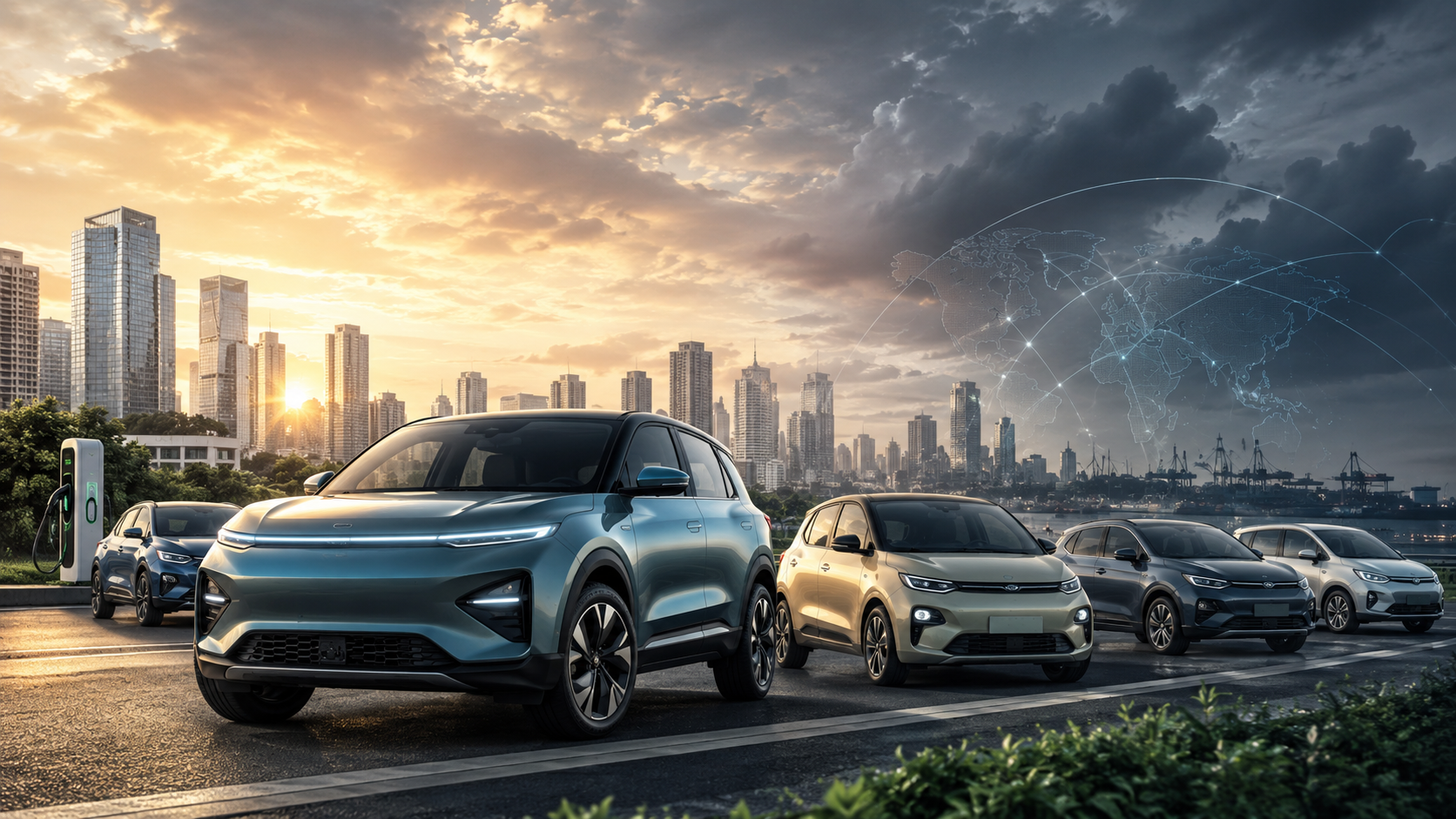
Tata Motors Passenger Vehicles, now trading under the TMPV identity, has entered FY27 with a story that is both promising and complicated. On one side, the India passenger vehicle business is showing visible strength, supported by SUVs, electric vehicles, CNG models, and record domestic volumes. On the other, the consolidated picture remains weighed down by Jaguar Land Rover, where global demand, tariffs, costs, and operational disruptions continue to shape profitability.
A Strong Finish to a Challenging Year
TMPV ended Q4 FY26 with consolidated revenue of about ₹105.4K crore, up 7.2% year-on-year. The quarter also delivered free cash flow of ₹11.4K crore, helped by normalized JLR production and record domestic volumes. However, profitability did not move in the same direction: profit attributable to shareholders fell 31.7% year-on-year to ₹5,783 crore, showing that revenue momentum alone was not enough to absorb cost and global business pressures.
For the full year FY26, consolidated revenue stood at ₹335.6K crore, down 8.3% year-on-year, while EBITDA and EBIT margins came in at 6.8% and 1.1%, respectively. This contrast between a strong March-quarter recovery and a weaker full-year base makes TMPV’s current position especially interesting: the company is not starting FY27 from a place of weakness, but it is clearly carrying the burden of a demanding global cycle.
India PV Becomes the Bright Spot
The clearest positive signal for TMPV is its domestic passenger vehicle performance. The company’s India PV business has benefited from strong SUV demand, better EV traction, and expanding CNG penetration. In Q4 FY26, domestic volumes reportedly reached a record 201.8K units, growing more than 37% year-on-year.
This momentum was visible earlier in the year as well. In February 2026, TMPV reported total sales of 63,331 units, compared with 46,811 units in February 2025, a 35% year-on-year increase. EV sales, including domestic and international business, rose 57% to 8,385 units during the month.
The numbers point to a wider shift in the company’s positioning. TMPV is no longer only a traditional passenger vehicle manufacturer competing on safety and value. It is increasingly becoming a multi-powertrain player, with petrol, diesel, CNG, and electric vehicles all contributing to its growth engine.
EVs Remain Central to the TMPV Identity
Tata’s EV business continues to play a defining role in TMPV’s market image. In FY26, annual EV sales reportedly crossed 92,000 units, while Tata Motors retained leadership in India’s electric passenger vehicle segment with a 40.2% Vahan market share. EV penetration in the company’s portfolio stood at 14%, while CNG models contributed 27% of total sales volumes.
This balance is important. EVs give TMPV a future-ready brand advantage, but CNG gives it a practical bridge for cost-conscious buyers who want lower running costs without depending on charging infrastructure. In a market like India, where affordability, range anxiety, and charging access still matter, this dual focus gives TMPV more room to grow than a pure EV-only strategy.
The SUV and Small-Car Equation
TMPV’s SUV portfolio has become one of its biggest strengths, but the company is also keeping an eye on the entry-level market. Reports suggest that TMPV is expected to launch the Tata Tiago facelift in India on May 28, 2026, a move that would refresh its presence in the compact hatchback segment.
This matters because India’s passenger vehicle market is not growing in only one direction. Utility vehicles are expected to remain dominant, but affordability-driven small cars could also see renewed interest, especially after tax and pricing changes. Industry projections suggest India’s passenger vehicle sales may approach 5.9 million units in FY27, supported by utility vehicle demand and improved affordability in smaller segments.
For TMPV, the opportunity lies in serving both ends of the market: aspirational SUV buyers on one side and budget-conscious urban buyers on the other.
JLR: The Elephant in the Room
Despite the domestic business momentum, TMPV’s consolidated performance remains deeply influenced by JLR. The luxury vehicle subsidiary adds scale, global reach, and premium positioning, but it also brings exposure to overseas demand cycles, tariffs, product transitions, and operational disruptions.
Recent coverage highlights that while India PV has been scaling steadily, JLR continues to be the bigger swing factor for consolidated profitability. Q4 FY26 revenue improved, but profit declined because JLR-related headwinds offset much of the domestic strength.
This creates a two-speed story. In India, TMPV looks energetic and well-positioned. Globally, it still has to prove that JLR can stabilize margins and deliver consistent cash generation in a tougher environment.
Dividend Signals and Investor Sentiment
The board recommended a final dividend of ₹3 per share for FY26, even as consolidated profit fell year-on-year.
Investor reaction has been mixed. Some reports noted optimism around domestic momentum, SUV demand, and EV leadership, while others pointed to caution around JLR and margin pressure. This divide is understandable. TMPV offers a strong India growth story, but investors cannot ignore the global earnings volatility embedded in the consolidated structure.
What Lies Ahead for TMPV
The next phase for TMPV will depend on three things: whether India PV volumes remain strong, whether EV adoption continues to scale profitably, and whether JLR can reduce its drag on consolidated margins.
The domestic business has several advantages: a well-known brand, a wide product portfolio, a strong EV lead, and growing acceptance in SUVs and CNG vehicles. The company is also entering FY27 with a market that may benefit from stronger PV demand and improving affordability. But the challenge will be converting volume strength into durable profitability.
Conclusion: A Promising Story, But Not a Simple One
TMPV’s current position is best described as a recovery-and-reinvention story. The India passenger vehicle business is showing the kind of growth that can build confidence, especially with SUVs, EVs, and CNG vehicles forming a balanced portfolio. Yet the consolidated numbers remind investors and industry watchers that the road ahead is not free of pressure.
TMPV has the ingredients of a long-term mobility leader: scale, brand trust, electric ambition, and a widening product mix. But for the story to become stronger, the company will need more than sales momentum. It will need consistent margins, healthier global performance, and steady execution across both India PV and JLR.
For now, TMPV stands at an interesting crossroads: domestically confident, globally tested, and strategically positioned for one of the most important phases in India’s passenger vehicle market.
Feel free to share your experiences and insights in the comments below. Let’s continue the conversation and grow together as a community of traders and analysts.
By sharing this experience and insights, I hope to contribute to the collective knowledge of our professional community, encouraging a culture of strategic thinking and informed decision-making.
As always, thorough research and risk management are crucial. The dynamic nature of financial markets demands vigilance, agility, and a deep understanding of the tools at your disposal. Here’s to profitable trading and navigating the election season with confidence!
Ready to stay ahead of market trends and make informed investment decisions? Follow our page for more insights and updates on the latest in the financial world!
For a free online stock market training by Yogeshwar Vashishtha (M.Tech IIT) this Saturday from 11 am – 1 pm, please sign up with https://pathfinderstrainings.in/training/freetrainings.aspx
Experience profits with my winning algo strategies – get a free one-month trial with ₹15 lakh capital! – https://terminal.algofinders.com/algo-terminal
Disclaimer
This article should not be interpreted as investment advice. For any investment decisions, consult a reputable financial advisor. The author and publisher are not responsible for any losses incurred by investors or traders based on the information provided.