

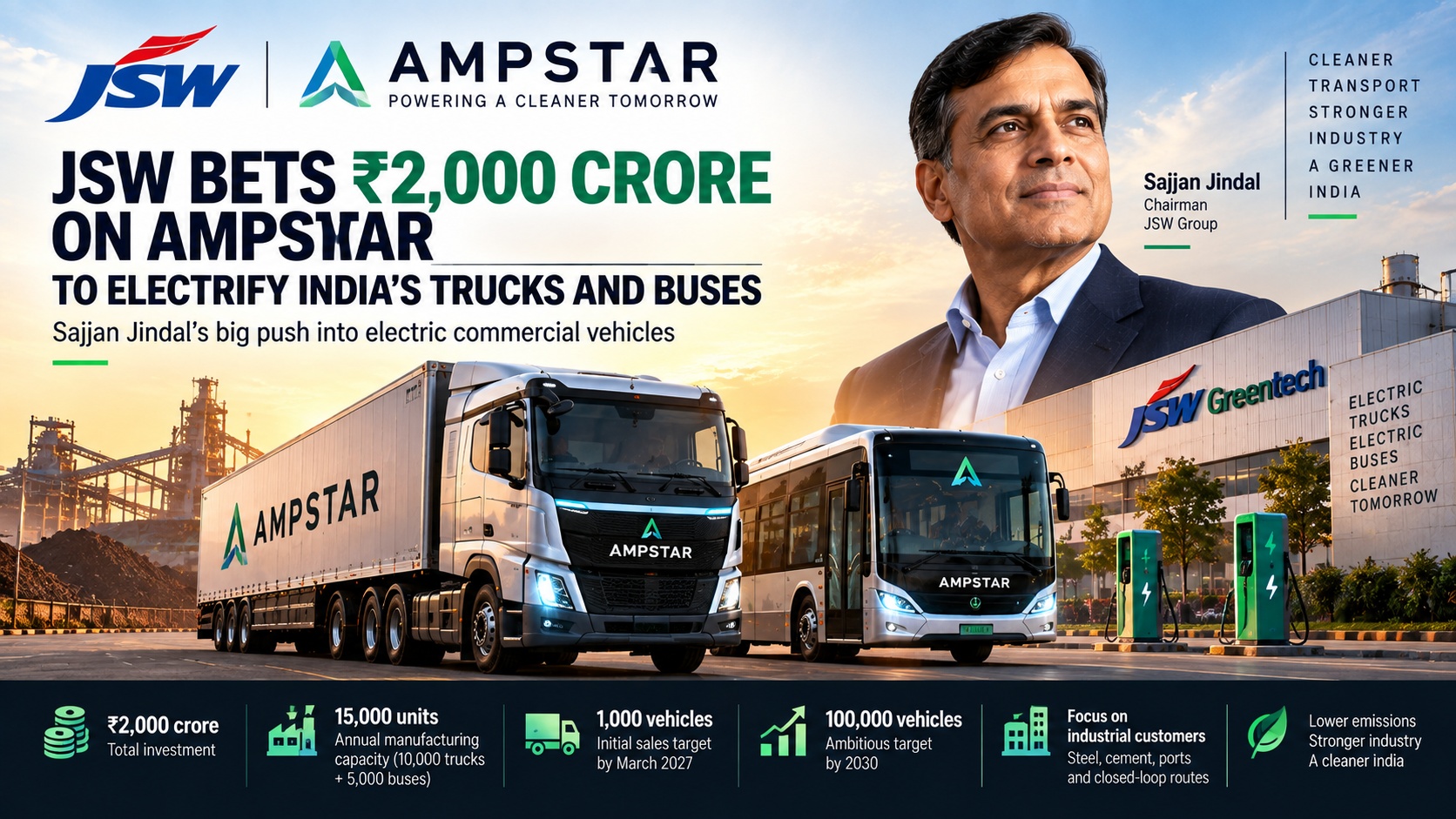
JSW Group is making an ambitious push into India’s electric commercial vehicle market, with chairman Sajjan Jindal betting ₹2,000 crore on a new business that could eventually challenge established truck and bus manufacturers.
Through JSW Greentech, the conglomerate has launched Ampstar, its dedicated brand for electric trucks and buses. The company plans to initially target large industrial customers where vehicles operate on predictable routes—particularly steel plants, cement factories and ports.
The strategy addresses one of the biggest obstacles facing electric trucks: their significantly higher purchase price.
Instead of trying to electrify long-haul trucking immediately, JSW wants to begin where electric vehicles already make the most economic sense.
₹2,000 Crore Bet on Electric Commercial Vehicles
JSW Greentech’s electric commercial vehicle project involves an overall investment of approximately ₹2,000 crore.
Around ₹1,500 crore has been financed through borrowings, while the remaining ₹500 crore has been provided as equity by the JSW Group.
The company has established a 90-acre manufacturing facility at Aurangabad Industrial City in Maharashtra.
The plant can manufacture around 10,000 trucks and 5,000 buses annually, giving Ampstar total annual production capacity of approximately 15,000 vehicles.
JSW initially plans to sell as many as 1,000 vehicles by March 2027, but Sajjan Jindal has set a much more ambitious long-term target: 100,000 vehicles by 2030.
Industrial Customers Could Make Electric Trucks Work
JSW’s approach differs from simply launching electric replacements for conventional diesel trucks.
Electric heavy commercial vehicles can cost more than twice as much upfront as their diesel equivalents. That makes convincing conventional fleet operators difficult, particularly when vehicles travel unpredictable routes where charging infrastructure may not be readily available.
Industrial operations offer a solution.
Trucks transporting raw materials between mines, ports, warehouses, steel plants and cement factories frequently operate on fixed routes.
Their daily distances are predictable and they repeatedly return to the same facilities.
Charging stations can therefore be installed at known locations, eliminating much of the range uncertainty associated with long-distance electric trucking.
Lower electricity and maintenance costs can then gradually compensate for the higher initial purchase price.
JSW Already Has a Ready-Made Testing Ground
Few companies are better positioned to test this model than JSW itself.
The group’s steel, cement, paints and energy businesses collectively use around 17,000 trucks.
Nearly half operate on closed-loop routes of less than 500 kilometres.
That creates an enormous captive environment in which Ampstar vehicles can be deployed, tested and improved before JSW attempts to scale aggressively among external customers.
It also provides something valuable for future buyers: operating data.
If JSW can demonstrate that electric trucks reduce total logistics costs within its own steel and cement operations, convincing other industrial companies becomes considerably easier.
UltraTech and Adani Ports Show Interest
According to Sajjan Jindal, large companies are already showing considerable interest in electric trucks.
He specifically pointed to UltraTech Cement and Adani Ports as examples of corporations seeking additional vehicles.
The interest makes sense.
Cement plants, steel facilities and ports operate enormous logistics networks where thousands of tonnes of material are moved every day.
Even relatively small reductions in fuel expenditure per truck can become meaningful when multiplied across hundreds or thousands of vehicles.
Ports are particularly suitable because trucks often travel predictable distances and have periods of downtime during which they can recharge.
Ampstar Starts With a 55-Tonne Electric Truck
Ampstar’s first heavy truck will be a 55-tonne electric tractor-trailer.
The company subsequently plans to introduce tippers, fixed-body trucks and dumpers.
Its electric bus portfolio will cover vehicles ranging from approximately 7 metres to 18 metres, targeting applications including city transportation, intercity routes, employee transport and school buses.
The vehicles will offer power outputs ranging from around 150 kW to 500 kW.
JSW is also developing supporting technologies including proprietary electric driveline software, control algorithms and battery thermal-management systems.
This is important because JSW wants Ampstar to be more than an assembly operation.
JSW Owns the Technology
One of the most significant aspects of Ampstar is that the commercial vehicle business does not have a foreign technology partner.
JSW Greentech says it owns the technology used in its vehicles and therefore does not need to pay royalties or technology-transfer fees to another manufacturer.
That distinguishes Ampstar from some of JSW Group’s other automotive ventures.
JSW already operates a passenger-vehicle joint venture with China’s SAIC Motor through JSW MG Motor India and is separately exploring other automotive partnerships.
Ampstar, however, is intended to be a JSW-controlled commercial vehicle business built around internally owned technology.
That could become an important advantage if production volumes eventually reach the scale envisioned by Jindal.
Flexible Financing Could Help Overcome the Price Problem
The higher upfront price of electric trucks remains perhaps the biggest obstacle to widespread adoption.
JSW is therefore not relying solely on traditional vehicle purchases.
Ampstar intends to offer different ownership models including outright purchases, leasing and Battery-as-a-Service.
Leasing can be particularly attractive for commercial operators because the economic decision becomes less about the vehicle’s sticker price and more about its monthly operating cost.
If electricity, maintenance and financing costs collectively produce lower expenses than running a diesel truck, fleet operators have a stronger incentive to switch.
Several major banks have also approved Ampstar products for financing, which should make vehicles more accessible to customers.
The Real Competition Is Diesel Economics
Ampstar will face formidable competitors.
India’s commercial vehicle industry already includes major groups such as Tata Motors, Mahindra and the Hinduja Group’s Ashok Leyland.
Electric buses also have specialised competitors, while electric trucks face growing competition from Chinese manufacturers.
But Ampstar’s biggest competitor may ultimately be the diesel engine.
Diesel trucks benefit from an enormous refuelling network, established servicing infrastructure, predictable resale values and decades of familiarity among fleet operators.
Electric trucks must demonstrate sufficiently lower operating costs to compensate customers for changing that established system.
This is why JSW’s focus on closed-loop industrial operations is strategically important.
It targets applications where electric vehicles have the greatest probability of proving their economic advantage first.
Trucks and Buses Represent a Huge Electrification Opportunity
Commercial vehicles represent an especially important target for electrification because their fuel consumption is disproportionately high.
Trucks and buses account for a substantial portion of India’s diesel consumption despite representing a much smaller percentage of the country’s total vehicle population.
Replacing heavily utilised diesel commercial vehicles with electric alternatives could therefore have a much greater impact on fuel consumption than electrifying vehicles that travel relatively short distances each day.
For JSW, that creates both a commercial opportunity and a strategic connection with India’s broader effort to reduce dependence on imported oil.
Sajjan Jindal’s Automotive Ambitions Are Growing
Ampstar also needs to be viewed as part of Sajjan Jindal’s much larger automotive strategy.
JSW’s ambitions now span electric trucks, buses and passenger vehicles.
The group already owns a significant stake in JSW MG Motor India through its partnership with SAIC Motor and is developing a separate JSW-branded electric passenger-car business.
It has also been exploring a potential partnership with Volkswagen Group.
Automobiles are therefore becoming an increasingly important new pillar alongside JSW’s traditional businesses in steel, cement, energy and infrastructure.
For Jindal, Ampstar is particularly significant because it is a business over which JSW has direct control rather than relying on an established international automotive partner.
A High-Risk but Potentially Large Opportunity
The economics are not yet guaranteed.
Electric trucks remain considerably more expensive than diesel vehicles. Charging infrastructure must be built. Battery durability needs to be demonstrated under demanding Indian operating conditions, and customers need convincing evidence that lifetime savings justify the initial premium.
JSW also needs enough production volume to make its ₹2,000 crore investment economically sustainable.
But the company has one unusual advantage: it can become its own first major customer.
Its fleet of 17,000 trucks provides a captive ecosystem where electric vehicles can prove themselves before the company attempts to conquer the wider market.
If Ampstar can demonstrate attractive economics inside steel plants, cement factories and ports, those industries could provide the foundation for broader adoption.
The Bigger Picture
JSW’s Ampstar venture represents a calculated attempt to electrify the part of India’s transportation industry where the economics may already be beginning to work.
Instead of waiting for nationwide charging infrastructure capable of supporting long-distance electric trucking, JSW is starting with predictable industrial routes where vehicles repeatedly return to the same locations.
The ₹2,000 crore investment, 15,000-unit annual manufacturing capacity and ambitious target of 100,000 vehicle sales by 2030 demonstrate that Sajjan Jindal sees this as much more than a small experiment.
The challenge now is proving that electric trucks can deliver something industrial customers care deeply about: lower lifetime logistics costs.
If JSW succeeds, Ampstar could develop from an internal solution for moving steel, cement and cargo into a serious challenger within India’s commercial vehicle industry.
And with JSW itself providing thousands of potential vehicles for electrification, Sajjan Jindal may already possess the most important customer needed to get the business moving—the conglomerate he built.
Feel free to share your experiences and insights in the comments below. Let’s continue the conversation and grow together as a community of traders and analysts.
By sharing this experience and insights, I hope to contribute to the collective knowledge of our professional community, encouraging a culture of strategic thinking and informed decision-making.
As always, thorough research and risk management are crucial. The dynamic nature of financial markets demands vigilance, agility, and a deep understanding of the tools at your disposal. Here’s to profitable trading and navigating the election season with confidence!
Ready to stay ahead of market trends and make informed investment decisions? Follow our page for more insights and updates on the latest in the financial world!
For a free online stock market training by Yogeshwar Vashishtha (M.Tech IIT) this Saturday from 11 am – 1 pm, please sign up with https://pathfinderstrainings.in/training/freetrainings.aspx
Experience profits with my winning algo strategies – get a free one-month trial with ₹15 lakh capital! – https://terminal.algofinders.com/algo-terminal
Disclaimer
This article should not be interpreted as investment advice. For any investment decisions, consult a reputable financial advisor. The author and publisher are not responsible for any losses incurred by investors or traders based on the information provided.