

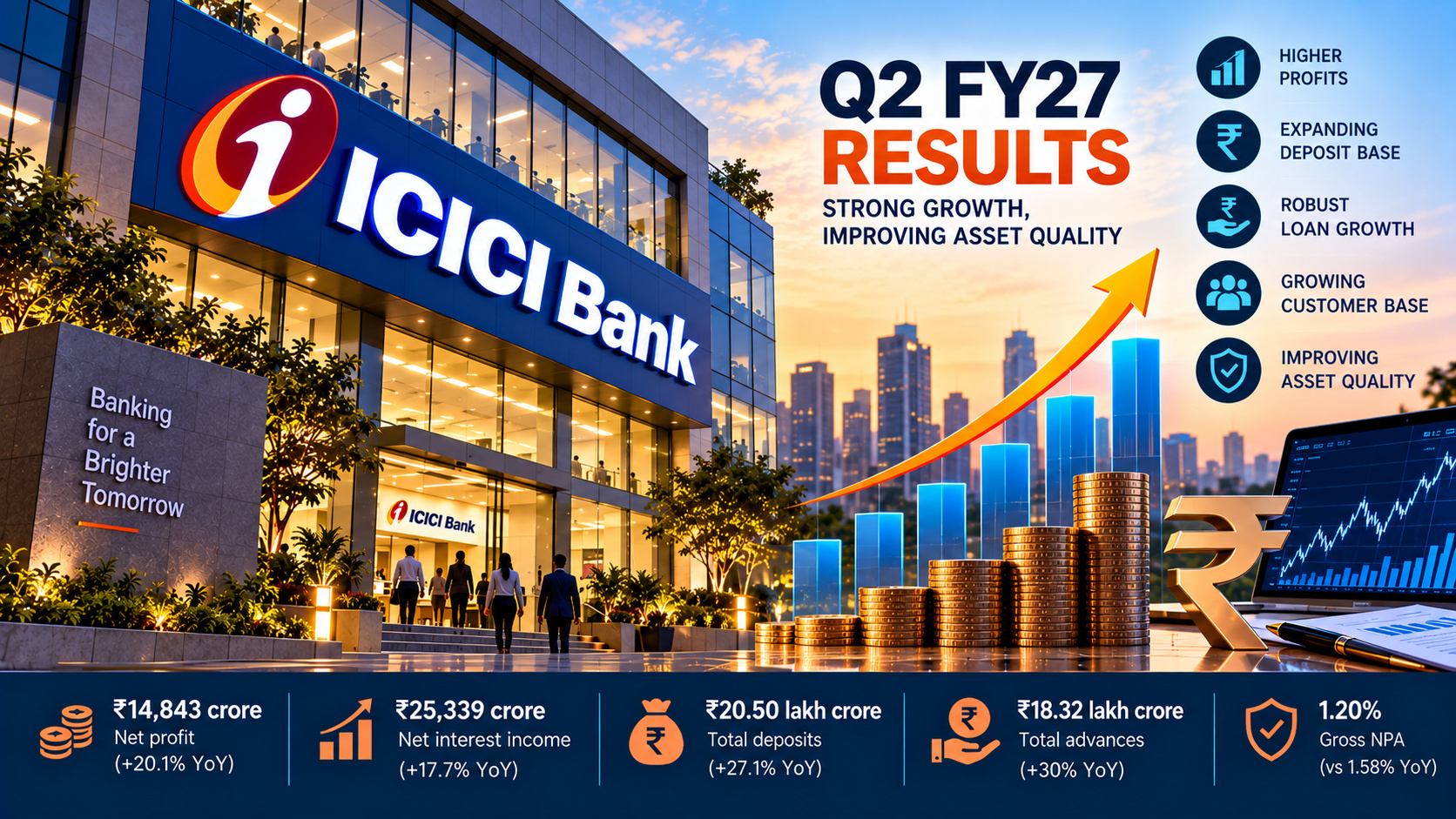
ICICI Bank, India’s second-largest private sector bank, delivered a strong financial performance for the second quarter of FY27, supported by healthy loan growth, rising interest income, robust deposit mobilisation and improving asset quality.
The bank announced its quarterly results on Saturday, October 17, 2026, reporting standalone net profit of ₹14,843 crore, representing a 20.1% year-on-year increase.
Net interest income grew 17.7% to ₹25,339 crore, while total deposits expanded 27.1% to ₹20.50 lakh crore. The loan portfolio also recorded significant growth, reaching ₹18.32 lakh crore.
The results highlighted the strength of ICICI Bank’s core banking operations, although a moderation in net interest margins and weaker treasury performance remained areas of concern.
ICICI Bank Q2 FY27 Financial Performance
The September quarter demonstrated broad-based growth across the bank’s lending, deposit and fee-income businesses.
Key financial highlights included:
- Standalone net profit: ₹14,843 crore, up 20.1% year-on-year.
- Consolidated net profit: ₹16,333 crore, up approximately 22.3%.
- Net interest income: ₹25,339 crore, up 17.7%.
- Core operating profit: ₹20,805 crore, up 21.8%.
- Net interest margin: 4.18%, compared with 4.30% a year earlier.
- Total deposits: ₹20,49,874 crore, up 27.1%.
- Total advances: ₹18,31,580 crore, up 30%.
- Gross NPA ratio: 1.20%, compared with 1.58% a year earlier.
- Net NPA ratio: 0.30%.
- Provisions: ₹851 crore, compared with ₹914 crore a year earlier.
The results were particularly encouraging because operating profit increased faster than expenses, while the bank maintained healthy capital adequacy and improving credit quality.
Net Interest Income Rises Nearly 18%
ICICI Bank reported net interest income of ₹25,339 crore during Q2 FY27, compared with ₹21,529 crore in the corresponding quarter last year.
This represents an increase of 17.7%.
Net interest income is the difference between interest earned on loans and investments and the interest paid on deposits and other borrowings.
For banks, it is one of the most important indicators of core lending profitability.
ICICI Bank’s strong growth in net interest income was supported by the expansion of its loan portfolio and continued demand for credit across retail, business banking and corporate segments.
However, the growth in interest income was accompanied by a decline in net interest margins.
The bank reported a net interest margin of 4.18%, compared with 4.30% a year earlier and 4.36% in the preceding quarter.
The sequential comparison was partly affected by an eight-basis-point benefit from interest on a tax refund in Q1 FY27.
Excluding that benefit, the previous quarter’s margin stood at approximately 4.28%.
This indicates that the underlying sequential margin decline was closer to 10 basis points.
Although margins remain relatively healthy, sustained pressure could restrict future earnings growth if funding costs rise or lending yields moderate.
Deposits Surge 27% to ₹20.50 Lakh Crore
One of the biggest highlights of ICICI Bank’s quarterly performance was its substantial deposit growth.
Total deposits reached ₹20,49,874 crore as of September 30, 2026, representing an increase of 27.1% year-on-year.
Average deposits during the quarter increased 21.2% to ₹18,88,219 crore.
The strong deposit performance reflects the bank’s ability to attract customer funds through its distribution network, digital banking services and established customer relationships.
However, an important portion of the increase came from foreign currency non-resident bank deposits, commonly known as FCNR(B) deposits.
Excluding these deposits, total deposit growth stood at approximately 17% year-on-year.
This distinction is important because headline deposit growth can sometimes be influenced by specific funding arrangements that may not reflect underlying domestic deposit mobilisation.
Nevertheless, the bank’s core deposit growth remained healthy.
Strong deposits provide a stable funding base, supporting lending expansion while reducing dependence on wholesale borrowing.
CASA Ratio Declines to 35.8%
Despite strong deposit mobilisation, the bank experienced a moderation in its low-cost deposit mix.
The average current account and savings account ratio stood at 35.8% during Q2 FY27.
Average CASA deposits increased 10.7% year-on-year, considerably slower than the growth in total average deposits.
The difference was largely associated with the faster expansion of term deposits, including FCNR(B) inflows.
CASA deposits are important because they generally carry lower interest costs than fixed deposits.
A higher CASA ratio can support stronger net interest margins by reducing a bank’s average funding expenses.
Conversely, greater reliance on term deposits can increase funding costs.
For ICICI Bank, improving the proportion of low-cost deposits will remain an important priority as it continues expanding its lending portfolio.
Loan Book Expands 30% to ₹18.32 Lakh Crore
ICICI Bank reported strong growth in its advances during the September quarter.
Total advances increased 30% year-on-year to ₹18,31,580 crore.
However, this headline growth included loans extended by international branches against FCNR(B) deposits.
Excluding these loans, the portfolio grew 24.1% year-on-year.
Domestic advances increased approximately 22.8%, indicating strong underlying demand across the Indian economy.
The bank reported healthy growth in several major lending categories.
The retail and rural loan portfolio increased 14.8% year-on-year.
Business banking loans expanded 33.8%, while the domestic corporate loan portfolio grew 30.6%.
The performance demonstrates that loan growth was not concentrated in a single business segment.
Instead, ICICI Bank benefited from demand across households, businesses and larger corporations.
Diversified lending growth can support long-term profitability, provided the bank maintains disciplined underwriting and appropriate credit risk controls.
Business Banking Emerges as a Major Growth Driver
The business banking segment delivered particularly strong growth during Q2 FY27.
Loans in this category increased 33.8% year-on-year and 11.1% sequentially.
The expansion reflects growing demand for financing among businesses requiring working capital, equipment purchases, inventory financing and expansion funding.
India’s small and medium enterprise sector represents a significant opportunity for commercial banks.
As businesses increasingly adopt formal financial services and digital payment systems, banks can expand lending relationships and offer additional products.
For ICICI Bank, business banking provides opportunities to diversify its loan portfolio and deepen customer relationships.
However, rapid growth in business lending also requires careful monitoring of borrower cash flows and repayment capacity.
The bank’s ability to sustain growth without increasing credit costs will be an important indicator of long-term performance.
Corporate Lending Records Strong Expansion
ICICI Bank’s domestic corporate loan portfolio increased 30.6% year-on-year during the September quarter.
The strong growth suggests continued demand for financing from larger businesses.
Corporate borrowing can be influenced by working capital requirements, capital expenditure, refinancing and business expansion.
A healthy corporate lending environment can benefit banks by increasing loan volumes and creating opportunities for transaction banking, treasury services and fee-based income.
However, corporate lending margins can be relatively competitive because large borrowers often have access to multiple banks and capital market funding alternatives.
For ICICI Bank, maintaining appropriate pricing and credit standards will remain essential as corporate lending expands.
Asset Quality Improves as Bad Loans Decline
One of the most encouraging aspects of ICICI Bank’s quarterly performance was the continued improvement in asset quality.
The gross non-performing asset ratio declined to 1.20% as of September 30, 2026, compared with 1.58% in the corresponding quarter last year.
The net NPA ratio stood at just 0.30%.
Non-performing assets represent loans where borrowers have failed to meet repayment obligations beyond the prescribed period.
Lower NPA ratios generally indicate better loan portfolio quality and reduced stress among borrowers.
ICICI Bank’s improvement reflects its efforts to strengthen credit underwriting, recover stressed loans and maintain disciplined risk management.
The bank wrote off gross non-performing assets amounting to ₹1,592 crore during the quarter.
Its provisioning coverage ratio on non-performing loans stood at 75%.
This indicates that the bank has already made provisions against a substantial portion of its recognised stressed assets.
However, investors should continue monitoring fresh slippages, recoveries and the performance of rapidly expanding lending segments.
Provisions Decline to ₹851 Crore
ICICI Bank reported provisions of approximately ₹851 crore during Q2 FY27, compared with ₹914 crore in the same quarter last year.
The decline represents an improvement of nearly 7%.
Lower provisions can support profitability by reducing the amount of earnings allocated toward potential credit losses.
The bank also maintained a contingency provision buffer of ₹13,100 crore.
Additionally, it continued to hold ₹1,283 crore in standard asset provisions related to its agricultural priority sector portfolio, as directed by the Reserve Bank of India.
These provisions provide additional financial buffers against potential risks.
For investors, the combination of improving NPA ratios, relatively contained provisions and healthy capital adequacy suggests that the bank’s balance sheet remains resilient.
Nevertheless, credit costs can change as economic conditions and borrower repayment behaviour evolve.
Core Operating Profit Jumps 21.8%
ICICI Bank’s core operating profit increased 21.8% year-on-year to ₹20,805 crore.
Excluding dividends received from subsidiaries, core operating profit increased 25% to ₹20,342 crore.
This is particularly significant because it reflects strong growth in the bank’s underlying operations.
Operating expenses increased 8.5% to ₹12,811 crore, considerably slower than the growth in core operating profit.
The difference indicates improved operating leverage.
Operating leverage occurs when revenue or operating income grows faster than expenses, allowing a larger proportion of income to translate into profit.
For a large banking institution, controlling operating costs while expanding its business is essential for maintaining profitability.
The performance suggests that ICICI Bank continues to benefit from its scale, technology investments and operational efficiency.
Fee Income Rises 20% as Customer Activity Expands
Apart from interest income, ICICI Bank also reported healthy growth in its fee-based business.
Fee income increased 20.1% year-on-year to ₹7,795 crore.
Approximately 75% of fee income came from retail, rural and business banking customers.
Fee income is generated from services such as transaction banking, cards, distribution of financial products and other customer-related activities.
Unlike interest income, fee income does not depend directly on the size of the loan portfolio.
A diversified fee-income base can therefore strengthen profitability and reduce reliance on lending margins.
The strong performance suggests continued customer engagement across the bank’s financial services ecosystem.
However, the bank’s total non-interest income was affected by weaker treasury performance.
Treasury Loss Weighs on Non-Interest Income
ICICI Bank recorded a treasury loss of ₹230 crore during Q2 FY27.
This compares with a treasury gain of ₹220 crore in the corresponding quarter last year and ₹151 crore in the preceding quarter.
Treasury income can fluctuate because of changes in interest rates, bond prices and broader financial market conditions.
These fluctuations can influence reported profitability even when a bank’s core lending and fee-based operations remain healthy.
Excluding treasury income, non-interest income increased 12.5% year-on-year to ₹8,277 crore.
The bank also reported that profit before tax excluding treasury increased 23.4% to ₹19,954 crore.
This indicates that underlying business profitability was stronger than the headline results alone might suggest.
ICICI Bank’s Branch Network Continues Expanding
ICICI Bank continued investing in its physical distribution network during the first half of FY27.
The bank added 145 branches during the six-month period.
As of September 30, 2026, it operated 7,656 branches and 12,143 ATMs and cash recycling machines.
Physical branches remain important despite the rapid expansion of digital banking.
They support deposit mobilisation, lending relationships, customer servicing and financial product distribution.
The bank’s extensive branch network also provides opportunities to expand into semi-urban and emerging markets.
However, branch expansion increases operating expenses.
ICICI Bank must therefore maintain strong customer acquisition and business volumes to ensure that its distribution investments generate sustainable returns.
Capital Adequacy Remains Healthy
ICICI Bank maintained a strong capital position during the September quarter.
Its total capital adequacy ratio stood at 16.68%, while the Common Equity Tier 1 ratio was 16.01%.
Both figures remained comfortably above the applicable regulatory minimum requirements.
Capital adequacy measures a bank’s ability to absorb potential losses while continuing its lending operations.
A strong capital position is particularly important when loan growth is accelerating.
It provides financial flexibility and supports future expansion without immediately requiring additional equity capital.
For ICICI Bank, healthy capital ratios offer a foundation for continued business growth.
However, rapid credit expansion will require careful management of risk-weighted assets and capital consumption.
Subsidiaries Strengthen Consolidated Earnings
ICICI Bank’s consolidated net profit increased approximately 22.3% year-on-year to ₹16,333 crore.
The consolidated performance benefited from the contribution of its financial services subsidiaries.
ICICI Life Insurance reported quarterly net profit of ₹374 crore, compared with ₹299 crore a year earlier.
Its value of new business increased to ₹1,283 crore during the first half of FY27, while the value-of-new-business margin improved to 26%.
ICICI Lombard General Insurance reported net profit of ₹946 crore, compared with ₹820 crore in the corresponding quarter last year.
However, its combined ratio increased to 107%, reflecting pressure on underwriting profitability.
During the quarter, ICICI Bank also acquired an additional 2% stake in ICICI Life Insurance for approximately ₹1,470 crore.
The group’s diversified financial services presence creates opportunities across banking, insurance, investments and other financial products.
These businesses provide additional sources of earnings and strengthen the bank’s broader customer ecosystem.
What Investors Should Watch Next
The coming quarters will be important in determining whether ICICI Bank can sustain its strong earnings momentum.
Net interest margins will remain a key indicator.
Although the bank continues generating healthy interest income, the decline in margins suggests that funding costs and lending yields require close monitoring.
Deposit growth will also be important, particularly the performance of CASA deposits and the underlying growth rate excluding FCNR(B) inflows.
The bank’s business banking and corporate lending portfolios will attract attention following their strong expansion.
Investors will assess whether these segments can sustain growth while maintaining stable credit quality.
Asset-quality trends, provisioning requirements and operating efficiency will also influence future profitability.
Finally, the performance of subsidiaries and the bank’s ability to sustain fee-income growth could provide additional support to consolidated earnings.
The Bigger Picture
ICICI Bank’s Q2 FY27 results demonstrate the strength of its core banking franchise and its ability to generate healthy earnings growth in a competitive financial services environment.
Standalone net profit increased 20.1% to ₹14,843 crore, while net interest income rose 17.7% to ₹25,339 crore.
Total deposits crossed ₹20 lakh crore, and the loan portfolio expanded to ₹18.32 lakh crore.
The bank also delivered strong operating profit growth and improved asset quality, with gross NPAs declining to 1.20%.
However, the moderation in net interest margins, declining CASA ratio and treasury losses highlight areas requiring attention.
The substantial contribution of FCNR(B)-linked deposits and advances also means that underlying growth should be evaluated separately from headline balance-sheet expansion.
For ICICI Bank, the next phase of growth will depend on sustaining healthy credit demand, protecting lending margins and maintaining disciplined asset quality as its loan portfolio expands.
The bank’s strong capital position, diversified lending operations, expanding customer relationships and improving operating efficiency provide a solid foundation for continued growth.
Nevertheless, investors will increasingly focus on whether the bank can sustain its earnings momentum while navigating changing interest rates, funding costs and competitive pressures across India’s banking industry.
Feel free to share your experiences and insights in the comments below. Let’s continue the conversation and grow together as a community of traders and analysts.
By sharing this experience and insights, I hope to contribute to the collective knowledge of our professional community, encouraging a culture of strategic thinking and informed decision-making.
As always, thorough research and risk management are crucial. The dynamic nature of financial markets demands vigilance, agility, and a deep understanding of the tools at your disposal. Here’s to profitable trading and navigating the election season with confidence!
Ready to stay ahead of market trends and make informed investment decisions? Follow our page for more insights and updates on the latest in the financial world!
For a free online stock market training by Yogeshwar Vashishtha (M.Tech IIT) this Saturday from 11 am – 1 pm, please sign up with https://pathfinderstrainings.in/training/freetrainings.aspx
Experience profits with my winning algo strategies – get a free one-month trial with ₹15 lakh capital! – https://terminal.algofinders.com/algo-terminal
Disclaimer
This article should not be interpreted as investment advice. For any investment decisions, consult a reputable financial advisor. The author and publisher are not responsible for any losses incurred by investors or traders based on the information provided.