

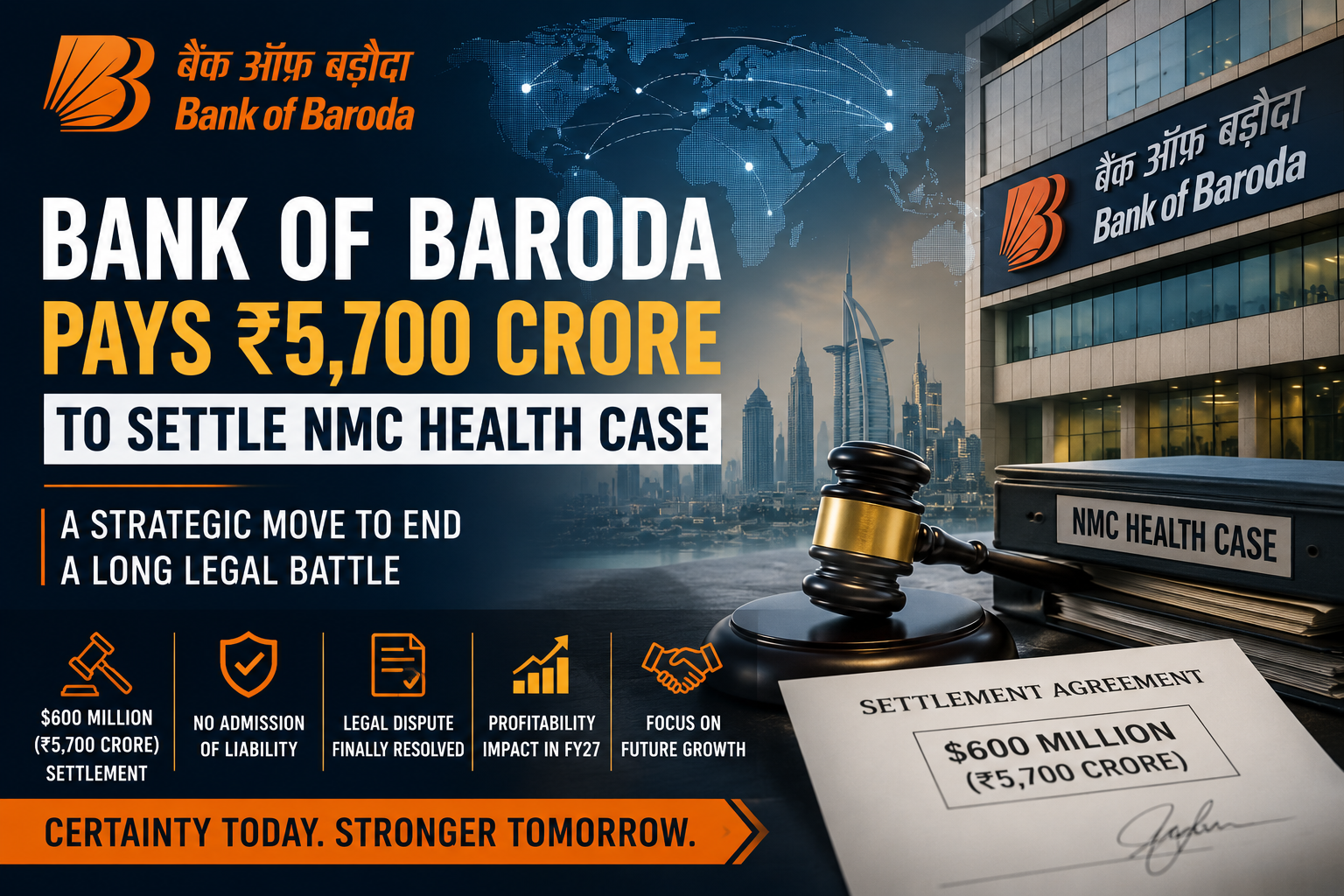
Banking institutions frequently navigate legal disputes as part of their international operations, but few cases have attracted as much attention as Bank of Baroda’s decision to pay $600 million (approximately ₹5,700 crore) to settle long-running litigation linked to the collapse of UAE-based healthcare giant NMC Health. The settlement marks the end of one of the largest cross-border legal disputes involving an Indian public sector bank and raises important questions about litigation risk, international banking, financial governance, and long-term strategic decision-making. Although the bank has emphasized that the agreement was reached without any admission of liability or wrongdoing, the financial impact is expected to be significant, particularly in the current financial year.
Understanding the Background
NMC Health was once among the largest private healthcare providers in the Middle East, enjoying rapid growth and international investor confidence. However, the company collapsed after the discovery of billions of dollars in previously undisclosed debt and alleged financial irregularities, triggering insolvency proceedings and multiple legal actions across different jurisdictions.
As one of NMC Health’s lenders through its Abu Dhabi operations, Bank of Baroda became involved in legal proceedings initiated by the company’s joint administrators. These proceedings extended across courts in Abu Dhabi and England, creating years of legal uncertainty for the bank.
Why Did Bank of Baroda Choose to Settle?
Rather than continuing a prolonged legal battle, Bank of Baroda opted for an out-of-court settlement worth $600 million.
Several factors likely influenced this decision:
- Eliminating years of litigation uncertainty
- Avoiding escalating legal expenses
- Capping financial exposure
- Bringing closure to a complex international dispute
- Allowing management to focus on core banking operations
Importantly, the settlement agreement explicitly states that it does not constitute an admission of liability or wrongdoing by the bank, instead representing a commercial resolution intended to conclude the dispute efficiently.
The Immediate Financial Impact
The payment represents one of the largest legal settlements involving an Indian public sector bank.
Although the settlement is a one-time expense, analysts expect it to materially affect Bank of Baroda’s profitability in the current financial year.
Potential consequences include:
- Lower quarterly earnings
- Reduced reported profitability
- Pressure on return ratios
- Short-term impact on investor sentiment
However, many market participants also view the settlement as removing a significant legal overhang that had persisted for several years.
Why Legal Closure Can Be Valuable
For financial institutions, uncertainty often carries costs beyond direct legal expenses.
Long-running litigation can affect:
- Investor confidence
- Capital allocation decisions
- Management focus
- International reputation
- Future business opportunities
By resolving the dispute, Bank of Baroda eliminates a major source of uncertainty that could otherwise have continued for several more years.
This clarity may ultimately prove beneficial despite the immediate financial cost.
Cross-Border Banking Comes With Complex Risks
Modern banks increasingly operate across multiple jurisdictions.
International lending introduces additional challenges such as:
- Different legal systems
- Regulatory complexities
- Cross-border insolvency proceedings
- Currency exposure
- Compliance requirements
- Jurisdictional disputes
The NMC Health case illustrates how overseas lending relationships can evolve into highly complex legal matters when corporate failures occur.
Lessons in Risk Management
The settlement also highlights the importance of comprehensive risk management for financial institutions.
Banks today invest heavily in:
- Credit assessment
- Corporate governance reviews
- Regulatory compliance
- Fraud detection
- Transaction monitoring
- International due diligence
As banking operations become increasingly global, robust internal controls become even more critical for managing exposure to large corporate borrowers.
Market Reaction and Investor Perspective
Large one-time settlements often generate short-term market volatility.
Investors typically assess two competing factors:
Negative factors
- Immediate reduction in profits
- Large cash outflow
- Impact on financial ratios
Positive factors
- Elimination of legal uncertainty
- Reduced future litigation risk
- Improved visibility into future earnings
- Greater management focus on business growth
While the financial impact is substantial, markets often value certainty once major legal disputes are resolved.
Implications for India’s Banking Sector
The case serves as an important reminder that Indian banks have become increasingly integrated into global financial markets.
As overseas operations expand, banks must continue strengthening:
- International compliance frameworks
- Risk governance
- Credit monitoring
- Legal preparedness
- Cross-border regulatory coordination
Managing these risks effectively will become increasingly important as Indian financial institutions pursue global growth opportunities.
Looking Ahead
With the settlement now concluded, Bank of Baroda can focus on its core priorities, including:
- Expanding lending operations
- Improving profitability
- Strengthening asset quality
- Accelerating digital transformation
- Enhancing customer service
- Supporting long-term business growth
The removal of a major legal overhang may also provide greater strategic flexibility in the years ahead.
A Case That Highlights the Cost of Corporate Failures
The collapse of NMC Health affected multiple stakeholders, including lenders, investors, creditors, employees, and regulators.
The legal proceedings that followed demonstrate how the consequences of large corporate failures can extend across multiple countries and continue for years after the original events.
For banks operating internationally, such cases reinforce the need for strong governance, careful credit evaluation, and effective legal risk management.
Conclusion
Bank of Baroda’s ₹5,700 crore settlement with the administrators of NMC Health marks the conclusion of one of the most significant cross-border legal disputes involving an Indian public sector bank. While the payment is expected to weigh on near-term profitability, it also removes a long-standing legal uncertainty that had overshadowed the bank for several years.
The episode underscores both the opportunities and risks associated with international banking. As Indian financial institutions continue expanding their global presence, the importance of rigorous risk management, strong governance, and prudent lending practices will only continue to grow. For Bank of Baroda, the settlement represents not just the end of a legal chapter, but also an opportunity to move forward with greater clarity and renewed focus on its long-term growth objectives.
Feel free to share your experiences and insights in the comments below. Let’s continue the conversation and grow together as a community of traders and analysts.
By sharing this experience and insights, I hope to contribute to the collective knowledge of our professional community, encouraging a culture of strategic thinking and informed decision-making.
As always, thorough research and risk management are crucial. The dynamic nature of financial markets demands vigilance, agility, and a deep understanding of the tools at your disposal. Here’s to profitable trading and navigating the election season with confidence!
Ready to stay ahead of market trends and make informed investment decisions? Follow our page for more insights and updates on the latest in the financial world!
For a free online stock market training by Yogeshwar Vashishtha (M.Tech IIT) this Saturday from 11 am – 1 pm, please sign up with https://pathfinderstrainings.in/training/freetrainings.aspx
Experience profits with my winning algo strategies – get a free one-month trial with ₹15 lakh capital! – https://terminal.algofinders.com/algo-terminal
Disclaimer
This article should not be interpreted as investment advice. For any investment decisions, consult a reputable financial advisor. The author and publisher are not responsible for any losses incurred by investors or traders based on the information provided.