

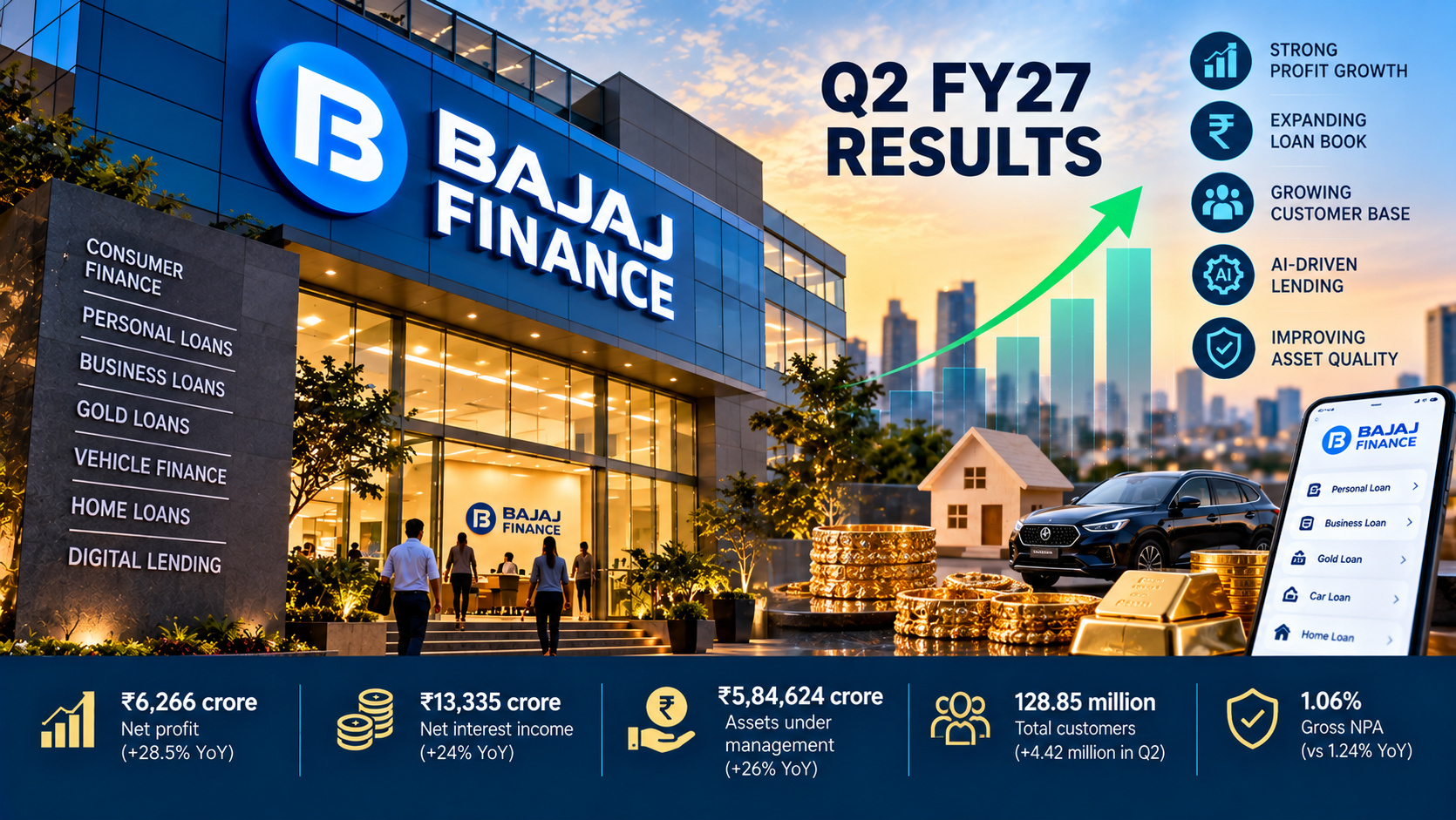
Bajaj Finance, one of India’s largest non-banking financial companies (NBFCs), delivered a strong financial performance for the second quarter of FY27, supported by robust loan growth, higher interest income, improving asset quality and continued expansion of its customer base.
The company announced its quarterly results on Monday, October 19, 2026, reporting consolidated net profit attributable to shareholders of ₹6,266 crore, representing a 28.5% year-on-year increase.
Net interest income rose approximately 24% to ₹13,335 crore, while assets under management (AUM) expanded 26% to ₹5,84,624 crore.
The company also raised its full-year AUM growth guidance to 26–27%, reflecting confidence in sustained lending demand.
However, despite the strong operating performance, earnings fell short of market expectations, highlighting the importance of profitability, credit costs and asset quality in determining investor sentiment.
Bajaj Finance Q2 FY27 Financial Performance
The September quarter demonstrated broad-based growth across the company’s lending operations.
Key consolidated financial highlights included:
- Net profit attributable to shareholders: ₹6,266 crore, up 28.5% year-on-year.
- Total consolidated profit: Approximately ₹6,367 crore, up 28.8%.
- Revenue: Approximately ₹24,546 crore, up 22.8%.
- Net interest income: ₹13,335 crore, up approximately 24%.
- Net total income: ₹15,974 crore, up 23%.
- Operating profit: ₹10,699 crore, up 23%.
- Assets under management: ₹5,84,624 crore, up 26%.
- New loans booked: 13.45 million, up 11%.
- Gross NPA ratio: 1.06%, compared with 1.24% a year earlier.
- Net NPA ratio: 0.42%, compared with 0.60% a year earlier.
The results demonstrate the company’s ability to expand lending operations while maintaining relatively stable operating expenses and improving several important asset-quality indicators.
Assets Under Management Surge to ₹5.85 Lakh Crore
One of the biggest highlights was the continued expansion of Bajaj Finance’s loan portfolio.
Consolidated assets under management reached ₹5,84,624 crore as of September 30, 2026, compared with ₹4,62,261 crore in the corresponding period last year.
This represents approximately 26% year-on-year growth.
During the September quarter alone, the company added ₹37,680 crore to its assets under management.
AUM is particularly important for lending institutions because it represents the outstanding portfolio of loans and other financing assets generating income.
Higher AUM generally supports future interest income, provided the company maintains adequate lending spreads and controls credit losses.
Bajaj Finance’s expansion reflects demand across its diversified portfolio, which includes consumer durable financing, personal loans, business loans, mortgages, vehicle financing and gold loans.
Its broad distribution network and established customer relationships continue to provide opportunities for cross-selling financial products.
However, rapid loan growth also increases the importance of underwriting discipline, particularly in unsecured consumer lending.
Net Interest Income Grows 24%
Bajaj Finance reported net interest income of approximately ₹13,335 crore, compared with ₹10,785 crore in the same quarter last year.
This represents growth of nearly 24%.
Net interest income is the difference between the interest earned on loans and the interest paid on borrowings and deposits.
For NBFCs, this is one of the most important measures of core lending profitability.
The increase indicates that Bajaj Finance benefited from a larger loan portfolio and effective management of its funding costs.
The company’s cost of funds declined to 7.31% during the quarter, improving by nine basis points sequentially.
Lower borrowing costs can support profitability by improving the difference between lending yields and funding expenses.
However, the company expects some moderation in net interest margins as its lending portfolio evolves.
Maintaining healthy interest spreads while expanding lending volumes will therefore remain important.
Customer Base Expands to Nearly 129 Million
Bajaj Finance continued to strengthen its customer franchise during the quarter.
The company added approximately 4.42 million customers, taking its total customer base to 128.85 million as of September 30, 2026.
Its cross-sell customer franchise reached approximately 82.36 million.
The expansion reflects the company’s ability to attract borrowers through its consumer financing ecosystem, digital platforms and physical distribution network.
A large customer base offers significant commercial advantages.
Existing customers can potentially be offered additional financial products, reducing customer acquisition costs and creating opportunities for repeat borrowing.
The company booked 13.45 million new loans during the quarter, compared with 12.17 million a year earlier.
Management expects to book approximately 60–62 million new loans during FY27 and add 18–20 million customers.
Achieving these targets would further strengthen Bajaj Finance’s position in India’s rapidly expanding retail credit market.
Gold Loan Business Emerges as a Major Growth Driver
Gold loans have become an increasingly important component of Bajaj Finance’s growth strategy.
The company’s gold loan portfolio more than doubled year-on-year to approximately ₹24,195 crore.
During the September quarter, Bajaj Finance opened 321 additional gold loan branches, taking the total network to 2,022.
Management expects to expand the network to approximately 2,700–2,800 branches by the end of FY27.
Gold loans offer several advantages for lenders.
Unlike unsecured personal loans, gold loans are backed by physical collateral, which can reduce potential losses in the event of borrower defaults.
They also benefit from strong demand among households and small businesses seeking relatively quick access to credit.
However, gold lending is not entirely risk-free.
Changes in gold prices, loan-to-value ratios, repayment behaviour and operational controls can influence credit risk.
Bajaj Finance experienced a transitional increase in stressed gold loan accounts during the quarter, partly related to short-tenor lending schemes that have since been discontinued.
The company indicated that it does not expect this temporary increase to materially affect overall credit costs.
Asset Quality Improves Despite Higher Provisions
Asset quality remained an important positive development.
Bajaj Finance’s consolidated gross non-performing asset ratio declined to 1.06%, compared with 1.24% a year earlier.
The net NPA ratio also improved to 0.42% from 0.60%.
These figures suggest that the proportion of problematic loans in the overall portfolio has declined.
However, total loan losses and provisions increased to approximately ₹2,166 crore, compared with ₹2,080 crore in the corresponding quarter last year.
The company included an additional ₹337 crore management and macroeconomic provision during the quarter.
Excluding this additional provision, loan losses and provisions declined approximately 12% year-on-year to ₹1,829 crore.
This distinction is important.
The higher reported provision figure does not necessarily indicate a broad deterioration in underlying credit quality.
Nevertheless, the company experienced an increase in Stage 2 and Stage 3 assets, particularly within its gold loan portfolio.
Investors will monitor whether these accounts normalise as management expects.
Profitability Remains Strong, but Earnings Miss Expectations
Although Bajaj Finance delivered nearly 29% profit growth, its consolidated earnings fell short of analyst expectations.
Net profit attributable to shareholders stood at approximately ₹6,266 crore, compared with market estimates of around ₹6,645 crore.
Higher tax expenses contributed to the earnings shortfall.
The company’s tax expense increased approximately 31% year-on-year, reducing the amount of operating profit that translated into net earnings.
Despite this, operating profitability remained healthy.
Operating profit increased 23% to ₹10,699 crore, while the operating expenses-to-net total income ratio improved marginally to 33%, compared with 33.1% a year earlier.
Management expects further improvement of approximately 25–40 basis points in this ratio during FY27.
The company’s annualised return on assets reached 4.6%, while return on equity improved to 20.6%.
These figures indicate that Bajaj Finance continues to generate strong returns relative to its asset base and shareholders’ equity.
FY27 AUM Growth Guidance Raised to 26–27%
Following its strong first-half performance, Bajaj Finance raised its full-year AUM growth guidance.
The company now expects assets under management to grow 26–27% in FY27, compared with its previous forecast of 23–25%.
The upward revision suggests that management expects lending demand to remain healthy across its major business segments.
The company has retained its medium-term AUM growth ambition of 23–25%, indicating that the higher FY27 forecast reflects stronger near-term business momentum rather than a permanent increase in its long-term growth assumptions.
Bajaj Finance is also targeting medium-term profit growth of approximately 20–25%.
However, delivering these ambitions will require a balance between aggressive expansion and disciplined risk management.
Loan growth alone is not sufficient to create shareholder value if credit losses, borrowing costs or operating expenses increase disproportionately.
Digital Lending and Artificial Intelligence Gain Importance
Technology continues to play a central role in Bajaj Finance’s expansion.
The company has been investing in digital lending platforms, automated underwriting, data analytics and artificial intelligence to improve customer acquisition and operational efficiency.
During Q2 FY27, AI-driven initiatives generated approximately ₹2,744 crore in disbursements, representing growth of 112% year-on-year.
This highlights the increasing commercial contribution of technology-led lending channels.
AI-based systems can help financial institutions analyse customer behaviour, improve fraud detection, personalise product offerings and streamline loan approvals.
Automation can also reduce processing costs and improve the efficiency of large-scale lending operations.
However, the use of AI in financial services requires strong governance, data protection and responsible credit assessment.
For Bajaj Finance, the challenge will be to expand digital lending without compromising underwriting standards.
Funding Position and Capital Adequacy Remain Healthy
Bajaj Finance maintained a strong funding and liquidity position during the September quarter.
Its deposit book stood at approximately ₹69,754 crore, representing 14% of consolidated borrowings.
The company also maintained a liquidity buffer of nearly ₹19,995 crore.
Its consolidated capital adequacy ratio stood at 20.33%, while Tier-1 capital was approximately 19.43%.
These indicators are important because NBFCs depend on access to funding markets to sustain lending growth.
A diversified borrowing structure and adequate capital reserves help financial institutions manage liquidity pressures and unexpected credit losses.
The company’s capital position provides a foundation for continued business expansion, although sustained growth at the current pace will require careful capital planning.
Expansion Across India’s Retail Credit Market
Bajaj Finance continued to expand its physical distribution network.
The company added approximately 4,100 distribution points during the quarter.
By September 30, 2026, it had a presence across 4,091 locations, supported by more than 254,000 active distribution points.
Management plans to open approximately 150–175 new locations during FY27.
The expansion reflects the growing demand for formal consumer and business financing across India.
Increasing financial inclusion, digital payment adoption and rising household consumption continue to create opportunities for organised lenders.
However, competition is also intensifying.
Banks, fintech companies and other NBFCs are increasingly targeting similar customer segments.
Bajaj Finance’s competitive advantage lies in its established distribution network, large customer database, technology infrastructure and diversified product portfolio.
Maintaining this advantage will require continued innovation and disciplined execution.
What Investors Should Watch Next
The coming quarters will be important in determining whether Bajaj Finance can sustain its strong growth momentum.
Investors will closely monitor the company’s progress toward its revised AUM growth target of 26–27%.
The performance of the gold loan business will also attract attention, particularly the normalisation of Stage 2 and Stage 3 accounts.
Credit costs remain another important variable.
Although asset-quality ratios have improved, rapid lending expansion can create future risks if borrower repayment capacity weakens.
Net interest margins will also be closely watched as the company balances lending yields against funding costs.
Additionally, investors will assess whether operating efficiencies and AI-led lending initiatives can support stronger profitability.
The company’s ability to achieve 20–25% medium-term profit growth will depend on maintaining this balance between expansion, margins and asset quality.
The Bigger Picture
Bajaj Finance’s Q2 FY27 results highlight the strength of its diversified lending franchise and its ability to expand in India’s growing consumer credit market.
Consolidated net profit attributable to shareholders increased 28.5% to ₹6,266 crore, while net interest income grew approximately 24% to ₹13,335 crore.
Assets under management reached ₹5.85 lakh crore, supported by strong loan demand and continued customer acquisition.
The company’s expanding gold loan operations, digital lending capabilities and extensive distribution network provide multiple avenues for future growth.
At the same time, the earnings miss, higher reported provisions and transitional stress within the gold loan portfolio demonstrate that risks remain.
For Bajaj Finance, the next phase of growth will depend not simply on expanding its loan book but on maintaining asset quality, controlling credit costs and converting strong lending demand into sustainable profitability.
With management raising its FY27 AUM growth guidance to 26–27%, the company has signalled confidence in its business outlook.
The coming quarters will reveal whether Bajaj Finance can sustain this momentum while preserving the financial discipline that has supported its position among India’s leading NBFCs.
Feel free to share your experiences and insights in the comments below. Let’s continue the conversation and grow together as a community of traders and analysts.
By sharing this experience and insights, I hope to contribute to the collective knowledge of our professional community, encouraging a culture of strategic thinking and informed decision-making.
As always, thorough research and risk management are crucial. The dynamic nature of financial markets demands vigilance, agility, and a deep understanding of the tools at your disposal. Here’s to profitable trading and navigating the election season with confidence!
Ready to stay ahead of market trends and make informed investment decisions? Follow our page for more insights and updates on the latest in the financial world!
For a free online stock market training by Yogeshwar Vashishtha (M.Tech IIT) this Saturday from 11 am – 1 pm, please sign up with https://pathfinderstrainings.in/training/freetrainings.aspx
Experience profits with my winning algo strategies – get a free one-month trial with ₹15 lakh capital! – https://terminal.algofinders.com/algo-terminal
Disclaimer
This article should not be interpreted as investment advice. For any investment decisions, consult a reputable financial advisor. The author and publisher are not responsible for any losses incurred by investors or traders based on the information provided.