

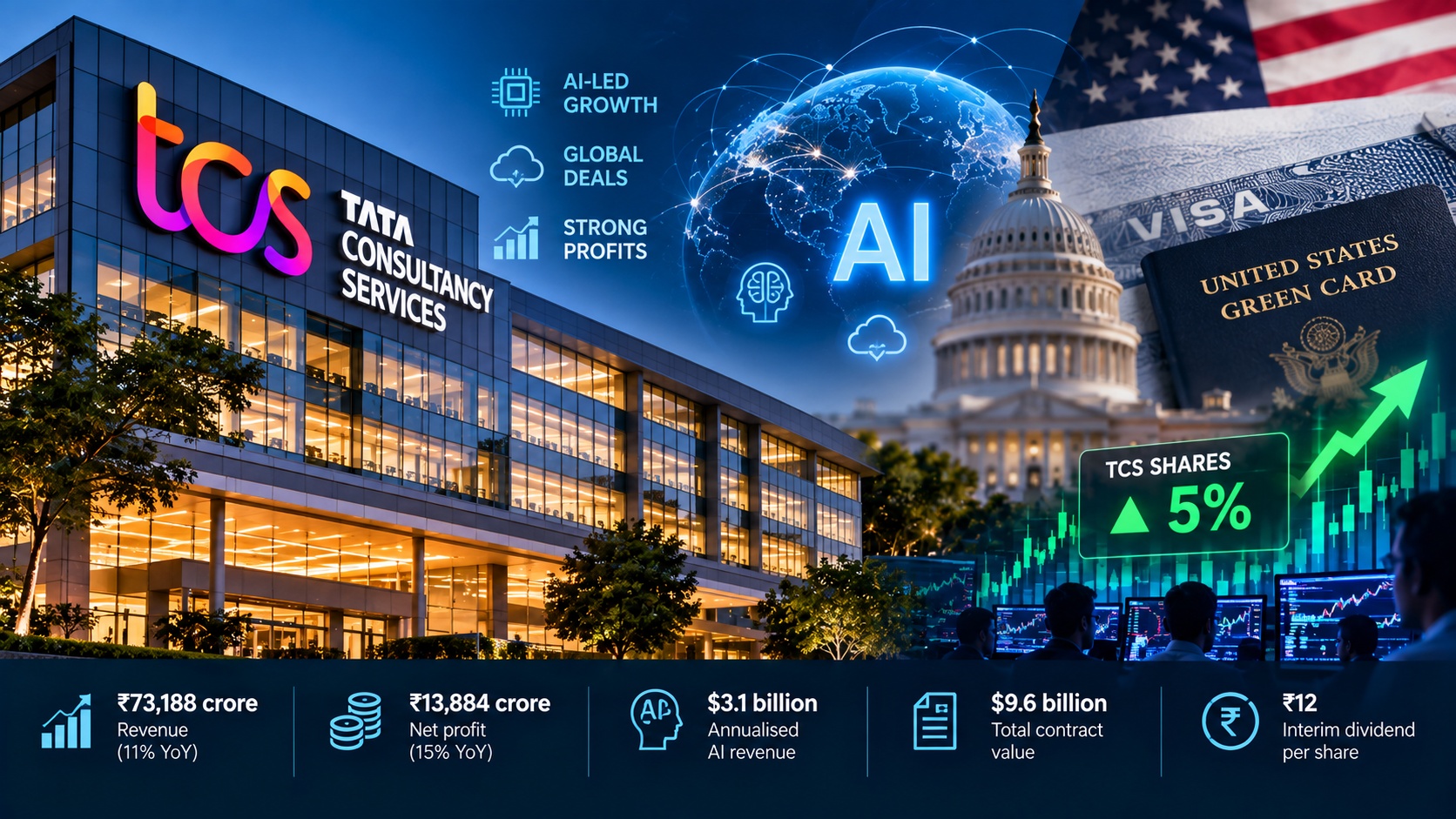
India’s largest IT services company, Tata Consultancy Services (TCS), has delivered a mixed but encouraging financial performance for the second quarter of FY27, with strong profit growth, expanding artificial intelligence opportunities and major international deals helping restore investor confidence.
For the July–September 2026 quarter, TCS reported consolidated revenue of ₹73,188 crore, representing approximately 11% year-on-year growth, while net profit increased around 15% to ₹13,884 crore.
However, beneath the strong headline numbers, the company continues to face sluggish underlying demand, limited sequential revenue growth and pressure on operating margins.
Despite these concerns, investors responded positively. TCS shares surged nearly 5% during early trading on October 9, reflecting optimism surrounding the company’s AI business, deal pipeline and improving long-term opportunities.
TCS Q2 FY27 Financial Performance
The company’s quarterly results demonstrated solid year-on-year growth in rupee terms, although much of the revenue improvement reflected favourable currency movements.
Key financial highlights included:
- Revenue: ₹73,188 crore, up approximately 11% year-on-year.
- Net profit: ₹13,884 crore, up approximately 15% year-on-year.
- Dollar revenue: $7.64 billion, up 2.36% year-on-year.
- Sequential dollar revenue growth: Just 0.2%.
- Constant-currency growth: 0.5% quarter-on-quarter.
- Operating margin: 24%.
- Net profit margin: Approximately 19%.
- Total contract value: $9.6 billion.
- AI annualised revenue: $3.1 billion.
- Interim dividend: ₹12 per share.
The results exceeded market expectations on profitability, with analysts having anticipated net profit of approximately ₹13,786 crore.
Nevertheless, the modest sequential revenue increase highlighted that a meaningful recovery in global technology spending has yet to materialise.
Slowest Second-Quarter Growth in Three Years
One of the most important concerns surrounding TCS’s results was its weak underlying revenue momentum.
The company recorded its slowest second-quarter revenue growth in three years, despite outperforming analyst expectations.
In dollar terms, revenue increased only 0.2% compared with the previous quarter.
CEO K. Krithivasan acknowledged that the global demand environment had not materially improved.
Large international clients remain cautious about discretionary technology spending, particularly on projects that do not offer immediate financial benefits.
Macroeconomic uncertainty, geopolitical tensions and concerns about global economic growth continue to influence corporate IT budgets.
The banking and financial services segment provided some support, helping offset weaker performance in certain regional markets.
For TCS, the challenge is converting its substantial order pipeline into faster revenue growth.
AI Revenue Reaches $3.1 Billion
Artificial intelligence emerged as the most encouraging component of the company’s quarterly performance.
TCS reported that its annualised AI revenue run rate reached $3.1 billion, representing more than 10% of its overall annualised revenue base.
This marks an important milestone in the company’s transition from traditional IT outsourcing toward AI-driven enterprise transformation.
The company is expanding its offerings across AI-native software development, intelligent automation, cybersecurity, cloud infrastructure and autonomous business operations.
AI is also changing how customers purchase technology services.
Instead of paying primarily for large teams of developers and support engineers, companies are increasingly interested in automated platforms capable of delivering measurable productivity improvements.
TCS is attempting to capture this transition by developing reusable AI platforms and integrating advanced technologies into existing client relationships.
However, the company must ensure that new AI-driven business opportunities grow quickly enough to compensate for potential reductions in traditional software development and maintenance work.
Porsche and Best Buy Deals Strengthen the Pipeline
TCS secured several strategically important agreements during the quarter.
One of the largest involved German automobile manufacturer Porsche.
The partnership includes a five-year transformation programme valued at approximately €1.25 billion, involving the deployment of artificial intelligence and advanced digital technologies.
TCS also agreed to acquire MHP, Porsche’s Germany-based management and IT consulting subsidiary.
Another significant development involved American electronics retailer Best Buy.
Under the agreement, TCS will take over Best Buy’s Global Capability Centre in India and transform it into an AI Capability Centre.
These agreements illustrate a changing business model in which TCS is becoming more deeply integrated into customers’ operations rather than simply providing outsourced technology services.
The company recorded a total contract value of $9.6 billion during the quarter, providing visibility into future revenue opportunities.
Operating Margins Remain Under Pressure
Despite improving profitability in rupee terms, TCS’s operating margin remained unchanged at 24%.
This was the second consecutive quarter without sequential margin expansion.
Higher subcontracting expenses were an important factor, as the company relied on external specialists to address mismatches between available employee skills and project requirements.
Although currency movements and operational improvements provided some support, these benefits were insufficient to produce stronger margins.
TCS is also investing in AI capabilities, acquisitions, infrastructure and employee training.
These investments could strengthen long-term competitiveness but may weigh on profitability in the near term.
Management continues to maintain a long-term aspirational operating margin range of 26–28%, although achieving this will require stronger revenue growth and improved operating leverage.
US Green Card Restrictions Create Fresh Uncertainty
Alongside the quarterly results, Indian IT companies faced another major development involving US immigration policy.
The Trump administration announced restrictions affecting the Permanent Labour Certification programme, which companies use when sponsoring eligible foreign employees for employment-based permanent residency.
The move raised concerns across India’s IT services sector because companies such as TCS, Infosys, Wipro and HCLTech maintain substantial operations in the United States.
Restrictions on green card sponsorship could complicate long-term workforce planning and retention for affected employers.
Companies may need to increase local recruitment or shift more work to offshore delivery centres.
Both approaches can affect operating costs and project execution.
However, TCS has indicated that the immediate impact on its operations should be limited.
The company stated that its permanent labour certification applications had remained in single digits over the preceding two years.
It also reaffirmed plans to recruit another 15,000 employees in the United States over the next five years.
TCS believes its existing localisation strategy should help protect customer engagements and workforce continuity.
TCS Shares Jump Nearly 5%
Investors responded positively to the earnings announcement despite the weak underlying revenue environment.
On October 9, TCS shares rose as much as 4.7% to approximately ₹2,173.55 on the BSE during morning trading.
The rally followed better-than-expected quarterly profitability, growing AI revenue, significant contract wins and the announcement of a ₹12 interim dividend.
The market reaction also reflected expectations that TCS may gradually benefit from improving discretionary spending and greater adoption of AI-driven services.
However, analysts remained divided on the company’s valuation and future growth trajectory.
Emkay Global retained an Add rating with a target price of ₹2,600, reflecting optimism about AI-led opportunities and long-term margin recovery.
BOB Capital, meanwhile, upgraded the stock from Sell to Hold but maintained a more cautious outlook, assigning a target price of ₹2,015.
The difference highlights the uncertainty surrounding how quickly TCS can convert its technology investments into sustained earnings growth.
AI Presents Both an Opportunity and a Threat
The rapid adoption of artificial intelligence represents one of the most significant structural changes in the history of India’s IT services industry.
Traditional outsourcing models have relied heavily on deploying large numbers of skilled employees to develop, maintain and support enterprise software.
AI-powered coding assistants and autonomous software agents are beginning to automate portions of that work.
For companies such as TCS, this creates a potential risk to existing revenue streams.
Customers may eventually require fewer billable engineering hours for routine software development and maintenance.
At the same time, AI is creating new opportunities involving enterprise modernisation, data infrastructure, cybersecurity, cloud migration and intelligent automation.
TCS is attempting to position itself on both sides of this transformation.
The company is using AI internally to improve productivity while simultaneously developing AI-powered services for customers.
Its ability to manage this transition will play a major role in determining its future growth and profitability.
Workforce Strategy Is Also Changing
TCS ended the first half of FY27 with approximately 598,056 employees after adding 4,258 people.
The company continues to recruit selectively while investing in employee reskilling and new technology capabilities.
As AI becomes more deeply integrated into software development, demand for certain traditional roles could change.
However, opportunities are expanding in areas such as AI engineering, cloud architecture, cybersecurity, data science and enterprise transformation.
TCS will need to manage this transition carefully, ensuring that employee capabilities evolve alongside customer requirements.
The company’s global workforce remains one of its largest competitive advantages, but the future may increasingly depend on the productivity and specialised skills of that workforce rather than headcount growth alone.
What Investors Should Watch Next
The next few quarters will be particularly important for TCS.
Investors will be monitoring whether the company’s $9.6 billion order pipeline translates into stronger revenue growth and whether AI-related contracts begin contributing more meaningfully to profitability.
Operating margins will also remain a key indicator.
If revenue growth accelerates while subcontracting expenses stabilise, TCS could benefit from improved operating leverage.
Conversely, continued weakness in discretionary spending and aggressive competition for AI contracts could restrict margin expansion.
US immigration policy, global interest rates, currency movements and technology spending by major American and European corporations will remain important external factors.
The upcoming quarterly results from Infosys, Wipro and HCLTech should provide additional insight into whether the broader Indian IT services industry is approaching a sustainable recovery.
The Bigger Picture
TCS’s Q2 FY27 performance highlights a company undergoing a major technological transition.
Its revenue of ₹73,188 crore and net profit of ₹13,884 crore demonstrate the resilience of its established business, while annualised AI revenue of $3.1 billion shows that new technology opportunities are becoming increasingly significant.
Major partnerships with Porsche and Best Buy reinforce the company’s ambitions to move beyond conventional outsourcing and become a strategic technology transformation partner.
However, the underlying demand environment remains challenging.
Sequential dollar revenue growth of just 0.2%, stagnant operating margins and increasing competition from AI-powered automation indicate that the company has not yet returned to a strong growth cycle.
The nearly 5% share-price rally suggests investors are beginning to recognise the potential value of its AI transformation, even as operational challenges persist.
For TCS, the next stage will be about execution: converting AI investments into sustainable revenue growth, protecting profitability and adapting its workforce and business model to a rapidly changing technology landscape.
The company has demonstrated that it can remain profitable during a difficult industry cycle. The bigger question is whether artificial intelligence can become the catalyst that restores meaningful long-term growth.
Feel free to share your experiences and insights in the comments below. Let’s continue the conversation and grow together as a community of traders and analysts.
By sharing this experience and insights, I hope to contribute to the collective knowledge of our professional community, encouraging a culture of strategic thinking and informed decision-making.
As always, thorough research and risk management are crucial. The dynamic nature of financial markets demands vigilance, agility, and a deep understanding of the tools at your disposal. Here’s to profitable trading and navigating the election season with confidence!
Ready to stay ahead of market trends and make informed investment decisions? Follow our page for more insights and updates on the latest in the financial world!
For a free online stock market training by Yogeshwar Vashishtha (M.Tech IIT) this Saturday from 11 am – 1 pm, please sign up with https://pathfinderstrainings.in/training/freetrainings.aspx
Experience profits with my winning algo strategies – get a free one-month trial with ₹15 lakh capital! – https://terminal.algofinders.com/algo-terminal
Disclaimer
This article should not be interpreted as investment advice. For any investment decisions, consult a reputable financial advisor. The author and publisher are not responsible for any losses incurred by investors or traders based on the information provided.