

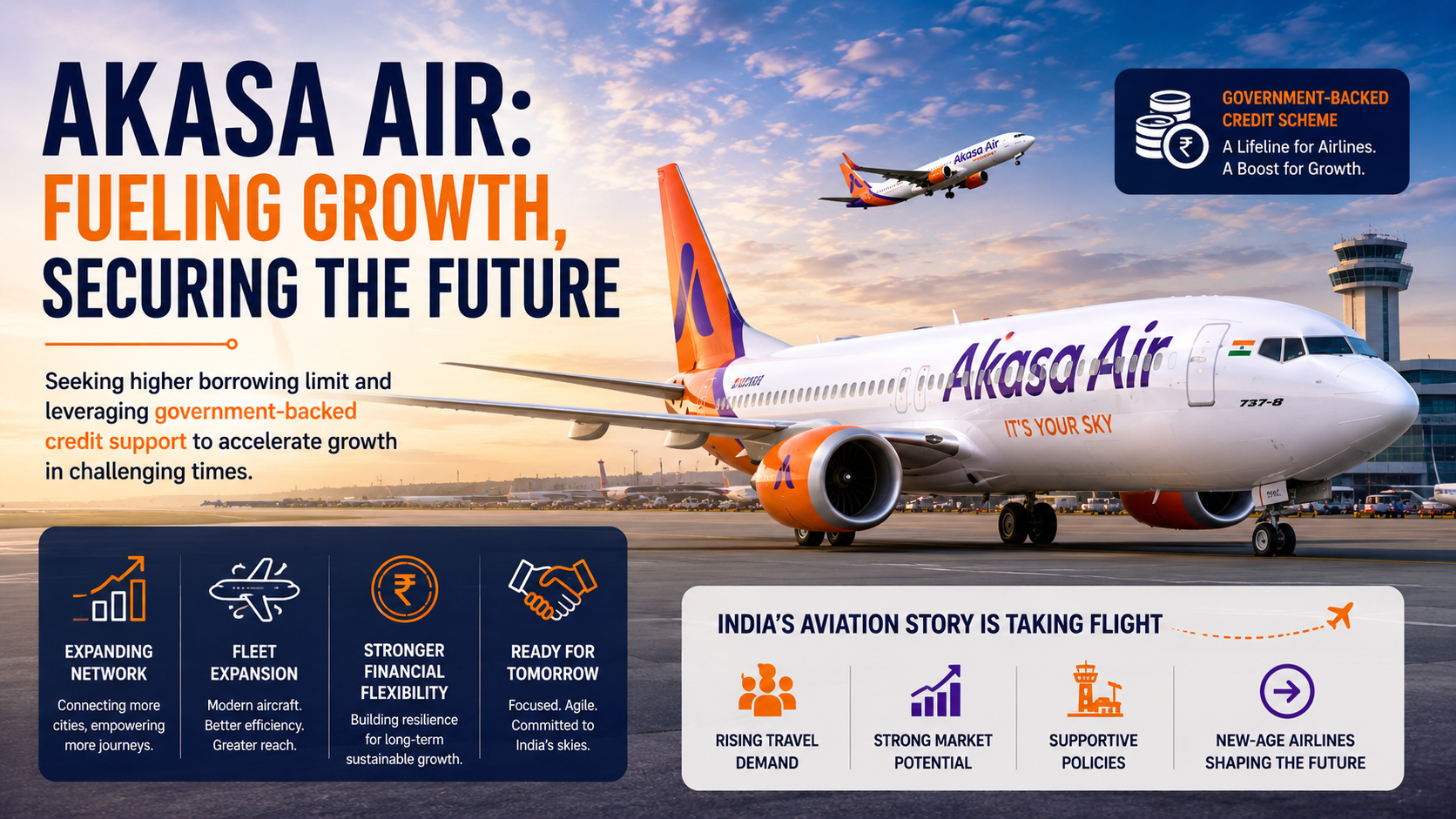
India’s aviation sector is entering a new phase of expansion, driven by rising passenger demand, increasing regional connectivity, and ambitious growth plans from emerging airlines. However, building an airline is one of the most capital-intensive businesses in the world. Aircraft purchases, leasing costs, fuel expenses, airport charges, and operational investments require continuous access to capital.
For Akasa Air, one of India’s newest airlines, the next stage of growth depends not only on expanding its fleet and network but also on strengthening its financial foundation.
The airline’s plans to increase borrowing capacity highlight the challenges and opportunities involved in scaling an aviation business in a highly competitive market. The government’s credit support measures for airlines have also created additional liquidity options as the sector manages rising costs and external disruptions.
Building a New Airline in India’s Competitive Aviation Market
Akasa Air entered India’s aviation industry with a clear ambition: to become a significant low-cost carrier by combining affordable fares, efficient operations, and a modern fleet.
The airline began operations in 2022 and quickly expanded its presence across domestic routes. Unlike traditional carriers with decades of history, Akasa was built in a new era of aviation where efficiency, technology, and cost control are critical.
The airline’s growth strategy has focused on:
- Expanding flight routes across major Indian cities
- Increasing aircraft capacity
- Building brand recognition among travellers
- Creating an efficient low-cost operating model
However, rapid expansion requires substantial financial resources.
Why Airlines Need Constant Capital
Airlines operate with unique financial pressures compared with many other businesses.
A growing airline must continuously invest in:
- Aircraft acquisition or leasing
- Maintenance and engineering capabilities
- Pilot and crew hiring
- Airport infrastructure
- Technology systems
- Marketing and customer acquisition
Even profitable airlines require significant capital because growth often comes before returns.
For a young airline like Akasa, increasing borrowing capacity can provide flexibility to manage expansion while maintaining operational stability.
Government Support Provides a Financial Cushion
The aviation industry has faced multiple challenges in recent years, including high fuel prices, geopolitical uncertainty, and pressure on airline cash flows.
To support businesses facing liquidity stress, the government introduced the Emergency Credit Line Guarantee Scheme (ECLGS) 5.0, which included a dedicated allocation for airlines. Eligible airlines can access government-backed credit support, with aviation-specific provisions allowing loans up to certain limits under the scheme.
Such measures are designed to help airlines maintain operations and manage short-term financial pressure while continuing their growth plans.
The Challenge of Competing With Established Players
India’s aviation industry is dominated by large and established airlines with significant scale advantages.
Companies such as IndiGo have built strong market positions through extensive networks, fleet size, and operational efficiency. Meanwhile, Air India Express is also expanding as part of the broader transformation of the Air India group.
For Akasa, competing effectively requires more than adding aircraft. It needs to achieve high aircraft utilization, maintain cost efficiency, and build customer loyalty.
Expansion Requires a Long-Term Vision
Akasa Air’s strategy is based on the belief that India’s aviation market still has significant growth potential.
India has one of the fastest-growing aviation markets globally, supported by:
- Rising middle-class incomes
- Increased business travel
- Growth of domestic tourism
- Better airport infrastructure
- Greater acceptance of air travel among smaller cities
This creates a strong opportunity for airlines that can scale efficiently.
The company has also previously raised capital from investors to support expansion and strengthen operations.
The Importance of Fleet Growth
For airlines, fleet size directly influences network expansion and revenue opportunities.
More aircraft allow airlines to:
- Add new routes
- Increase flight frequency
- Improve customer convenience
- Capture greater market share
However, fleet expansion also increases costs. Aircraft financing, maintenance obligations, and operational expenses must be carefully managed.
The challenge for Akasa is achieving the right balance between aggressive expansion and financial discipline.
Competition Is Becoming More Intense
The Indian aviation sector is witnessing a major transformation.
While low-cost carriers continue to dominate domestic travel, competition is increasing as airlines expand internationally and strengthen their networks.
The future winners are likely to be companies that can combine:
- Low operating costs
- Strong customer experience
- Reliable service
- Efficient fleet management
- Financial stability
For a young airline, every operational decision can have a major impact on long-term success.
The Road Ahead for Akasa Air
Akasa Air’s borrowing plans represent a broader reality of the aviation business: growth requires capital.
The airline has successfully established itself as a new player in Indian aviation, but the next phase will test its ability to scale sustainably.
Access to funding can help support expansion, but long-term success will depend on execution — maintaining efficiency, controlling costs, and building a strong market position.
Conclusion: Funding the Flight Path Ahead
Akasa Air represents India’s new generation of aviation companies. Its journey reflects both the opportunities and challenges of building an airline in one of the world’s fastest-growing travel markets.
The company’s focus on increasing financial flexibility shows that aviation growth is not only about adding more flights — it is about creating a sustainable business model capable of surviving one of the most competitive industries.
As India’s aviation market continues to expand, Akasa’s ability to manage growth, capital, and competition will determine whether it can become a long-term challenger in the skies.
Feel free to share your experiences and insights in the comments below. Let’s continue the conversation and grow together as a community of traders and analysts.
By sharing this experience and insights, I hope to contribute to the collective knowledge of our professional community, encouraging a culture of strategic thinking and informed decision-making.
As always, thorough research and risk management are crucial. The dynamic nature of financial markets demands vigilance, agility, and a deep understanding of the tools at your disposal. Here’s to profitable trading and navigating the election season with confidence!
Ready to stay ahead of market trends and make informed investment decisions? Follow our page for more insights and updates on the latest in the financial world!
For a free online stock market training by Yogeshwar Vashishtha (M.Tech IIT) this Saturday from 11 am – 1 pm, please sign up with https://pathfinderstrainings.in/training/freetrainings.aspx
Experience profits with my winning algo strategies – get a free one-month trial with ₹15 lakh capital! – https://terminal.algofinders.com/algo-terminal
Disclaimer
This article should not be interpreted as investment advice. For any investment decisions, consult a reputable financial advisor. The author and publisher are not responsible for any losses incurred by investors or traders based on the information provided.