

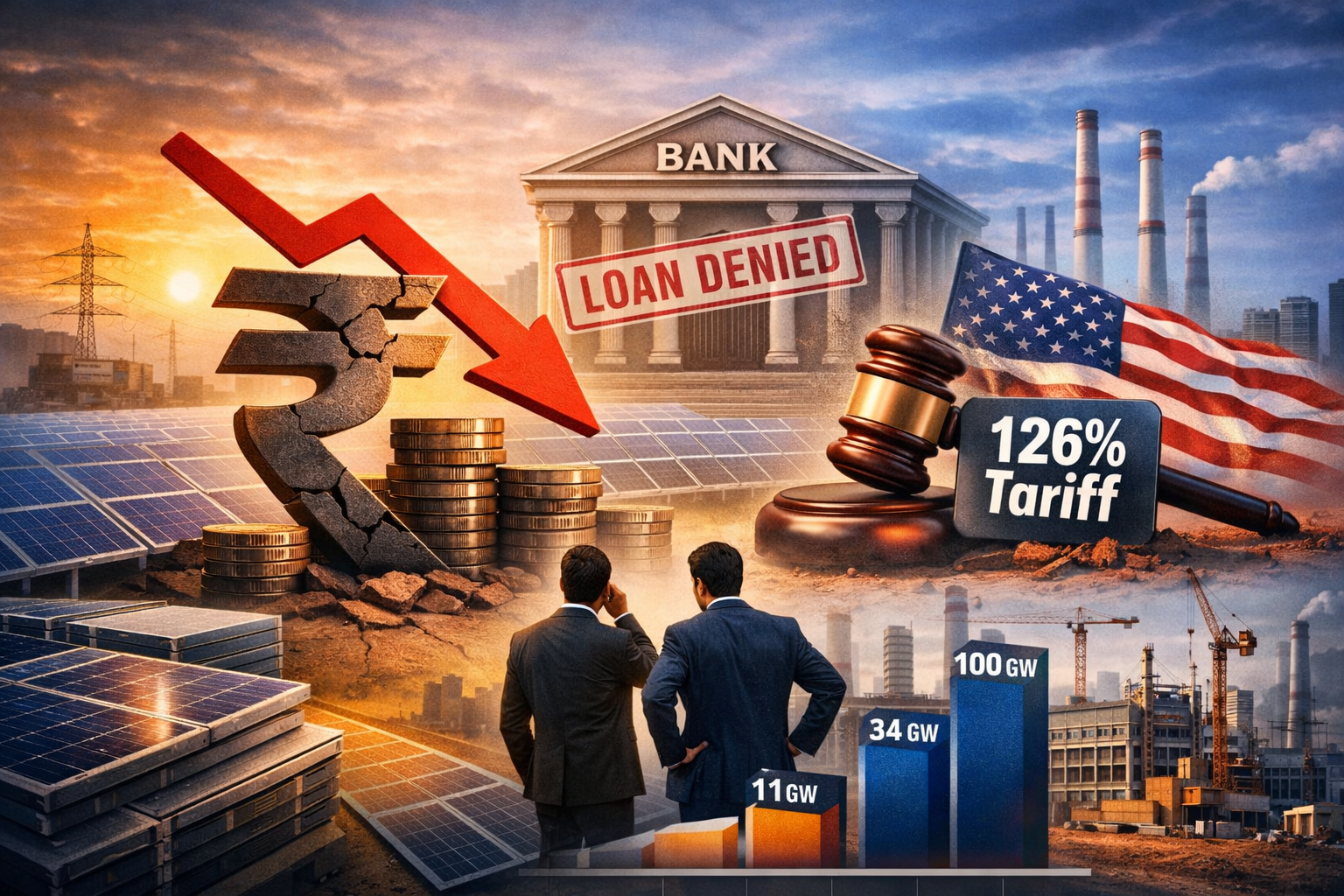
India’s ambitious push toward clean energy has positioned solar power at the heart of its future. With aggressive targets and strong policy backing, the country has witnessed a surge in solar module manufacturing capacity over the past few years. But beneath this rapid expansion lies a growing concern—financial stress. Today, India’s solar module manufacturers are facing a tightening credit environment, as lenders grow cautious amid rising overcapacity, global trade barriers, and evolving industry dynamics.
The Credit Squeeze: When Optimism Meets Caution
The optimism that once fueled easy financing in the solar manufacturing sector is now giving way to prudence. Banks and non-banking financial institutions (NBFCs) are becoming increasingly hesitant to extend fresh loans to new solar module projects.
A key indicator of this shift is the reduction in the loan-to-cost ratio—the proportion of a project financed through debt. By lowering this ratio, lenders are effectively asking companies to invest more of their own equity. This move reflects a deeper concern: the risk of projects becoming financially unviable in an oversupplied market.
Some lenders are even stepping back entirely. As one senior official from a non-bank lender indicated, financing new solar module companies may be off the table—at least for now. This marks a significant turning point for an industry that once enjoyed strong financial backing.
Policy Signals and Global Pressures
The tightening of credit is not happening in isolation. It follows a December advisory from India’s Ministry of New and Renewable Energy (MNRE), urging financial institutions to adopt a cautious approach when funding new solar manufacturing capacity.
Adding to the pressure is the international landscape. A preliminary 126% tariff imposed by the United States on solar modules threatens to severely impact India’s export potential. With the US being a key market, this move risks choking demand and intensifying the domestic supply glut.
Together, these factors have created a perfect storm—where both domestic and global signals are pushing lenders to rethink their exposure to the sector.
Oversupply: The Core of the Problem
India’s solar manufacturing capacity has expanded at an astonishing pace. In just a few years, capacity has jumped from around 11 GW in 2022 to over 100 GW by late 2025.
This rapid growth, however, has outpaced demand.
As more companies entered the market to capitalize on early opportunities, the result has been a crowded landscape with shrinking margins. Banks are now responding by tightening due diligence—carefully evaluating project viability, promoter credibility, and the exact use of funds before approving loans.
In essence, the era of easy expansion is over. Financial discipline is taking center stage.
Industry Evolution: From Boom to Consolidation
The solar module industry is now entering a familiar phase seen in many emerging technologies—market consolidation.
Initially, low entry barriers allowed numerous players to set up module assembly units. But as the industry matures, survival increasingly depends on scale, technology, and integration.
A striking contrast highlights this shift:
- Over 100 module manufacturers operate in India
- Fewer than 10 companies manufacture solar cells
This imbalance underscores the deeper challenge—while assembling modules is relatively simple, producing solar cells and upstream components requires advanced technology and significant capital investment.
The Push Toward Backward Integration
To remain competitive, companies are being encouraged to integrate backwards—moving beyond module assembly into manufacturing cells, ingots, wafers, and even polysilicon.
Each step up the value chain brings higher complexity and larger capital requirements:
- ~1 GW capacity may suffice for module assembly
- 5+ GW is needed for viable cell manufacturing
- 10 GW for ingots
- 20–30 GW for polysilicon
This escalating scale makes it clear why only a handful of well-capitalized players are likely to succeed.
Backward integration also reduces dependence on imports—particularly from China—while increasing domestic value addition, aligning with India’s broader industrial strategy.
The Future: Survival of the Strongest
Looking ahead, the solar manufacturing sector in India is expected to undergo significant consolidation. Industry experts anticipate that only five to seven major players will ultimately dominate the market.
These companies will likely be:
- Deeply integrated across the value chain
- Financially robust
- Technologically advanced
- Capable of operating at massive scale
Large investments are already underway. For instance, leading players are committing tens of thousands of crores toward integrated manufacturing facilities, signaling a long-term bet on consolidation and efficiency.
Conclusion: A Necessary Correction in India’s Solar Journey
India’s solar manufacturing story is far from over—but it is entering a more disciplined phase. The current credit squeeze, while challenging, may ultimately serve as a necessary correction.
By forcing greater financial prudence, encouraging backward integration, and filtering out weaker players, the industry is being reshaped into a more sustainable and competitive ecosystem.
The road ahead may be tougher, but it is also clearer: in India’s solar sector, scale, strategy, and resilience will determine who shines—and who fades.
Feel free to share your experiences and insights in the comments below. Let’s continue the conversation and grow together as a community of traders and analysts.
By sharing this experience and insights, I hope to contribute to the collective knowledge of our professional community, encouraging a culture of strategic thinking and informed decision-making.
As always, thorough research and risk management are crucial. The dynamic nature of financial markets demands vigilance, agility, and a deep understanding of the tools at your disposal. Here’s to profitable trading and navigating the election season with confidence!
Ready to stay ahead of market trends and make informed investment decisions? Follow our page for more insights and updates on the latest in the financial world!
For a free online stock market training by Yogeshwar Vashishtha (M.Tech IIT) this Saturday from 11 am – 1 pm, please sign up with https://pathfinderstrainings.in/training/freetrainings.aspx
Experience profits with my winning algo strategies – get a free one-month trial with ₹15 lakh capital! – https://terminal.algofinders.com/algo-terminal
Disclaimer
This article should not be interpreted as investment advice. For any investment decisions, consult a reputable financial advisor. The author and publisher are not responsible for any losses incurred by investors or traders based on the information provided.