

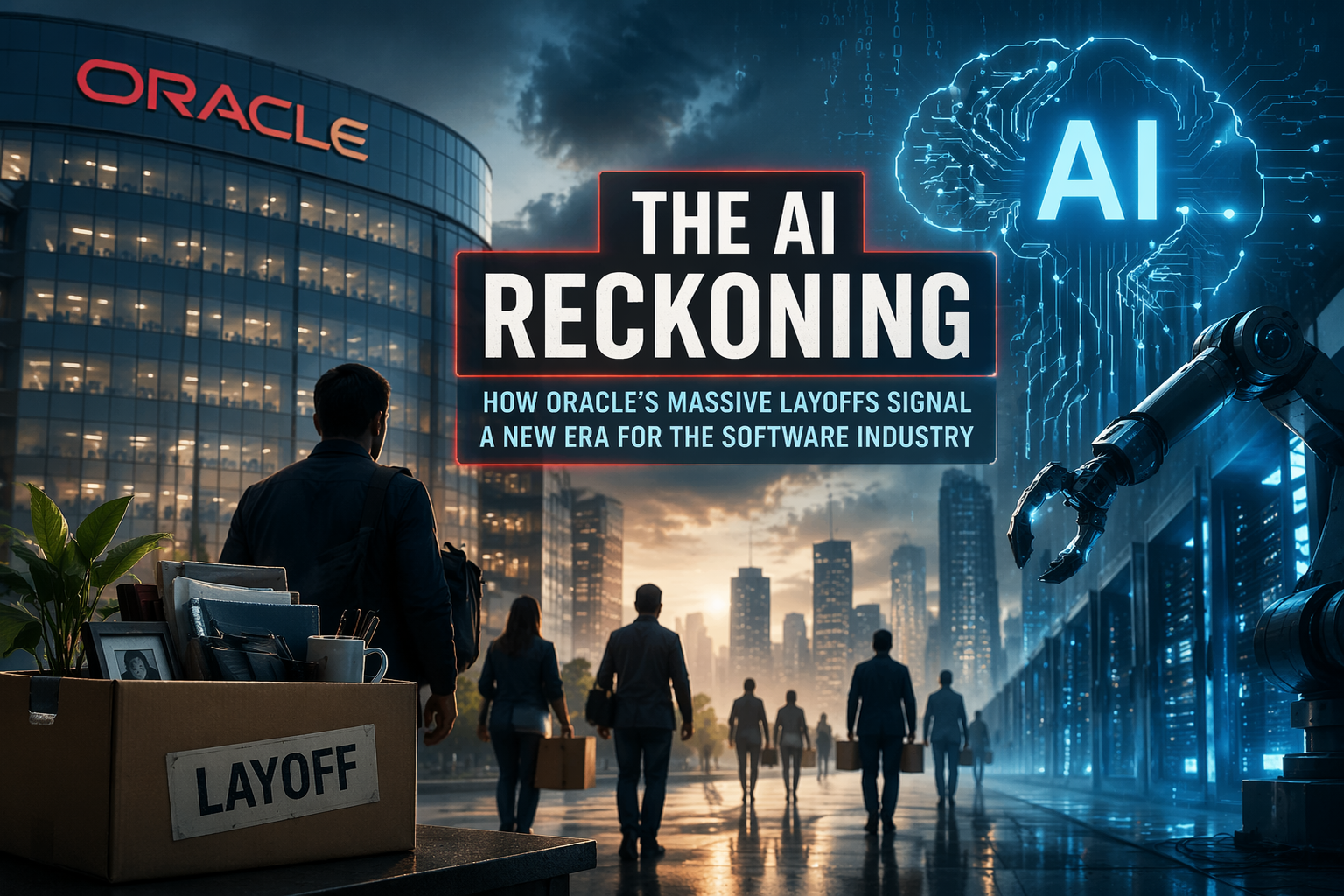
The global technology landscape is undergoing a dramatic transformation, and few events illustrate this shift more starkly than Oracle Corporation’s recent decision to lay off approximately 30,000 employees—nearly one-fifth of its workforce. What initially appears as a corporate restructuring move is, in reality, a reflection of deeper structural changes driven by artificial intelligence (AI), automation, and evolving business priorities. This moment is not just about one company—it marks a turning point for the entire software industry.
A Sudden Shock Across the Workforce
Oracle’s layoffs were executed with striking speed and uniformity. Employees across departments—from engineering and sales to human resources—received early morning emails informing them of their termination due to “broader organisational change.”
For many, the experience was abrupt and disorienting. Some initially believed the notification was a mistake or prank, only to realize its seriousness when system access was revoked. Even employees who had actively reskilled themselves found their roles deemed redundant, highlighting a harsh reality: adaptability alone is no longer sufficient when the nature of work itself is changing.
India, a major hub for Oracle with around 30,000 employees, has been particularly affected, with estimates suggesting that nearly half of the layoffs may occur there.
The Real Driver: AI and Strategic Reallocation
At the heart of these layoffs lies a strategic pivot toward artificial intelligence. Oracle, like many technology firms, is redirecting resources from labor-intensive operations to AI-driven infrastructure and innovation.
A key factor is Oracle’s massive partnership with OpenAI, involving a $300 billion investment in computing power over five years. This requires significant expansion in data center capacity—an expensive endeavor that necessitates cost-cutting elsewhere.
In this context, layoffs become less about performance and more about capital allocation. Companies are increasingly choosing to invest in machines and infrastructure rather than human labor, especially when AI tools can perform tasks faster and more efficiently.
The Rise of Lean Tech Organizations
Industry experts suggest that Oracle’s move is part of a broader trend toward leaner organizational structures. The traditional model of large engineering teams is being replaced by smaller, more agile units powered by AI tools.
AI coding assistants and automation platforms are enabling fewer employees to accomplish more. This doesn’t necessarily mean AI is directly replacing workers overnight, but it is reducing the need for large teams and multiple management layers.
The implication is clear: efficiency is now measured not by headcount but by output per employee.
A Ripple Effect Across the SaaS Industry
Oracle’s decision is unlikely to remain an isolated case. Analysts predict a “rolling wave” of similar actions across SaaS (Software-as-a-Service) and enterprise software companies over the next 12 to 24 months.
Several factors are contributing to this trend:
- Pressure to maintain profit margins
- High investment requirements for AI infrastructure
- Shift from operational expenditure (labor) to capital expenditure (technology)
- Automation of routine and support functions
Roles tied to customization, support, and routine operations are especially vulnerable as AI systems evolve from assistants to autonomous agents capable of executing workflows independently.
Financial Pressures and Investor Sentiment
Oracle’s financial situation also sheds light on the timing of these layoffs. Despite strong operating margins, the company carries significant net debt—around $82 billion—prompting a need for tighter financial discipline.
Meanwhile, investor sentiment toward software companies has become increasingly cautious. Stock prices across major tech firms have declined, reflecting concerns about the long-term impact of AI disruption.
Interestingly, even as companies invest heavily in AI, the market is still uncertain about how these investments will translate into sustainable growth.
The Human Cost of Technological Progress
Beyond strategy and numbers lies the human dimension. Employees described the layoffs as unsettling and, in many cases, unexpected. Freshers saw job offers put on hold, while experienced professionals with decades of service found themselves suddenly displaced.
Yet, there were exceptions. Some employees retained their roles by aligning closely with AI initiatives—such as presenting AI adoption roadmaps—indicating a new criterion for job security: relevance to the AI-driven future.
What This Means for the Future of Work
Oracle’s layoffs offer several critical insights into the future of the software industry:
1. AI Will Redefine Job Roles
Jobs won’t disappear entirely, but they will evolve. Roles that involve repetitive, rule-based tasks are most at risk.
2. Continuous Learning Is Necessary—but Not Sufficient
Reskilling must be aligned with industry direction, particularly AI and data-driven technologies.
3. Organizational Structures Will Become Flatter
Fewer layers of management and smaller teams will become the norm.
4. Capital Will Flow Toward Infrastructure
Companies will prioritize investments in AI infrastructure over workforce expansion.
Conclusion: A Defining Moment for the Tech Industry
Oracle’s layoffs are more than a corporate decision—they are a signal of a paradigm shift. As AI reshapes the foundations of the software industry, companies are rethinking how they operate, invest, and grow.
For professionals, the message is clear: the future belongs to those who can align themselves with emerging technologies and evolving business priorities. For companies, the challenge lies in balancing innovation with responsibility, ensuring that progress does not come at an unsustainable human cost.
The age of AI is not just arriving—it is restructuring the very fabric of work.
Feel free to share your experiences and insights in the comments below. Let’s continue the conversation and grow together as a community of traders and analysts.
By sharing this experience and insights, I hope to contribute to the collective knowledge of our professional community, encouraging a culture of strategic thinking and informed decision-making.
As always, thorough research and risk management are crucial. The dynamic nature of financial markets demands vigilance, agility, and a deep understanding of the tools at your disposal. Here’s to profitable trading and navigating the election season with confidence!
Ready to stay ahead of market trends and make informed investment decisions? Follow our page for more insights and updates on the latest in the financial world!
For a free online stock market training by Yogeshwar Vashishtha (M.Tech IIT) this Saturday from 11 am – 1 pm, please sign up with https://pathfinderstrainings.in/training/freetrainings.aspx
Experience profits with my winning algo strategies – get a free one-month trial with ₹15 lakh capital! – https://terminal.algofinders.com/algo-terminal
Disclaimer
This article should not be interpreted as investment advice. For any investment decisions, consult a reputable financial advisor. The author and publisher are not responsible for any losses incurred by investors or traders based on the information provided.