

Adani Group is exploring a significant restructuring of the debt associated with its landmark acquisition of Ambuja Cements and ACC, potentially using one of the conglomerate’s fastest-growing privately held businesses to raise fresh financing.
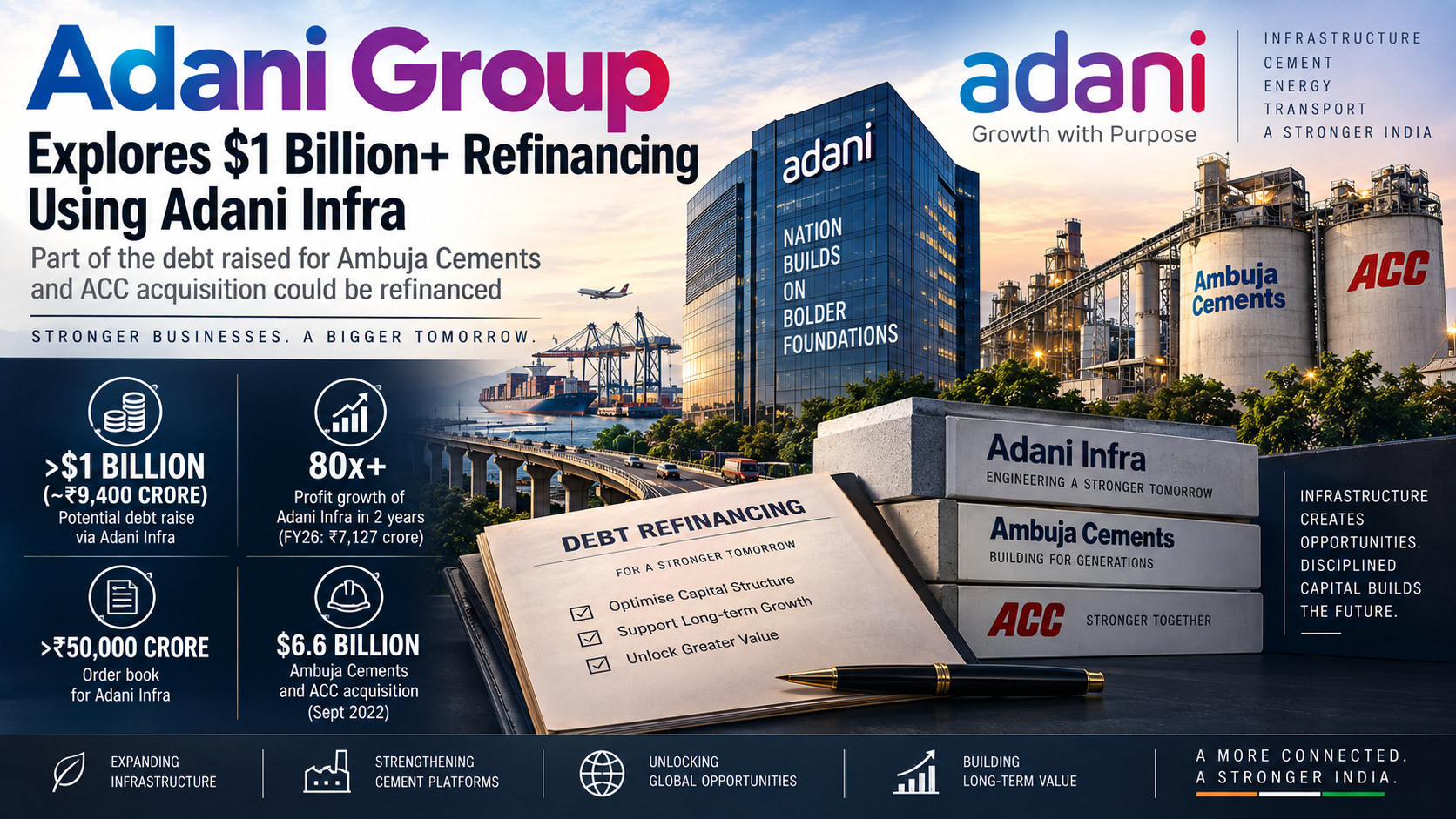
The group is considering raising more than $1 billion—approximately ₹9,400 crore—through promoter-owned Adani Infra (India) Ltd. The proceeds could be used to refinance part of the debt originally raised by the Adani family to finance the acquisition of Ambuja Cements and ACC.
The proposal remains at an early stage and the final amount has not yet been decided. However, the potential transaction demonstrates how dramatically Adani Infra’s financial position has changed over the past two years.
Once primarily an internal infrastructure-services company, Adani Infra has emerged as a highly profitable engineering, procurement and construction platform with an order book exceeding ₹50,000 crore and FY26 profit of more than ₹7,000 crore.
That financial strength could now be used to secure funding at more attractive interest rates and potentially reshape the financing structure behind one of the Adani Group’s largest acquisitions.
The ₹9,400 Crore-Plus Refinancing Plan
The proposed transaction centres on Adani Infra raising fresh debt and using the proceeds to refinance part of the borrowings connected with the Ambuja Cements and ACC acquisition.
The amount under consideration could exceed $1 billion, although the final size of the borrowing remains undecided.
Foreign banks could potentially participate through a syndicated loan structure, while private credit funds are another possible source of financing.
For Adani Group, the objective would be straightforward: use the increasingly strong financial profile of Adani Infra to obtain favourable borrowing terms.
Adani Infra now possesses both a substantial order book and significant profitability, potentially making it an attractive borrower for international lenders.
The Debt Goes Back to the Ambuja-ACC Acquisition
The refinancing proposal can be traced back to Adani Group’s entry into India’s cement industry.
In September 2022, the group completed the approximately $6.6 billion acquisition of Holcim’s controlling stakes in Ambuja Cements and ACC.
The transaction instantly transformed Adani into one of India’s largest cement producers and created a major new pillar within the conglomerate’s infrastructure portfolio.
Large acquisitions of this nature typically involve substantial bridge financing that is later replaced with longer-term borrowing.
In October 2023, Endeavour Trade and Investment Ltd., a Mauritius-based private entity controlled by the Adani family, raised $3.5 billion from a consortium of 10 international banks.
The three-year financing was used to refinance bridge loans originally taken for the Ambuja-ACC transaction.
The latest proposal involving Adani Infra could represent another stage in the evolution of that acquisition financing.
Why Adani Infra Has Become Important
The most interesting part of the proposed refinancing is not necessarily the amount being borrowed—it is the company that could raise it.
Adani Infra has undergone an extraordinary transformation.
At the beginning of FY25, the company was designated as the central project management consultant and engineering, procurement and construction arm for the Adani Group.
Previously, individual Adani companies maintained separate project-management teams.
Under the new structure, Adani Infra became the nodal agency responsible for infrastructure execution across the conglomerate.
Its activities include engineering and design, procurement of materials, project monitoring, contract closure and asset-management planning.
Centralising these functions can potentially improve purchasing efficiency, logistics, inventory management and utilisation of engineering resources across the group.
Profit Surges to ₹7,127 Crore
The financial impact of Adani Infra’s expanded role has been dramatic.
The company reported approximately ₹7,127 crore in profit during FY26.
That represents an increase of more than 80 times in just two years following its appointment as the group’s captive project-management and EPC arm.
Revenue from operations has also surged.
Annual operating revenue climbed roughly 13-fold to ₹11,301 crore.
These numbers have transformed Adani Infra into one of the more significant privately held cash-generating businesses within the broader Adani ecosystem.
Its order book has also crossed ₹50,000 crore, providing lenders with greater visibility over potential future revenue and cash generation.
Adani’s Massive Infrastructure Spending Supports the Business
Adani Infra’s rapid expansion is closely linked to the enormous capital expenditure being undertaken across the wider Adani Group.
The conglomerate’s businesses span ports, airports, electricity transmission, renewable energy, thermal power, roads, data centres and other infrastructure sectors.
During FY26 alone, Adani Group said its capital expenditure exceeded ₹1.5 trillion, or ₹1.5 lakh crore.
A centralised engineering and project-management company can capture a substantial portion of the activity created by this investment programme.
Around 95% of Adani Infra’s revenue currently comes from other Adani Group companies.
That concentration creates an obvious dependence on the group’s internal capital expenditure programme, but it also gives Adani Infra a large pipeline of projects as long as Adani continues investing aggressively in infrastructure.
Credit Agencies Expect Meaningful Surplus Cash Flow
Adani Infra’s improving financial profile has also attracted attention from credit-rating agencies.
India Ratings & Research has highlighted the company’s involvement across engineering, procurement, contract management and asset planning.
According to the rating agency’s assessment, the centralised structure could improve cost optimisation, resource utilisation, logistics and inventory management across Adani Group.
More importantly from a financing perspective, India Ratings expects Adani Infra to generate meaningful surplus cash flow between FY26 and FY29 based on its order book and management’s projections.
That expectation helps explain why the company could become an attractive vehicle for refinancing acquisition-related debt.
A lender assessing Adani Infra today is looking at a significantly different business from the one that existed only a few years ago.
Dollar Bond Plan Was Previously Considered
This is not the first time Adani Group has considered using Adani Infra to access international debt markets.
The group had previously explored raising as much as $1 billion through dollar-denominated bonds issued by Adani Infra.
However, that proposal was shelved amid turmoil in global debt markets following escalating conflict involving the US, Israel and Iran.
The latest approach could therefore involve a different funding structure.
Instead of relying exclusively on international bond markets, Adani Infra could raise a syndicated loan from foreign banks.
Private credit funds could also participate.
Having several potential funding channels gives the group greater flexibility to compare borrowing costs, maturities and covenant structures before deciding how to proceed.
Why Refinancing Matters
Refinancing does not necessarily mean that the overall debt disappears.
Instead, existing borrowing is replaced with new financing that may offer more favourable characteristics.
The benefits can include lower interest rates, longer repayment periods, improved covenant terms or a more suitable borrowing structure.
For a large conglomerate, even relatively small changes in borrowing costs can have a significant financial impact when billions of dollars of debt are involved.
The attractiveness of the proposed Adani Infra transaction therefore depends heavily on whether the company can secure better financing terms than those attached to the existing acquisition debt.
Its ₹7,127 crore annual profit, ₹50,000 crore-plus order book and expectations of strong future cash generation could strengthen that negotiating position.
Adani Infra Is Already Deploying Its Growing Financial Strength
Adani Infra’s rapidly expanding financial resources are not being used solely for infrastructure execution.
Since the beginning of 2026, the company has also become an important buyer of shares in listed Adani Group businesses.
Over approximately nine months, Adani Infra spent a cumulative ₹11,653 crore purchasing shares in four listed companies:
Adani Enterprises, Adani Energy Solutions, Adani Green Energy and Adani Power.
The investments demonstrate the scale of capital now available within the company.
Adani Infra is wholly controlled by the S.B. Adani Family Trust and other group entities, making it an important privately held component of the promoter ecosystem.
Its growing financial importance therefore extends beyond simply executing infrastructure projects.
A New Financial Role for Adani Infra
The potential refinancing illustrates how Adani Infra’s role within the conglomerate may be evolving.
Initially, its importance came from centralising project execution.
That allowed Adani Group to consolidate engineering, procurement and project-management expertise across its rapidly expanding infrastructure portfolio.
But the resulting increase in revenue and profitability has created another possibility.
Adani Infra can potentially use its own financial strength to access capital markets and banking relationships.
That means the company could gradually become both an operational infrastructure platform and a strategically important financing vehicle within the promoter-controlled group structure.
The proposed Ambuja-ACC refinancing would be a significant demonstration of that expanded role.
Cement Remains a Major Strategic Business for Adani
The original acquisition itself remains strategically important.
Buying Ambuja Cements and ACC gave Adani an immediate large-scale position in India’s cement industry rather than requiring the conglomerate to spend years building capacity organically.
Cement fits naturally with Adani’s wider infrastructure exposure.
The group is already heavily involved in ports, logistics, roads, airports, energy and construction-related infrastructure—all sectors closely linked with India’s long-term investment cycle.
Since the acquisition, Adani’s cement strategy has continued expanding through capacity additions, acquisitions and consolidation.
The financing behind the original transaction therefore supports a business that has become an increasingly important component of the group’s overall portfolio.
The Key Question Is the Cost of Capital
The ultimate significance of the proposed transaction will depend on the terms Adani Infra can obtain.
If lenders are willing to provide more than $1 billion at attractive interest rates because of the company’s rapidly improving earnings and substantial order book, refinancing could reduce the effective cost of financing associated with the cement acquisition.
It could also demonstrate renewed confidence among international lenders in financing Adani-related entities.
However, the proposal remains preliminary.
The amount could change, the financing structure could evolve, and the group could ultimately decide against proceeding through Adani Infra.
The existing acquisition debt’s current refinancing status is also not entirely clear.
These uncertainties mean the proposal should currently be viewed as a potential financing strategy rather than a completed transaction.
From Internal EPC Arm to ₹7,000 Crore Profit Powerhouse
The larger story is the transformation of Adani Infra itself.
In only two years, the company has moved from being a relatively less-visible private group entity to one of Adani’s most profitable businesses.
Its operating revenue has increased roughly 13-fold to ₹11,301 crore.
Profit has climbed to ₹7,127 crore.
Its order book exceeds ₹50,000 crore.
It has invested ₹11,653 crore in listed Adani Group companies during 2026.
And now it could potentially raise more than $1 billion from international lenders to help refinance debt associated with the group’s landmark cement acquisition.
That progression illustrates how Adani Group is increasingly centralising both infrastructure execution and financial resources within selected entities.
A Potentially Important Step in Adani’s Capital Strategy
If completed, the proposed Adani Infra borrowing could represent an important next step in the group’s post-acquisition capital strategy.
The Ambuja Cements and ACC transaction required billions of dollars of financing. Several years later, Adani now has a rapidly growing private infrastructure business capable of potentially supporting a portion of that debt on more favourable terms.
The transaction would effectively connect two major parts of Adani’s expansion story: the group’s aggressive infrastructure investment programme, which helped transform Adani Infra into a highly profitable company, and its $6.6 billion entry into India’s cement industry.
The immediate objective may be refinancing.
But the broader implication is more significant.
Adani Infra is emerging as an increasingly powerful financial and operational asset within the promoter-controlled Adani ecosystem. If its earnings and cash generation continue growing alongside the group’s massive infrastructure investment programme, its role could extend far beyond project management.
The company that was created to help Adani execute infrastructure projects may now also help finance the conglomerate’s next stage of growth.
Feel free to share your experiences and insights in the comments below. Let’s continue the conversation and grow together as a community of traders and analysts.
By sharing this experience and insights, I hope to contribute to the collective knowledge of our professional community, encouraging a culture of strategic thinking and informed decision-making.
As always, thorough research and risk management are crucial. The dynamic nature of financial markets demands vigilance, agility, and a deep understanding of the tools at your disposal. Here’s to profitable trading and navigating the election season with confidence!
Ready to stay ahead of market trends and make informed investment decisions? Follow our page for more insights and updates on the latest in the financial world!
For a free online stock market training by Yogeshwar Vashishtha (M.Tech IIT) this Saturday from 11 am – 1 pm, please sign up with https://pathfinderstrainings.in/training/freetrainings.aspx
Experience profits with my winning algo strategies – get a free one-month trial with ₹15 lakh capital! – https://terminal.algofinders.com/algo-terminal
Disclaimer
This article should not be interpreted as investment advice. For any investment decisions, consult a reputable financial advisor. The author and publisher are not responsible for any losses incurred by investors or traders based on the information provided.