

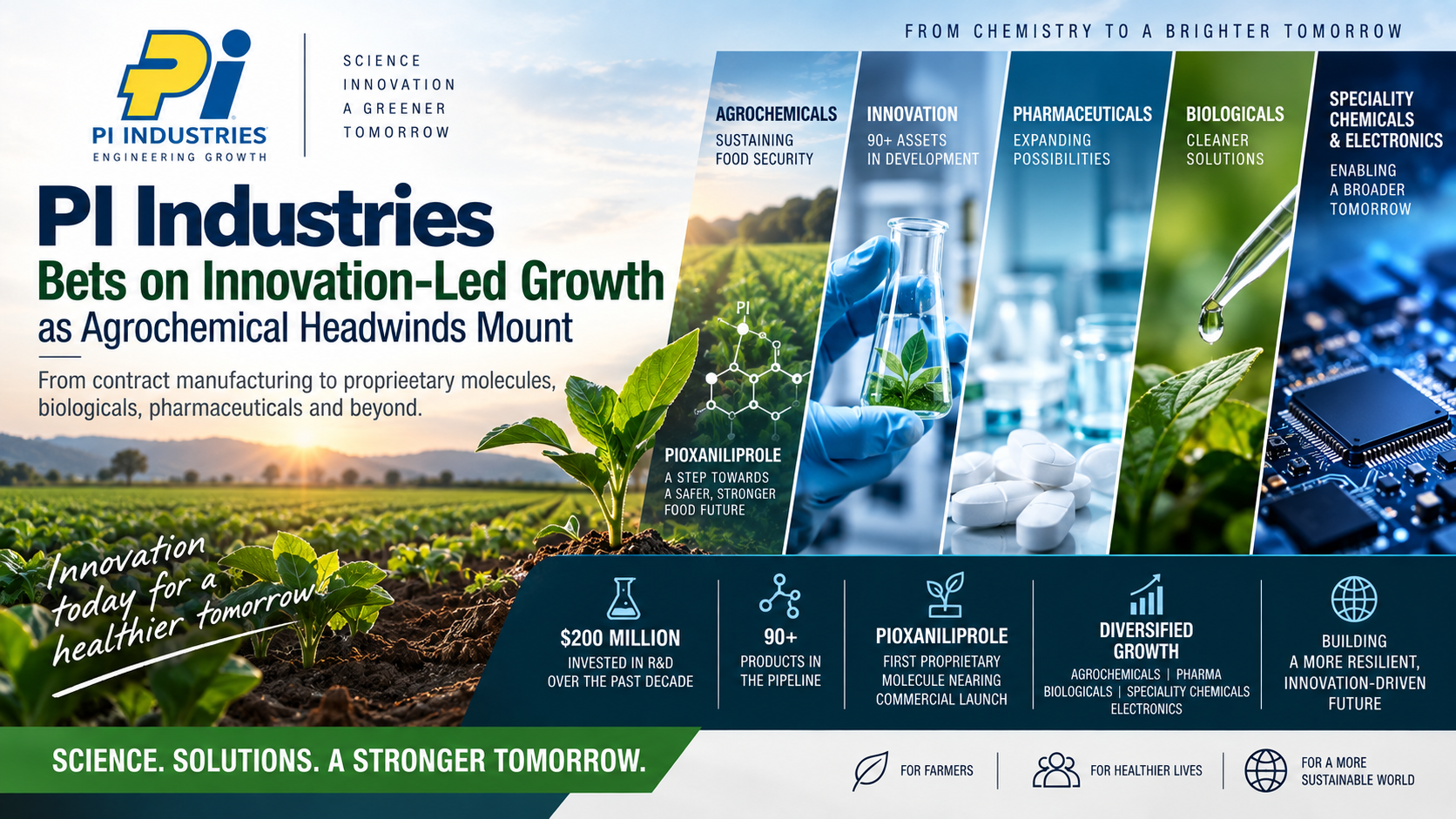
PI Industries is preparing for a major transformation as weakness in the global agrochemical industry forces the company to look beyond its traditional contract-manufacturing model and build its next phase of growth around innovation.
The company is increasing its focus on proprietary molecules developed through its own research capabilities while simultaneously expanding into pharmaceuticals, biological products, speciality chemicals and electronics.
The strategy comes at an important time. Falling agrochemical prices, excess global capacity, intense Chinese competition, geopolitical uncertainty and unpredictable weather have created a difficult operating environment for the industry.
PI Industries has already felt the impact. Revenue declined 10% year-on-year to ₹1,702 crore during the first quarter of FY27, while net profit dropped 39% to ₹244 crore.
Rather than treating these pressures simply as a cyclical slowdown, PI Industries is using them as an opportunity to fundamentally change the nature of its business.
From Contract Manufacturing to Innovation
For years, PI Industries built a successful business by manufacturing complex agrochemical products for major global innovators.
That model gave the company scale, technological capabilities and deep relationships with international customers.
However, management increasingly believes that relying primarily on cost-plus manufacturing may not provide a sufficiently strong competitive advantage over the long term.
The company’s next objective is therefore to own more of the intellectual property and innovation behind the products it manufactures.
Instead of merely producing molecules developed by customers, PI wants to discover and develop proprietary products itself.
The transition has the potential to move the company higher up the value chain and create stronger competitive barriers.
$200 Million Invested in Research
PI Industries has spent approximately $200 million over the past decade developing its internal research capabilities.
That investment is now beginning to produce tangible results.
The company currently has around 90 assets under development across its innovation pipeline.
Developing proprietary molecules is considerably more difficult than conventional contract manufacturing. Research can take years, regulatory approvals are expensive, and many potential products never reach commercialisation.
But successful molecules can create substantially greater long-term value.
This is the trade-off PI Industries is increasingly willing to accept.
The company believes innovation can create a competitive moat that is difficult to replicate through manufacturing scale or lower costs alone.
Pioxaniliprole Could Become a Major Milestone
The first major test of PI Industries’ innovation strategy is Pioxaniliprole, an internally developed insecticide.
The molecule is designed for crops including corn and rice and is expected to become PI’s first proprietary innovative product to reach commercial markets.
The company expects regulatory approval in India during the current year, followed by launches in international markets through partnerships.
PI plans to file for approval in the United States next year, with Brazil expected to follow subsequently.
Potential markets also include Mexico and other parts of Latin America.
Management estimates that Pioxaniliprole could address an opportunity of approximately $100 million across India and international markets.
For PI Industries, however, the strategic significance could be even larger than the immediate revenue opportunity.
A successful launch would demonstrate that the company can move from being a manufacturing partner for global innovators to becoming an innovator itself.
More Proprietary Molecules Are Coming
Pioxaniliprole is only the beginning of PI Industries’ proprietary research programme.
Two additional molecules are already at advanced stages of development and are expected to be announced in the future.
Overall, approximately 90 assets are progressing through the company’s development pipeline.
Not all of these products will necessarily reach commercialisation.
Drug and agrochemical discovery inherently involves high failure rates, long development timelines and significant regulatory risk.
But a broad pipeline increases the probability that some products will eventually become commercially successful.
If PI can repeatedly develop proprietary molecules, its long-term business model could become substantially more diversified and innovation-driven.
Why the Agrochemical Industry Is Under Pressure
PI Industries’ strategic transformation is occurring against one of the more difficult environments faced by the global agrochemical industry in recent years.
Several factors are affecting demand and profitability simultaneously.
Excess manufacturing capacity has created pricing pressure across parts of the chemicals industry.
Chinese manufacturers remain aggressive competitors in several global markets.
Weather disruptions, including the impact of El Niño, have affected agricultural demand.
Macroeconomic uncertainty has made customers more cautious.
Geopolitical instability has added another layer of complexity to global supply chains.
Together, these factors have reduced visibility for companies heavily dependent on traditional agrochemical manufacturing.
PI Industries is therefore attempting to reduce its exposure to these structural risks before they become a permanent constraint on growth.
FY27 Expectations Have Become More Cautious
The challenging operating environment has already forced analysts and management to reassess near-term expectations.
PI Industries’ first-quarter FY27 revenue declined 10% to ₹1,702 crore, while net profit fell 39% to ₹244 crore.
Management has also lowered its FY27 revenue growth expectations to low single digits, compared with its earlier expectation of high-single-digit to low-double-digit growth.
Kotak Institutional Equities subsequently reduced its FY28 earnings-per-share estimate for PI Industries by 12.6% to ₹84.20.
The near-term picture therefore remains challenging.
However, management expects FY27 to perform better than FY26, supported by a potential recovery in exports during the second half of the year, new product launches and the gradual scaling up of pharmaceutical and biological businesses.
Export Recovery Could Provide Near-Term Support
Exports have historically been an important component of PI Industries’ growth story.
Weak global agrochemical demand has therefore had a significant impact on the company’s performance.
Management expects conditions to begin improving during the second half of FY27.
A recovery in international demand, combined with new product launches, could provide some relief to the core business while newer divisions continue developing.
This distinction is important because PI’s diversification initiatives will not become major earnings contributors overnight.
Businesses such as pharmaceutical CRDMO and proprietary molecule development require years of investment before reaching meaningful scale.
The existing agrochemical business therefore remains essential for funding the company’s transition.
Biologicals Could Reduce Dependence on Traditional Chemicals
Another important component of PI Industries’ diversification strategy is biological crop protection.
The company acquired PREtec in 2024 to strengthen its capabilities in environmentally friendly biopesticides.
Biological crop-protection products use naturally derived mechanisms and organisms to protect crops rather than relying exclusively on conventional synthetic chemicals.
Demand for such products could increase as agricultural companies and regulators place greater emphasis on sustainability and environmentally responsible farming.
For PI Industries, biologicals provide an opportunity to complement its existing chemical expertise rather than abandon it.
The company can potentially combine traditional chemistry, biological technologies and proprietary research to develop broader crop-protection solutions.
This could also reduce its dependence on segments facing intense commodity-like pricing pressure.
Pharmaceuticals Could Become a Major New Growth Engine
PI Industries is also building a pharmaceutical contract research, development and manufacturing organisation, or CRDMO, business.
The pharmaceutical opportunity is strategically attractive because many of the capabilities required—complex chemistry, process development, regulatory compliance and sophisticated manufacturing—overlap with expertise PI has developed through agrochemicals.
Management has indicated that enquiries within the pharmaceutical CRDMO business have increased significantly.
However, the company is also realistic about the timeline.
Meaningful progress is expected to become visible over the next two to three years.
Pharmaceutical outsourcing relationships take considerable time to develop because customers require extensive validation before transferring critical manufacturing processes to a new supplier.
Once established, however, these relationships can potentially become long-lasting and commercially attractive.
Electronics and Speciality Chemicals Add Another Layer of Diversification
PI Industries is not restricting its diversification to pharmaceuticals and biological products.
The company is also developing manufacturing capabilities in speciality chemicals and electronics.
These areas broaden PI’s potential customer base beyond agriculture and reduce dependence on a single end market.
The strategy reflects a broader trend among India’s leading chemical companies.
As competition increases in conventional manufacturing, companies are attempting to move toward specialised products where technical expertise, intellectual property and customer relationships matter more than simply offering the lowest production cost.
PI’s experience in complex chemistry provides a foundation for pursuing these opportunities.
Moving Away From Price Competition
At the centre of PI Industries’ strategy is a simple economic objective: avoid competing primarily on price.
Traditional cost-plus manufacturing can generate attractive returns when demand is strong and capacity is limited.
But the model becomes more vulnerable when global capacity expands.
If several manufacturers can produce similar products, customers gain greater bargaining power and margins can decline.
Proprietary molecules change that equation.
A differentiated product protected by intellectual property or specialised know-how cannot easily be replaced by a cheaper supplier.
This is why PI Industries increasingly views innovation as a competitive moat.
The company is effectively accepting greater research risk today in exchange for the possibility of stronger pricing power and more sustainable margins in the future.
The Transformation Will Take Time
PI Industries’ new strategy should not be viewed as a quick solution to the current agrochemical slowdown.
Developing proprietary products can take many years.
Pharmaceutical CRDMO relationships require lengthy qualification processes.
Biological platforms need regulatory approvals and market acceptance.
New speciality-chemical and electronics businesses must develop customers and manufacturing scale.
The transformation therefore carries significant execution risk.
PI must continue generating cash from its established agrochemical operations while funding several businesses whose commercial potential may only become clear years later.
That makes capital allocation particularly important.
The company needs to invest aggressively enough to build future growth engines without undermining returns in its existing business.
Innovation Could Fundamentally Change PI Industries
If successful, the strategy could significantly alter the way investors view PI Industries.
Historically, the company has largely been associated with agrochemical contract manufacturing and custom synthesis.
A future PI Industries could look considerably different.
Its portfolio could include proprietary crop-protection molecules, biological agricultural products, pharmaceutical research and manufacturing, speciality chemicals and electronics-related products.
Such diversification would reduce dependence on a single industry cycle.
More importantly, proprietary innovation could potentially improve the quality of earnings by creating stronger intellectual-property-driven competitive advantages.
Pioxaniliprole Will Be an Important Test
The launch of Pioxaniliprole will therefore be watched closely.
Commercial success would validate years of investment in internal research and demonstrate that PI Industries can independently develop globally relevant molecules.
It could also establish a template for the company’s remaining innovation pipeline.
With two additional molecules approaching advanced stages and around 90 assets under development, PI has created multiple potential opportunities.
The challenge will be converting scientific progress into commercially successful products.
Innovation pipelines often look impressive on paper, but ultimately their value depends on regulatory approvals, customer adoption and profitability.
Near-Term Pressure, Long-Term Transformation
PI Industries currently finds itself between two different business cycles.
Its traditional agrochemical operations are facing immediate pressure from weaker demand, lower prices, excess capacity and global competition.
At the same time, the businesses intended to drive its future—proprietary molecules, pharmaceuticals, biologicals, speciality chemicals and electronics—are still developing.
That creates a difficult transition period.
Near-term financial performance may remain volatile while investment in future growth continues.
But the strategy also gives PI Industries an opportunity to emerge as a substantially more diversified and innovation-driven company.
Building the Next PI Industries
For an 80-year-old organisation, PI Industries is effectively attempting to reinvent itself.
The company is moving away from the idea that manufacturing efficiency alone can provide a sustainable long-term advantage.
Instead, it wants research, intellectual property and specialised capabilities to become the foundation of its competitive position.
Approximately $200 million invested in research over the past decade has created a pipeline of around 90 assets. Pioxaniliprole is approaching its first commercial launch. Two more proprietary molecules are in advanced development. Biological capabilities are expanding, pharmaceutical CRDMO enquiries are increasing, and new opportunities are being explored in speciality chemicals and electronics.
None of these initiatives guarantees success.
Innovation is expensive, risky and slow.
But remaining dependent on conventional contract manufacturing carries its own risks as global competition intensifies and pricing pressure increases.
PI Industries has therefore chosen transformation over complacency.
The next several years will determine whether the company can convert its scientific capabilities into commercially successful products and build multiple businesses capable of reducing its dependence on the volatile agrochemical cycle.
If it succeeds, PI Industries may eventually be known not merely as one of India’s leading agrochemical manufacturers, but as a diversified science and technology company built around proprietary innovation.
Feel free to share your experiences and insights in the comments below. Let’s continue the conversation and grow together as a community of traders and analysts.
By sharing this experience and insights, I hope to contribute to the collective knowledge of our professional community, encouraging a culture of strategic thinking and informed decision-making.
As always, thorough research and risk management are crucial. The dynamic nature of financial markets demands vigilance, agility, and a deep understanding of the tools at your disposal. Here’s to profitable trading and navigating the election season with confidence!
Ready to stay ahead of market trends and make informed investment decisions? Follow our page for more insights and updates on the latest in the financial world!
For a free online stock market training by Yogeshwar Vashishtha (M.Tech IIT) this Saturday from 11 am – 1 pm, please sign up with https://pathfinderstrainings.in/training/freetrainings.aspx
Experience profits with my winning algo strategies – get a free one-month trial with ₹15 lakh capital! – https://terminal.algofinders.com/algo-terminal
Disclaimer
This article should not be interpreted as investment advice. For any investment decisions, consult a reputable financial advisor. The author and publisher are not responsible for any losses incurred by investors or traders based on the information provided.