

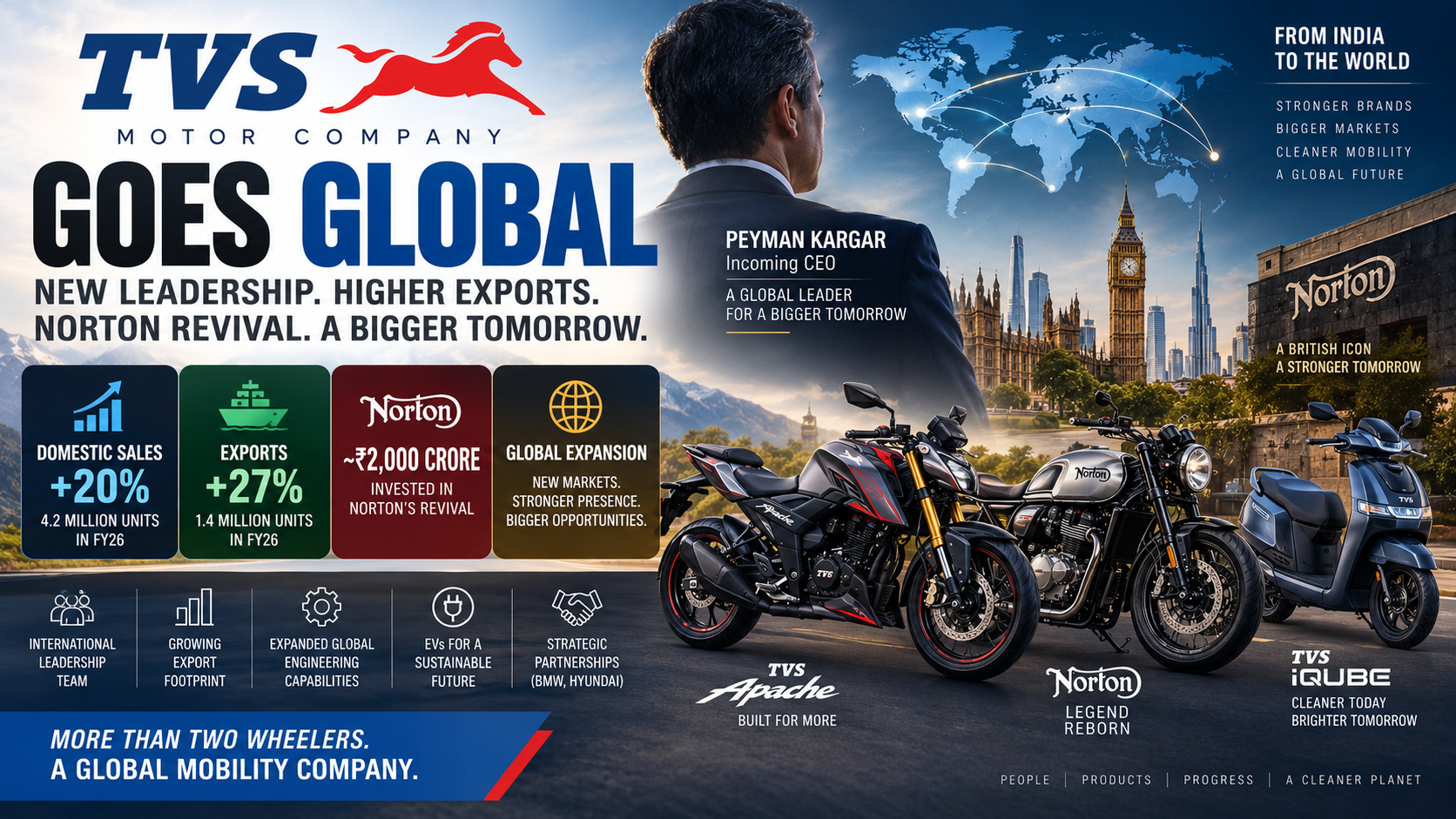
TVS Motor Company is entering a new phase in its evolution as the Indian two-wheeler manufacturer increasingly looks beyond its domestic market for growth, leadership talent, technology and premium-brand expansion.
Having established a formidable position in India’s motorcycle, scooter and electric two-wheeler markets, TVS is now attempting something significantly more ambitious—transforming itself into a genuinely global mobility company.
The strategy is visible across several areas. International executives are taking on important leadership roles, exports are growing faster than domestic sales, the company is expanding into new overseas markets, electric mobility remains a major priority, and its historic British motorcycle brand Norton is being rebuilt for a global comeback.
Together, these developments suggest that TVS Motor’s next phase of value creation could depend increasingly on markets outside India.
Peyman Kargar to Take Over as CEO
One of the clearest indications of TVS Motor’s changing global outlook is its leadership transition.
Peyman Kargar is set to take over as chief executive in January, succeeding K.N. Radhakrishnan.
Kargar joined TVS Motor as president of international business in May 2025 and brings extensive experience from the global automobile industry, including senior roles at Nissan and Renault.
His appointment is notable because his career before TVS was built largely outside India’s automobile industry.
Kargar is currently based in Dubai, although TVS has said that he will be based in Bengaluru after assuming the CEO role.
The decision to elevate an executive with extensive international automotive experience comes at a time when TVS is trying to increase its presence across global markets.
It suggests that the company increasingly views international experience as an important capability for its next stage of expansion.
TVS Is Building an Increasingly International Leadership Team
Kargar’s appointment is part of a broader change in TVS Motor’s senior leadership structure.
Chairman and managing director Sudarshan Venu and president of group strategy Sharad Mohan Mishra have been operating from Singapore, while several other strategically important positions now involve executives with significant global experience.
Former Jaguar Land Rover executive Nick Rogers was appointed president and chief technology officer, with responsibilities spanning Bengaluru and Oxford in the UK.
TVS has also tapped international automotive design and technology expertise as it attempts to strengthen both its core business and the Norton brand.
At the same time, the company’s main operational leadership remains strongly rooted in India.
Executives responsible for the India two-wheeler business, electric vehicles, commuter motorcycles and premium products continue to operate from India.
The emerging structure therefore combines Indian execution capabilities with an increasingly international approach to strategy, technology and leadership.
From Indian Two-Wheeler Manufacturer to Global Mobility Company
TVS Motor’s changing leadership structure reflects a larger strategic objective.
The company is no longer competing solely for market share in India’s enormous two-wheeler industry.
It wants to establish itself as a significant global manufacturer.
TVS has already overtaken Yamaha to become the world’s third-largest two-wheeler manufacturer by volumes, according to industry data cited in the report.
That scale provides the company with a strong manufacturing and engineering foundation from which to expand internationally.
But becoming one of the world’s largest manufacturers by volume is different from becoming a truly global brand.
The next challenge involves building stronger distribution networks, developing products for international customers, expanding premium offerings and establishing meaningful brand recognition across developed and emerging markets.
Exports Are Growing Faster Than Domestic Sales
TVS Motor’s FY26 performance demonstrates why international markets are becoming increasingly important.
Domestic two-wheeler sales grew approximately 20% to 4.2 million units during FY26.
Exports, however, increased by an even stronger 27% to approximately 1.4 million units.
The difference is significant.
India remains TVS Motor’s largest and most important market, but faster export growth means international operations could gradually account for a larger portion of the company’s overall business.
This diversification can become strategically valuable.
A stronger global presence reduces dependence on a single country while allowing TVS to participate in different growth cycles across Asia, Africa, Latin America and Europe.
International expansion also provides opportunities to sell higher-value motorcycles and scooters in markets where customers may be willing to pay substantially more for premium products.
Norton Is at the Centre of TVS Motor’s Premium Ambitions
Perhaps the most visible symbol of TVS Motor’s global ambitions is Norton Motorcycles.
TVS acquired the iconic British motorcycle company in 2020 for approximately ₹153 crore.
The acquisition gave TVS control of a brand with more than a century of motorcycle history and strong associations with British engineering and motorsport.
But rebuilding Norton has required far more capital than the original acquisition price.
TVS has absorbed losses of nearly ₹2,000 crore while investing in the revival of the business.
The company is now preparing Norton for a phased expansion across major international markets, including the UK, continental Europe, India and the United States.
This makes Norton one of TVS Motor’s most ambitious strategic investments.
Norton Moves From Turnaround to Expansion
After years of restructuring, product development and investment, Norton’s revival is beginning to move into its commercial phase.
The brand is rolling out a new generation of motorcycles while expanding its international retail network.
The Norton Atlas, for example, has begun reaching European retailers across the UK, Germany, Italy, France and Spain, with India and the United States expected to follow.
The motorcycle was designed and engineered at Norton’s headquarters in Solihull, UK, while production is taking place at TVS Motor’s Hosur manufacturing facility in India.
That arrangement provides an interesting example of how TVS can combine British brand heritage and engineering with Indian manufacturing scale.
Rather than operating Norton as an isolated overseas subsidiary, TVS can increasingly integrate the brand into its broader engineering, manufacturing and supply-chain ecosystem.
India Could Become an Important Manufacturing Base for Norton
The relationship between Norton and TVS Motor also demonstrates the potential strategic advantage of owning manufacturing capabilities in India.
Premium motorcycles developed for international customers can potentially benefit from India’s extensive automotive supplier network and relatively competitive manufacturing costs.
Norton’s Atlas illustrates this strategy.
While the motorcycle’s design philosophy and engineering originate from the UK, manufacturing at Hosur allows the brand to utilise TVS Motor’s established quality systems, supply chain and production scale.
Other Norton models can continue to be manufactured in the UK where appropriate.
This gives TVS flexibility to determine where individual motorcycles and components can be produced most efficiently without completely separating Norton from its British identity.
Premium Motorcycles Could Change TVS Motor’s Global Positioning
Historically, Indian two-wheeler companies built international businesses primarily by exporting affordable commuter motorcycles and scooters to developing economies.
Premium motorcycles create a different opportunity.
They offer significantly higher selling prices and can strengthen the manufacturer’s global brand perception.
Norton gives TVS an immediate presence in this category without requiring the company to build a luxury motorcycle brand from scratch.
If the revival succeeds, TVS could operate across a remarkably broad spectrum of the global two-wheeler market—from affordable commuter motorcycles and scooters to electric vehicles and high-performance British motorcycles.
That diversification could become an important competitive advantage.
Europe Is Becoming Increasingly Important
TVS Motor’s international ambitions extend beyond Norton.
Europe has emerged as an important strategic market for the company.
TVS has outlined expansion plans covering countries such as Italy, Spain and Portugal while introducing products designed for more developed motorcycle markets.
The company has also strengthened its engineering presence in Europe through the acquisition of Engines Engineering S.p.A. and the establishment of a Global Centre of Excellence for Design and Engineering in Bologna, Italy.
Building engineering capabilities closer to European consumers can help TVS better understand local expectations surrounding performance, design, technology and premium positioning.
It also gives the company access to a broader pool of automotive engineering talent.
BMW Partnership Adds Another Global Dimension
TVS Motor’s relationship with BMW Motorrad provides another pillar of its international strategy.
The companies have collaborated on motorcycles for years, combining BMW’s premium positioning and engineering requirements with TVS Motor’s development and manufacturing capabilities.
The relationship demonstrates that Indian manufacturers can play increasingly sophisticated roles within global automotive supply chains.
Instead of simply exporting low-cost vehicles, TVS can participate in the engineering and production of motorcycles sold under internationally recognised premium brands.
This experience can also support TVS as it develops its own products for international markets.
Electric Mobility Remains a Core Growth Area
TVS Motor’s global expansion is occurring simultaneously with the industry’s transition toward electric mobility.
The company has built a significant presence in India’s electric scooter market and continues to invest in new EV products and technologies.
Electric mobility could also provide Indian manufacturers with an unusual opportunity internationally.
Traditional internal-combustion motorcycle markets have been dominated by established Japanese and European brands for decades.
EVs effectively reset part of the competitive landscape.
Software, batteries, connected technologies and new vehicle architectures become increasingly important, potentially allowing newer competitors to gain ground more quickly.
TVS wants to ensure it participates in that transition rather than relying entirely on its conventional motorcycle and scooter business.
Hyundai Partnership Expands the Opportunity Into Electric Three-Wheelers
TVS Motor is also exploring opportunities beyond conventional two-wheelers.
The company signed a joint development agreement with Hyundai Motor Group for electric three-wheelers.
The partnership combines TVS Motor’s expertise in smaller mobility products with Hyundai’s global automotive capabilities.
The companies have also been testing a ride-hailing application linked to the deployment of electric three-wheelers.
This is strategically interesting because it pushes TVS toward a broader mobility ecosystem.
Instead of simply manufacturing vehicles, future opportunities could involve software, fleet operations, connected mobility and transportation services.
Global Talent Is Becoming a Competitive Advantage
TVS Motor’s recruitment strategy highlights an important reality about international expansion.
Factories and products alone do not create a global company.
Operating successfully across multiple markets requires executives who understand different consumers, regulatory systems, distribution networks, technologies and cultures.
By recruiting leaders with experience at companies such as Renault, Nissan and Jaguar Land Rover, TVS is attempting to accelerate that learning process.
International executives can potentially bring relationships, market knowledge and management experience that would take years to develop organically.
At the same time, TVS retains the Indian manufacturing, engineering and operational capabilities that helped create its current scale.
The objective appears to be combining both.
Why International Expansion Matters for TVS
India remains one of the world’s largest two-wheeler markets, so domestic growth will continue to matter enormously.
However, international markets offer several additional opportunities.
Exports can diversify revenue geographically. Developed markets can support premium products with higher selling prices. Emerging economies provide substantial demand for commuter motorcycles and scooters. Europe offers access to engineering expertise and premium consumers. Norton provides exposure to the luxury motorcycle market.
Meanwhile, electric mobility creates an opportunity to compete in an industry where the competitive hierarchy is still developing.
Together, these factors create a much larger addressable market than India alone.
The Risks Are Equally Significant
TVS Motor’s global strategy is ambitious, but it is not without risks.
Norton’s revival has already required losses approaching ₹2,000 crore, demonstrating how expensive it can be to rebuild a premium international brand.
Developed motorcycle markets are also intensely competitive.
TVS and Norton must compete against manufacturers with decades of established customer loyalty, extensive dealer networks and powerful global brands.
International expansion additionally introduces currency risks, regulatory complexity and higher marketing costs.
Leadership changes can create execution challenges as well.
Investors will therefore want evidence that TVS’s growing international investments eventually translate into sustainable revenue and profitability.
A New Chapter for TVS Motor
TVS Motor’s transformation is increasingly visible across its business.
The company has become one of the world’s largest two-wheeler manufacturers. Exports are growing faster than domestic volumes. Global executives are assuming important leadership positions. European engineering capabilities are expanding. Electric mobility remains a strategic priority. Partnerships with companies such as BMW and Hyundai are broadening the company’s technological reach.
And Norton is finally beginning to move from restructuring toward international expansion.
These initiatives are connected by a common objective: making TVS Motor less dependent on being viewed simply as an Indian two-wheeler manufacturer.
From Indian Champion to Global Contender
The appointment of Peyman Kargar as TVS Motor’s next chief executive represents more than a routine leadership change.
It arrives at a moment when the company itself is changing.
TVS’s domestic business remains exceptionally important, with 4.2 million two-wheelers sold in India during FY26. But exports have already reached approximately 1.4 million units and are growing faster, rising 27% during the year.
Meanwhile, Norton gives TVS an opportunity to participate in the global premium motorcycle industry, European investments expand its engineering capabilities, and EV initiatives could open entirely new markets.
The challenge now is execution.
TVS must successfully integrate international leadership with its existing organisation, turn Norton into a commercially sustainable premium brand, continue expanding exports and convert its investments in electric mobility and global engineering into profitable businesses.
If it succeeds, the company’s next decade could look very different from its previous one.
TVS Motor built its scale by becoming one of India’s strongest two-wheeler manufacturers. Its next ambition is considerably larger: becoming an Indian automotive company capable of competing, designing, manufacturing and building brands on a truly global stage.
Feel free to share your experiences and insights in the comments below. Let’s continue the conversation and grow together as a community of traders and analysts.
By sharing this experience and insights, I hope to contribute to the collective knowledge of our professional community, encouraging a culture of strategic thinking and informed decision-making.
As always, thorough research and risk management are crucial. The dynamic nature of financial markets demands vigilance, agility, and a deep understanding of the tools at your disposal. Here’s to profitable trading and navigating the election season with confidence!
Ready to stay ahead of market trends and make informed investment decisions? Follow our page for more insights and updates on the latest in the financial world!
For a free online stock market training by Yogeshwar Vashishtha (M.Tech IIT) this Saturday from 11 am – 1 pm, please sign up with https://pathfinderstrainings.in/training/freetrainings.aspx
Experience profits with my winning algo strategies – get a free one-month trial with ₹15 lakh capital! – https://terminal.algofinders.com/algo-terminal
Disclaimer
This article should not be interpreted as investment advice. For any investment decisions, consult a reputable financial advisor. The author and publisher are not responsible for any losses incurred by investors or traders based on the information provided.