

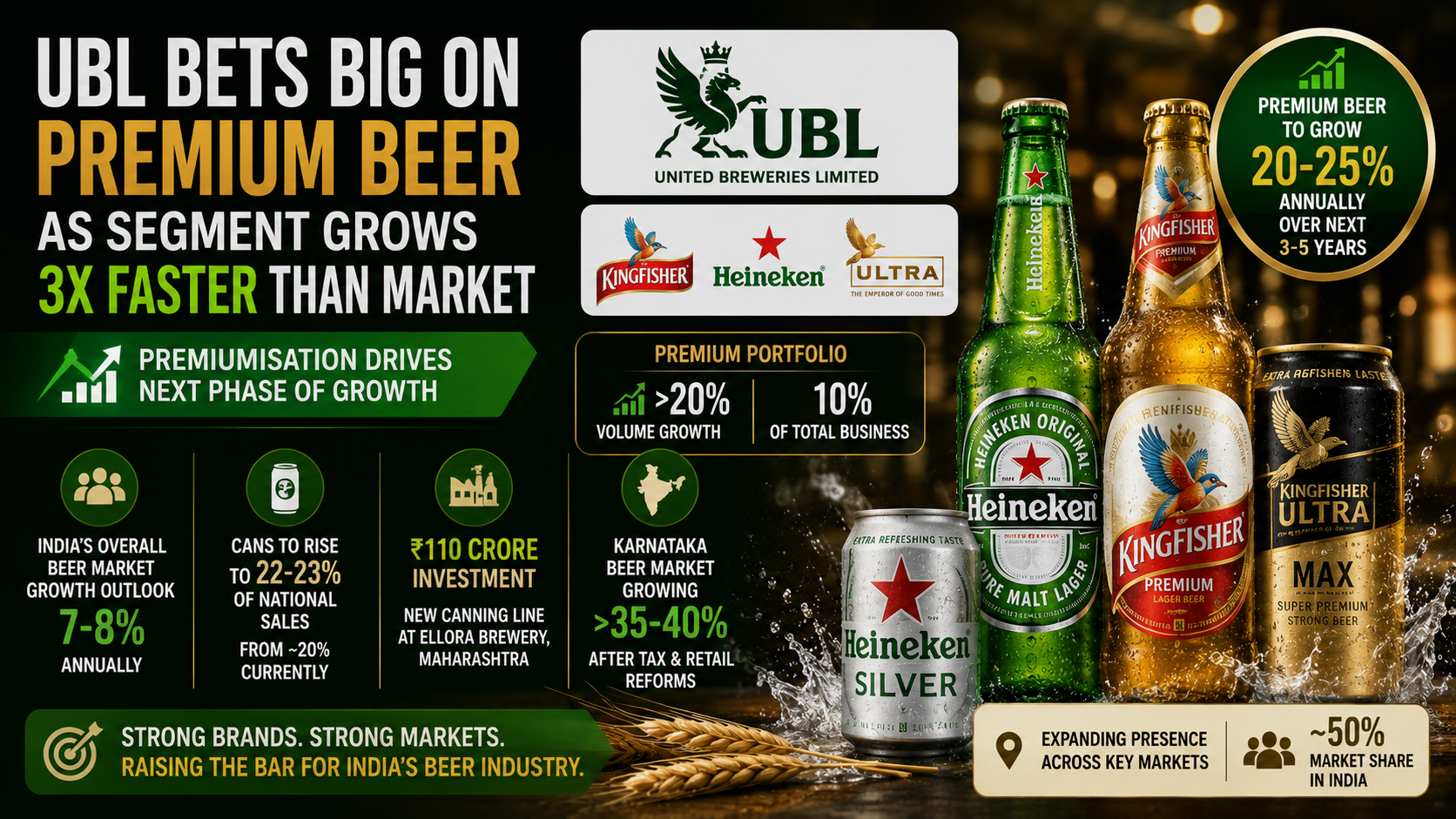
United Breweries Ltd. (UBL), the company behind Kingfisher and several of India’s best-known beer brands, is positioning premium beer as one of its most important growth engines for the coming years.
The company expects its premium portfolio to grow at around 20-25% annually over the next three to five years—almost three times the 7-8% growth it expects from India’s overall beer market.
The shift reflects an important change in India’s beer industry. Rising disposable incomes, changing consumer preferences and greater interest in premium products are gradually pushing brewers beyond the traditional volume-driven model.
UBL is responding by expanding brands such as Heineken, Heineken Silver, Kingfisher Ultra and Ultra Max while simultaneously investing in additional canning capacity.
Premium Beer Could Grow 20-25% Annually
Premiumisation is emerging as one of UBL’s strongest growth opportunities.
Premium products currently account for approximately 10% of the company’s total business but are already growing at more than 20% in volume terms.
UBL believes this momentum can continue, with premium beer potentially delivering annual growth of 20-25% over the next three to five years.
That would significantly outperform the broader Indian beer category, which the company expects to expand by around 7-8% annually.
The difference in growth rates could gradually change the composition of UBL’s overall portfolio. Even if mainstream beer remains the company’s largest business, premium products could account for a considerably larger share of revenue and volumes over time.
For UBL, this also provides an opportunity to move consumers gradually toward higher-value brands rather than relying exclusively on overall beer consumption growth.
Heineken Silver Is Emerging as a Fast-Growing Brand
Within the premium portfolio, Heineken Silver is showing particularly strong momentum.
UBL has introduced the brand in three states, and volumes are growing at more than 40% nationally.
The company is also expanding the Kingfisher Ultra portfolio as it attempts to capture consumers looking for more premium alternatives within familiar beer brands.
UBL has an unusually strong position from which to pursue this strategy.
Its portfolio stretches across different price points and consumer segments, from mass-market products such as Kingfisher Strong to premium and international brands such as Kingfisher Ultra and Heineken.
This allows the company to participate in both the expansion of India’s overall beer market and the shift toward premium products.
₹110 Crore Investment in Maharashtra Canning Facility
UBL’s premiumisation strategy is being accompanied by investments in manufacturing and packaging infrastructure.
The company has announced a ₹110 crore investment in a new canning facility at its Ellora brewery in Maharashtra.
The new line is expected to begin production by the end of September and will initially manufacture cans of Kingfisher Strong, Kingfisher Premium, Bullet Strong and London Pilsner.
This is UBL’s second major canning investment this year.
The company had earlier announced another canning line at its Nizam brewery in Telangana in July.
Together, the investments demonstrate that UBL expects cans to become an increasingly important part of India’s beer market.
Cans Could Rise to 22-23% of UBL’s National Sales
Currently, approximately 20% of UBL’s national sales come from cans, while bottles account for close to 80%.
The company expects its new canning facilities in Maharashtra and Telangana to increase the national share of cans to around 22-23%.
At first glance, this might appear to be simply a change in packaging. However, cans can influence both affordability and consumption patterns.
A smaller can can provide consumers with a lower entry price than a larger bottle. Cans are also relatively easy to chill, transport and store.
These advantages can become particularly important in markets where convenience and affordability influence purchasing decisions.
The packaging mix also varies dramatically between states.
In Uttar Pradesh, for example, cans account for around 70-80% of UBL’s business—far above the company’s national average.
This demonstrates how local regulations, distribution networks and consumer preferences can significantly influence the economics of India’s beer industry.
Bottles Still Have an Important Economic Advantage
UBL’s expansion into cans does not mean bottles are disappearing.
In fact, bottles continue to offer an important profitability advantage.
Returnable glass bottles can typically be collected and reused five or six times. That makes them economically attractive in markets where breweries have efficient collection and distribution networks.
Aluminium cans, by comparison, are single-use packaging from the brewer’s perspective.
The ideal packaging strategy therefore varies from one market to another.
Where bottle-return networks are efficient, glass can remain highly attractive. In markets where recovering bottles is difficult or where consumers strongly prefer smaller packaging, cans can provide a better solution.
UBL’s strategy appears to be about increasing flexibility rather than replacing one format with another.
India Is Already a Massive Beer Market
The opportunity is substantial because India already consumes approximately 440-460 million cases of beer annually.
UBL accounts for roughly half of that market, giving it enormous scale compared with most competitors.
Despite this size, India’s beer industry still has considerable room for expansion.
UBL expects the overall category to grow at approximately 7-8% annually.
Premium beer could grow considerably faster.
If UBL’s forecast of 20-25% annual premium growth proves accurate, the segment could become one of the most important contributors to incremental growth in India’s beer industry over the remainder of the decade.
Karnataka Shows How Policy Can Transform Beer Demand
One of the most interesting developments is occurring in Karnataka.
UBL says the state’s beer category is growing at more than 35-40% following changes to taxation and the retail model.
The experience demonstrates just how important government policy is to India’s alcoholic beverage industry.
Unlike many consumer products, alcohol is regulated and taxed primarily at the state level. Companies therefore operate within dramatically different tax structures, pricing systems and distribution models across India.
Changes to these rules can materially affect consumer behaviour.
When beer becomes more competitively priced relative to spirits, consumption can increase rapidly.
Karnataka provides a strong example of how taxation reforms can stimulate category growth.
Maharashtra Is Another Important Growth Market
Maharashtra has also emerged as an important market for UBL.
The state’s beer market has grown by more than 20% over the past two years.
Maharashtra also possesses a relatively large alcohol retail network, with more than 20% of the state’s alcohol outlets located there. Some outlets are specifically dedicated to beer and wine.
UBL expects the market to continue expanding as the consumer base grows, provided the regulatory environment remains supportive.
The company’s decision to invest ₹110 crore in additional canning capacity at its Ellora brewery therefore appears closely aligned with the growth it is witnessing in the state.
Increasing local manufacturing capacity can help UBL meet demand more efficiently while reducing the logistical challenges associated with transporting beer across large distances.
Affordability Remains Critical to Beer Consumption
Despite the premiumisation opportunity, UBL believes affordability remains fundamental to the industry’s long-term growth.
Beer competes not only against rival beer brands but also against entry-level spirits.
The price difference between the two categories can have a major influence on consumer behaviour.
When taxation makes beer disproportionately expensive compared with spirits, consumers may choose stronger alcoholic beverages because they provide more alcohol for the same expenditure.
When that price difference narrows, beer consumption can increase.
This means the future of India’s beer industry depends not only on brands, marketing and consumer preferences but also heavily on taxation and regulation.
For brewers such as UBL, favourable policy changes could potentially unlock substantial additional demand.
Rising Aluminium Prices Create a New Challenge
UBL’s investment in canning capacity comes at a time when aluminium costs are moving higher.
The company has indicated that aluminium prices have increased approximately 10-15% amid disruptions related to the West Asia conflict.
Higher packaging costs create margin pressure, particularly as cans become a larger component of UBL’s portfolio.
The company has therefore been implementing price increases and internal cost-recovery measures.
UBL has secured price increases across 24 states, helping it offset part of the pressure from higher input costs.
The company has also reduced its estimated full-year cost impact from the Middle East conflict to around ₹350-400 crore, compared with an earlier estimate of ₹400-500 crore.
Managing this cost pressure while continuing to expand premium volumes will be an important factor in determining profitability.
UBL Is Willing to Protect Margins Over Volumes
The company’s recent performance also indicates that management is prepared to sacrifice some volume when market conditions become economically unattractive.
Premium volumes increased around 17% during the recent period even after excluding deliberate volume reductions in certain markets where UBL chose to protect profitability amid higher costs.
This suggests the company is not pursuing premium growth at any price.
That discipline could become increasingly important as input costs fluctuate.
Premiumisation can potentially improve revenue per case, but those benefits can be undermined if packaging, raw-material and distribution costs rise faster than pricing.
UBL therefore needs to balance three objectives simultaneously: volume growth, premiumisation and profitability.
Premiumisation Could Change the Economics of UBL
If UBL succeeds in increasing the contribution of premium beer, the long-term impact could extend beyond faster volume growth.
Premium products generally allow beverage companies to generate greater revenue from each unit sold.
Consumers choosing Heineken Silver or Kingfisher Ultra, for example, represent a different economic opportunity from consumers purchasing mainstream beer exclusively on price.
As India’s middle-income and affluent consumer populations expand, UBL can potentially encourage existing customers to trade upward within its portfolio.
This is one reason premiumisation has become such an important strategy across India’s broader consumer industry.
Companies increasingly want not only more customers but also greater spending from existing customers.
The Next Growth Phase for India’s Beer Leader
UBL’s strategy is gradually becoming clearer.
The company expects India’s overall beer market to continue expanding at a healthy 7-8% annually, but it believes the real acceleration will come from premium products.
Premium beer is expected to grow 20-25% annually over the next three to five years.
Heineken Silver is already growing at more than 40%, while UBL continues expanding the Kingfisher Ultra portfolio.
At the same time, investments in new canning facilities in Maharashtra and Telangana should increase the company’s ability to respond to changing packaging preferences.
The national contribution from cans could rise from approximately 20% currently to around 22-23%.
Meanwhile, markets such as Karnataka and Maharashtra demonstrate how regulatory reforms can unlock much faster category growth.
A Premium Opportunity With Significant Long-Term Potential
United Breweries remains India’s dominant beer company, controlling roughly half of a market estimated at 440-460 million cases annually.
That scale provides the company with a powerful foundation, but its next phase of growth may look different from the one that built Kingfisher into a household brand.
The opportunity increasingly lies in convincing Indian consumers to move up the value chain.
Premium beer currently represents only a relatively small portion of UBL’s overall business, leaving significant room for expansion if consumer preferences continue evolving.
The company is investing behind that opportunity through premium brands, additional canning capacity and broader distribution while simultaneously attempting to manage rising input costs and a highly complex state-by-state regulatory environment.
If premium beer can sustain growth of 20-25% annually while India’s overall beer market expands at 7-8%, UBL’s portfolio could look substantially different within the next three to five years.
The bigger story, therefore, is not simply that Indians may drink more beer. It is that an increasing share of consumers may be willing to pay more for what they drink—and United Breweries intends to be one of the biggest beneficiaries of that shift.
Feel free to share your experiences and insights in the comments below. Let’s continue the conversation and grow together as a community of traders and analysts.
By sharing this experience and insights, I hope to contribute to the collective knowledge of our professional community, encouraging a culture of strategic thinking and informed decision-making.
As always, thorough research and risk management are crucial. The dynamic nature of financial markets demands vigilance, agility, and a deep understanding of the tools at your disposal. Here’s to profitable trading and navigating the election season with confidence!
Ready to stay ahead of market trends and make informed investment decisions? Follow our page for more insights and updates on the latest in the financial world!
For a free online stock market training by Yogeshwar Vashishtha (M.Tech IIT) this Saturday from 11 am – 1 pm, please sign up with https://pathfinderstrainings.in/training/freetrainings.aspx
Experience profits with my winning algo strategies – get a free one-month trial with ₹15 lakh capital! – https://terminal.algofinders.com/algo-terminal
Disclaimer
This article should not be interpreted as investment advice. For any investment decisions, consult a reputable financial advisor. The author and publisher are not responsible for any losses incurred by investors or traders based on the information provided.