

India’s flexible workspace sector continues to gain momentum as large technology companies increasingly combine traditional offices with managed and flexible workspaces. In one of the latest examples of this shift, WeWork India has signed a major managed office agreement with Cognizant Technology Solutions India in Chennai.
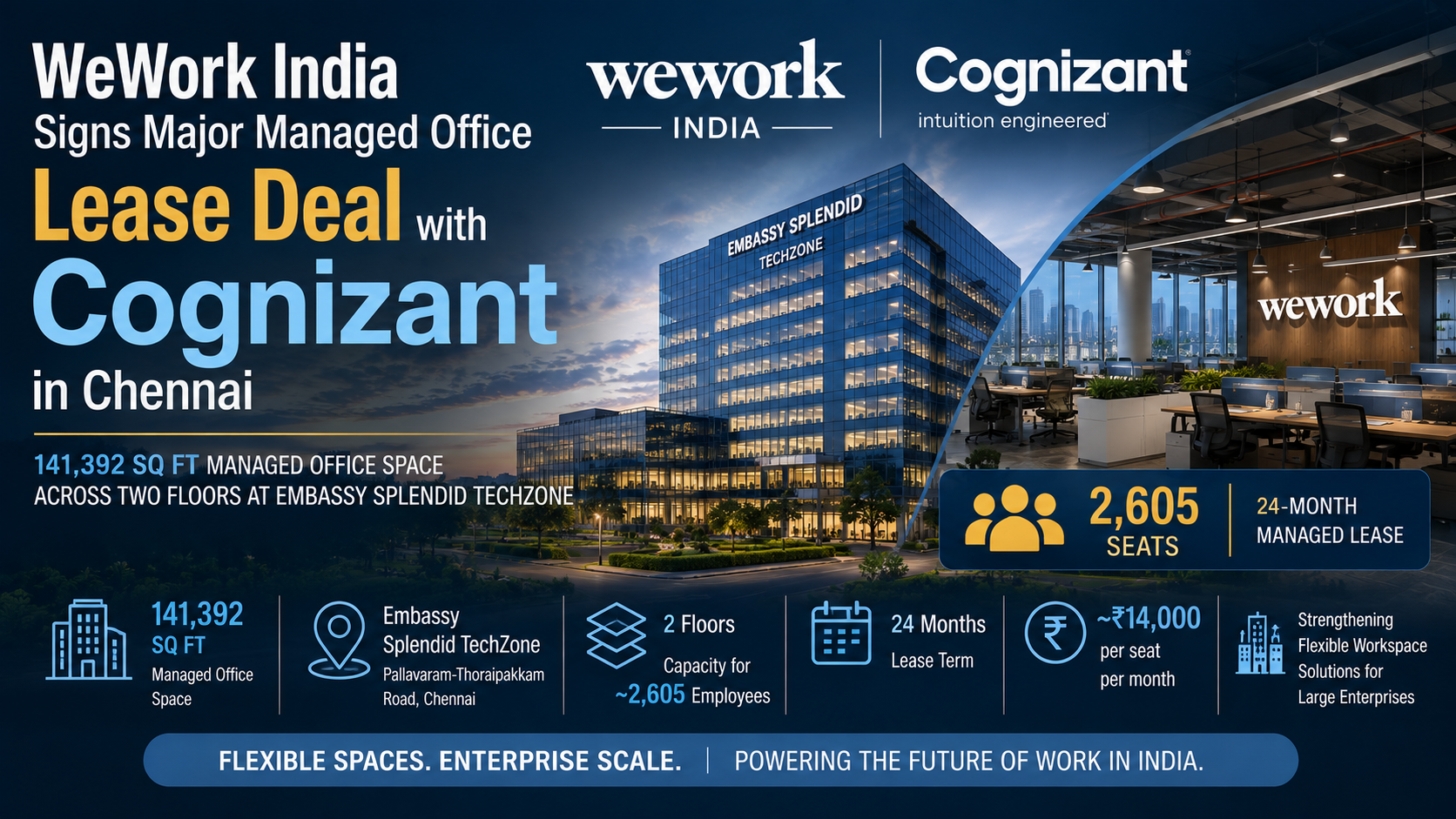
The transaction covers 141,392 sq ft of office space at Embassy Splendid TechZone and represents the first leasing arrangement between WeWork India and Cognizant.
Beyond the size of the transaction, the deal highlights an important transformation underway in India’s commercial real estate market. Large IT services companies and global capability centres are increasingly using managed offices as part of their long-term workplace strategies rather than treating flexible spaces simply as temporary alternatives to conventional offices.
2,605 Seats Across Two Floors
Under the agreement, Cognizant will occupy two floors at Embassy Splendid TechZone, a major office development located on Chennai’s Pallavaram-Thoraipakkam Road.
The managed office can accommodate approximately 2,605 employees.
The lease has been signed for 24 months, with Cognizant expected to pay around ₹14,000 per seat every month.
At that rate, the arrangement represents a substantial managed-office contract for WeWork India and strengthens its relatively new presence in the Chennai market.
The transaction is particularly noteworthy because Cognizant is one of India’s largest technology employers and maintains a significant presence in Chennai.
Cognizant Is Building a Larger Presence at the Same Office Park
Interestingly, the WeWork agreement is not Cognizant’s only major real estate commitment at Embassy Splendid TechZone.
Earlier in 2026, Cognizant pre-leased approximately 650,000 sq ft at the same property from Embassy Office Parks REIT.
That considerably larger facility is being established as a global capability centre for US Bancorp through a build-operate-transfer arrangement.
Under this model, Cognizant initially develops and operates the facility for its client. After an agreed period, the operation can eventually be transferred to the client.
The combination of the 650,000 sq ft conventional office commitment and the new 141,392 sq ft WeWork facility illustrates how large technology companies are increasingly adopting multiple real-estate formats simultaneously.
Instead of choosing between traditional leases and flexible offices, companies are using both depending on the requirements of individual projects and clients.
Why Managed Offices Are Becoming Attractive to IT Companies
The Cognizant-WeWork agreement reflects the growing popularity of flexible and managed office spaces among large corporations.
Traditionally, major IT companies would lease large commercial properties for several years, invest heavily in interiors and infrastructure, and then operate the facilities themselves.
Managed offices offer a different approach.
Companies can move employees into fully equipped facilities relatively quickly without undertaking extensive upfront investments in office development.
The workspace provider handles much of the physical infrastructure and operational requirements, allowing the tenant to focus primarily on its workforce and business operations.
This can be particularly useful when an IT company wins a new client contract and needs to assemble a large team quickly.
A managed workspace can function as an incubation or transitional facility while a larger permanent office is being developed.
That flexibility is becoming increasingly valuable as technology companies manage rapidly changing workforce requirements.
Flex Space Is Moving Beyond Startups
Flexible offices were once associated primarily with freelancers, startups and small companies seeking inexpensive shared workplaces.
That perception has changed significantly.
Large multinational corporations, IT companies, financial institutions and global capability centres now account for an increasingly important share of India’s flexible workspace demand.
For these organisations, the attraction is not simply shorter leases.
Managed offices can provide greater flexibility in workforce planning, faster occupancy, lower initial capital expenditure and access to professionally operated office infrastructure.
A company may need several thousand seats for a particular project but may not know whether the requirement will remain unchanged five or ten years later.
A managed office allows it to meet the immediate requirement without committing to a lengthy conventional property development cycle.
The Cognizant transaction—with capacity for more than 2,600 employees—demonstrates how large these flexible workspace requirements have become.
Cognizant Is Reshaping Its Indian Real Estate Portfolio
The agreement also comes as Cognizant continues to recalibrate its real estate footprint across India.
The technology company has been consolidating and restructuring parts of its property portfolio over the past several years.
In Chennai, Cognizant previously sold a large property to commercial real estate developer Bagmane Constructions for more than ₹600 crore.
The property is expected to eventually be redeveloped into an office park.
At the same time, Cognizant continues to lease new offices, renew existing facilities and take up additional space for clients.
This suggests that the company’s strategy is not necessarily about reducing its physical presence.
Instead, Cognizant appears to be moving toward a more flexible real estate model where property requirements are matched more closely with individual business and client needs.
The WeWork agreement fits naturally into that strategy.
Chennai Becomes Increasingly Important for WeWork India
For WeWork India, the Cognizant agreement represents an important milestone in Chennai.
The flexible workspace company entered the city only in 2024 and currently operates three centres there.
Securing a large enterprise client such as Cognizant strengthens WeWork India’s position in one of India’s most important technology and business-services markets.
Chennai has traditionally been a major destination for IT services, automobile manufacturing, financial services and engineering companies.
The expansion of GCCs is creating another source of commercial office demand.
As multinational companies establish technology, finance, analytics, engineering and business-support operations in India, cities such as Chennai are benefiting from the requirement for high-quality office infrastructure.
Flexible workspace companies can capture part of this demand by providing ready-to-use facilities while larger permanent campuses are developed.
WeWork India Has Built a Significant National Network
The Chennai expansion forms part of a much larger WeWork India portfolio.
The company has grown to 79 centres covering approximately 9.1 million sq ft across India.
Its network serves around 113,400 members.
WeWork India is majority-owned and promoted by Embassy Group and operates independently from the international WeWork business.
The company’s scale provides an important advantage when negotiating with large corporate customers.
Multinational companies increasingly want workspace partners capable of providing offices across several Indian cities rather than managing separate relationships with local operators in every market.
A nationwide flexible-office network can therefore become an important component of enterprise workplace strategies.
India’s Office Leasing Market Hits a Record
The Cognizant-WeWork transaction comes against the backdrop of exceptionally strong demand for commercial office space in India.
Gross office leasing across India’s major cities reached approximately 45.5 million sq ft during the first half of 2026.
That represented the highest leasing volume ever recorded during any six-month period.
For comparison, leasing stood at approximately 41.5 million sq ft during the corresponding period a year earlier.
The performance is particularly notable given broader geopolitical uncertainty and concerns about global economic growth.
India’s office market has continued expanding because the structural drivers of demand remain strong.
Among the most important of these drivers are global capability centres.
GCCs Account for 43% of Office Demand
Global capability centres accounted for approximately 43% of total office leasing during the first half of 2026.
GCC leasing reached a record 19.6 million sq ft during the period.
These centres are becoming increasingly important to India’s commercial real estate industry.
Global corporations are expanding Indian operations beyond traditional back-office activities into software development, artificial intelligence, engineering, finance, cybersecurity, product development and research.
That transformation requires increasingly sophisticated office infrastructure.
IT services companies such as Cognizant are also participating in the trend by establishing dedicated facilities for global clients.
Some are structured through build-operate-transfer arrangements, where the IT services company initially establishes and manages the operation before eventually transferring it to the international client.
This model can generate demand for both conventional offices and flexible workspaces.
Hybrid Real Estate Strategies Are Emerging
Perhaps the most important implication of the Cognizant-WeWork agreement is the emergence of hybrid corporate real estate strategies.
Large companies increasingly appear unwilling to rely exclusively on one type of office arrangement.
A corporation might maintain a long-term headquarters, lease large conventional offices for established operations and simultaneously use managed offices for new projects, temporary expansion or client-specific teams.
The result is a commercial real estate model combining permanence with flexibility.
Long-term leases provide stability and control for core operations.
Managed offices provide speed and adaptability.
Together, they allow companies to adjust their real estate portfolios more closely to changing workforce requirements.
For flexible workspace operators, this is potentially a much larger opportunity than simply serving startups.
Enterprise Clients Could Drive the Next Phase of Flex-Space Growth
The economics of the flexible workspace industry are increasingly being shaped by large enterprise contracts.
A single agreement involving thousands of seats can provide significantly greater occupancy visibility than hundreds of individual coworking memberships.
Enterprise clients can also take entire floors or dedicated sections of buildings, effectively creating private corporate offices operated by a flexible workspace provider.
The 2,605-seat Cognizant agreement is a good example.
Although the facility operates through WeWork India’s managed-office platform, it can provide Cognizant with a workplace designed around the company’s own operational requirements.
This blurs the traditional distinction between coworking spaces and conventional corporate offices.
What the Deal Means for WeWork India
For WeWork India, the transaction provides several strategic benefits.
It strengthens the company’s presence in Chennai, adds a major global technology company to its enterprise customer base and demonstrates its ability to accommodate office requirements involving thousands of employees.
The deal also places WeWork India directly within the rapidly expanding GCC and IT-services ecosystem.
If managed workspace continues becoming an accepted component of corporate real estate strategies, large technology companies could provide a significant pipeline of future demand.
The opportunity extends beyond Chennai.
Bengaluru, Hyderabad, Pune, Mumbai, Delhi-NCR and other major business centres are witnessing similar changes as companies seek greater flexibility in managing office portfolios.
A Sign of India’s Changing Workplace Market
The 141,392 sq ft agreement between WeWork India and Cognizant is ultimately about much more than another corporate office lease.
It reflects a structural transformation in how large companies think about real estate.
Cognizant is simultaneously committing to a large conventional office facility while taking more than 2,600 seats through a managed workspace provider at the same Chennai office park.
That combination demonstrates that flexible offices are increasingly becoming complementary to traditional commercial real estate rather than competing against it.
For WeWork India and other managed-office operators, that creates a substantial long-term opportunity.
India’s commercial office market is already experiencing record leasing, GCCs are expanding rapidly and IT services companies are establishing new facilities for global customers.
As these trends converge, managed workspaces could capture an increasingly important share of enterprise office demand.
The Cognizant deal provides another indication that India’s flexible workspace industry has moved well beyond its coworking origins. It is increasingly becoming part of the core infrastructure supporting how some of the world’s largest companies build and expand their operations in India.
Feel free to share your experiences and insights in the comments below. Let’s continue the conversation and grow together as a community of traders and analysts.
By sharing this experience and insights, I hope to contribute to the collective knowledge of our professional community, encouraging a culture of strategic thinking and informed decision-making.
As always, thorough research and risk management are crucial. The dynamic nature of financial markets demands vigilance, agility, and a deep understanding of the tools at your disposal. Here’s to profitable trading and navigating the election season with confidence!
Ready to stay ahead of market trends and make informed investment decisions? Follow our page for more insights and updates on the latest in the financial world!
For a free online stock market training by Yogeshwar Vashishtha (M.Tech IIT) this Saturday from 11 am – 1 pm, please sign up with https://pathfinderstrainings.in/training/freetrainings.aspx
Experience profits with my winning algo strategies – get a free one-month trial with ₹15 lakh capital! – https://terminal.algofinders.com/algo-terminal
Disclaimer
This article should not be interpreted as investment advice. For any investment decisions, consult a reputable financial advisor. The author and publisher are not responsible for any losses incurred by investors or traders based on the information provided.