

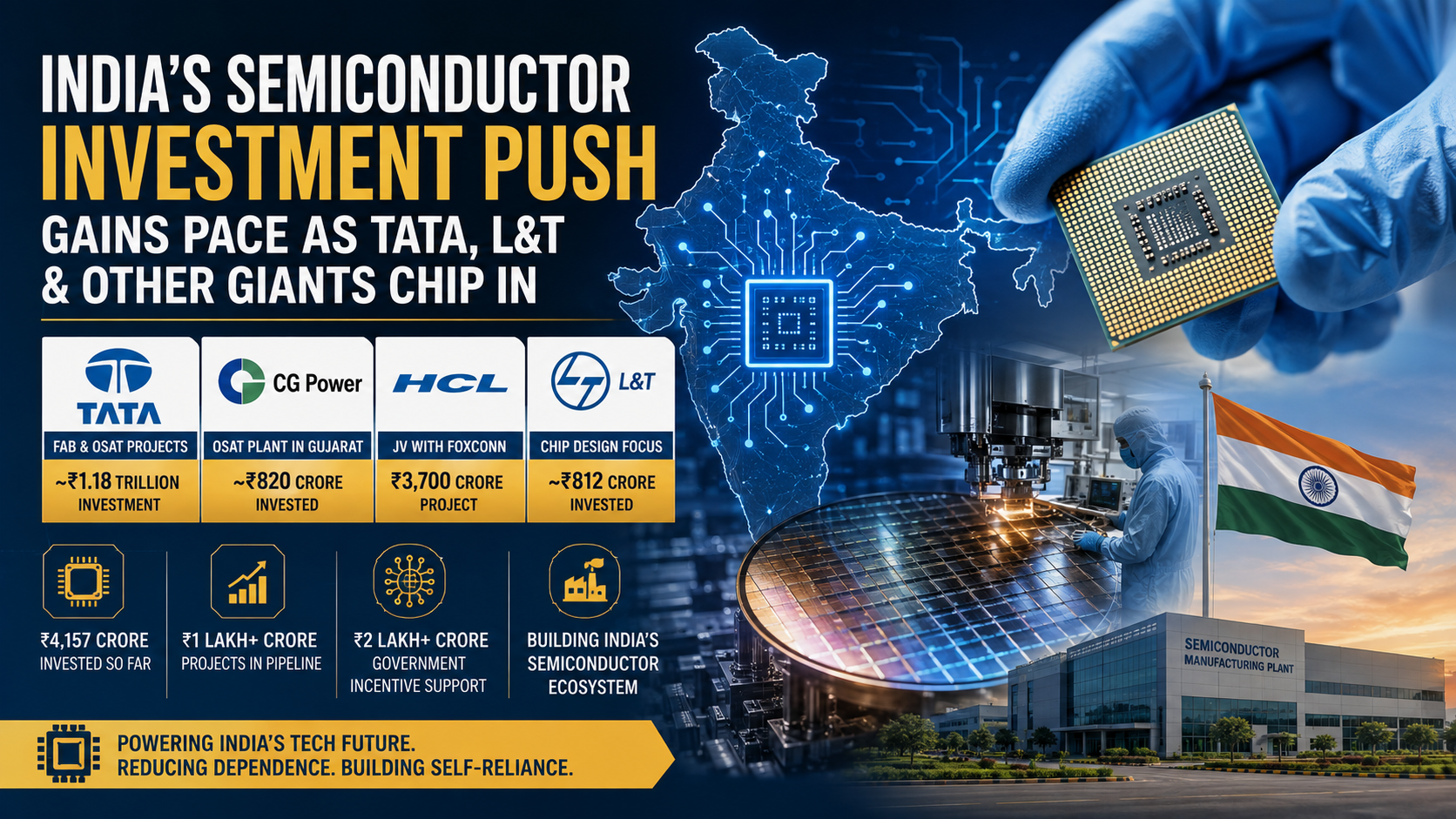
India’s ambition to become a significant player in the global semiconductor industry is beginning to move from policy announcements to actual investments. Some of the country’s largest and oldest industrial groups—including Tata, Larsen & Toubro (L&T), Murugappa Group and HCL—are committing substantial capital to semiconductor manufacturing, assembly, testing and chip design.
Over the past two financial years, four major Indian conglomerates have invested a combined ₹4,157 crore in semiconductor ventures. More importantly, this represents only the early stages of much larger projects that could eventually involve investments exceeding ₹1 lakh crore.
The developments signal a significant shift for India, which continues to depend on imports for roughly 95% of its semiconductor requirements. With chips becoming critical to automobiles, smartphones, artificial intelligence, defence systems, industrial equipment and data centres, building domestic semiconductor capabilities has become both an economic and strategic priority.
₹4,157 Crore Already Flowing Into India’s Chip Industry
The scale of corporate participation in India’s semiconductor push is becoming increasingly visible.
Tata Electronics, Murugappa Group’s CG Power and HCL Group have collectively announced semiconductor manufacturing and assembly projects worth around ₹1.29 trillion, or ₹1.29 lakh crore, under the India Semiconductor Mission.
These companies have so far invested approximately ₹3,345 crore into their respective projects.
L&T has separately invested ₹812 crore into its semiconductor design subsidiary, L&T Semiconductor Technologies, taking the combined investment by the four industrial groups to ₹4,157 crore.
While this amount remains relatively small compared with the total projects announced, it demonstrates that India’s semiconductor ambitions are gradually entering the execution phase.
Tata Leads India’s Semiconductor Manufacturing Push
Among Indian corporations, Tata Group has emerged as one of the most ambitious participants in semiconductor manufacturing.
Between FY25 and FY26, Tata Electronics invested approximately ₹2,401 crore across six tranches into two semiconductor subsidiaries—Tata Semiconductor Assembly and Test and Tata Semiconductor Manufacturing.
The group is developing two major semiconductor projects.
The first is a semiconductor fabrication facility in Dholera, Gujarat, while the second is an outsourced semiconductor assembly and testing facility in Jagiroad, Assam.
Together, these projects have an estimated cost of approximately ₹1.18 trillion, making Tata’s semiconductor initiative one of the largest technology manufacturing investments undertaken by an Indian private-sector company.
The Dholera facility is particularly important because it is expected to become India’s first commercial semiconductor fabrication plant capable of producing chips using more advanced process technologies.
India already has the government-owned Semiconductor Laboratory in Mohali, which has operated since the 1980s, but its manufacturing technologies are considerably older.
Tata’s project could therefore represent a major technological leap for India’s domestic semiconductor manufacturing capabilities.
CG Power Moves From Investment to Commercial Production
Murugappa Group company CG Power and Industrial Solutions is another major participant in India’s semiconductor ecosystem.
CG Power has invested approximately ₹820 crore into CG Semi, its semiconductor joint venture.
The venture brings together CG Power, Japanese semiconductor company Renesas Electronics and Thailand-based semiconductor assembly and testing specialist Stars Microelectronics.
CG Semi is developing an outsourced semiconductor assembly and testing facility in Sanand, Gujarat.
Unlike several semiconductor projects that remain under construction, CG Semi has already moved into commercial operations. The company announced in July that it had started commercial chip supplies from its Sanand facility.
This is an important milestone for India’s semiconductor strategy because it demonstrates the transition from project approvals and capital commitments to actual semiconductor production.
HCL Partners With Foxconn for ₹3,700 Crore Project
HCL Group is also entering semiconductor manufacturing through a partnership with global electronics manufacturing giant Foxconn.
The government approved the group’s ₹3,700 crore semiconductor project in Jewar, Uttar Pradesh, in May 2025.
The facility is being developed through India Chip, a joint venture in which HCL holds a 60% stake and Foxconn holds the remaining 40%.
HCL has already invested approximately ₹124 crore into the venture to begin construction.
The involvement of Foxconn is particularly significant because partnerships with established international manufacturers can provide Indian companies with access to global semiconductor expertise, manufacturing processes and supply-chain relationships.
Such collaborations could accelerate India’s ability to develop capabilities that would otherwise take considerably longer to build independently.
L&T Takes a Different Route Through Chip Design
While Tata, CG Power and HCL are concentrating heavily on semiconductor manufacturing and assembly, L&T is approaching the opportunity from another important part of the value chain—chip design.
L&T has invested approximately ₹812 crore into L&T Semiconductor Technologies.
The company has already started generating early-stage revenue and has set an ambitious target of generating approximately ₹5,000 crore in annual revenue by FY31.
Unlike the manufacturing projects of Tata Electronics, CG Power and HCL, L&T Semiconductor Technologies has not received incentives under the first phase of the India Semiconductor Mission.
However, the company is evaluating opportunities under the government’s recently approved Semicon 2.0 programme.
L&T’s strategy demonstrates that India’s semiconductor opportunity extends beyond building fabrication plants. Chip architecture, design, intellectual property, packaging, testing and specialised engineering services can potentially create substantial economic value while requiring different levels of capital investment.
Government Commits More Than ₹2 Lakh Crore
Corporate investments are being supported by an increasingly aggressive government semiconductor policy.
The government has earmarked more than ₹2 trillion—over ₹2 lakh crore—across two semiconductor incentive programmes.
Semicon 1.0, launched in 2021, carried an allocation of ₹76,000 crore.
Semicon 2.0, approved in July 2026, significantly expands the programme with an allocation of approximately ₹1.27 trillion.
The objective is to create a complete domestic semiconductor ecosystem rather than focusing exclusively on fabrication plants.
Government incentives are particularly important because semiconductor manufacturing requires enormous upfront capital investment. Building a modern fabrication facility can cost billions of dollars, while rapid technological changes mean companies must continually invest in new manufacturing equipment.
Central and state government incentives account for at least 70% of the announced project costs in several of India’s major semiconductor projects.
This helps explain why the ₹3,345 crore invested so far by Tata Electronics, HCL Group and CG Power remains only a fraction of their combined ₹1.29 trillion project commitments.
Why India Needs Its Own Semiconductor Ecosystem
India’s semiconductor push is driven partly by its enormous dependence on imported chips.
The country currently imports approximately 95% of its semiconductor requirements.
That creates strategic vulnerabilities because semiconductors are increasingly becoming essential infrastructure for the modern economy.
Everything from smartphones and automobiles to aircraft, hospitals, electricity grids, artificial intelligence systems and defence equipment depends on semiconductor components.
The global chip shortage following the pandemic demonstrated how disruptions in semiconductor supply chains can affect industries thousands of kilometres away from major manufacturing centres.
For India, establishing domestic semiconductor manufacturing therefore goes beyond simply reducing imports. It is increasingly being viewed as an issue of technological sovereignty and economic security.
India’s Semiconductor Demand Is Exploding
The strongest economic argument for building semiconductor capacity in India is the country’s rapidly growing domestic market.
India’s semiconductor consumption is estimated to have grown at an annual rate of approximately 18-20% over the past eight years.
The market has expanded from roughly $15 billion in 2018 to an estimated $62 billion in 2026.
And the growth could accelerate further.
India’s semiconductor market is projected to reach approximately $155 billion by 2031.
At that level, India could represent around 9% of global semiconductor consumption.
The growth will likely be driven by several industries simultaneously, including electric vehicles, smartphones, consumer electronics, telecommunications equipment, industrial automation, renewable energy systems, defence electronics, cloud infrastructure and artificial intelligence.
This rapidly expanding domestic demand gives semiconductor manufacturers something extremely valuable—a large potential customer base within India itself.
Large Conglomerates Could Become Anchor Investors
The participation of Tata, L&T, HCL and Murugappa Group could also have consequences beyond their individual investments.
Large conglomerates can act as anchor investors around which broader industrial ecosystems develop.
A semiconductor fabrication or packaging facility requires an extensive network of suppliers providing specialised chemicals, gases, wafers, manufacturing equipment, clean-room infrastructure, logistics and precision engineering services.
Once large-scale manufacturing facilities become operational, suppliers have stronger economic incentives to establish their own operations nearby.
This can gradually create semiconductor manufacturing clusters similar to those that exist in Taiwan, South Korea, Japan and the United States.
The presence of established Indian industrial groups also increases confidence among international semiconductor companies considering investments or partnerships in the country.
From Ambition to Execution
India has discussed building a domestic semiconductor industry for decades, but previous attempts struggled because of enormous capital requirements, infrastructure limitations and competition from established manufacturing hubs.
The current semiconductor push appears different because multiple elements are beginning to come together simultaneously.
Large Indian conglomerates are investing their own capital. The government is providing substantial financial incentives. International semiconductor and electronics companies are forming partnerships with Indian groups. Domestic semiconductor consumption is expanding rapidly. And several projects are now moving from approvals toward construction and commercial production.
However, India still has a considerable distance to travel before it can compete with established semiconductor economies.
Semiconductor manufacturing is among the world’s most technologically complex industries. Successful fabrication requires extremely sophisticated equipment, specialised engineering talent, reliable electricity and water supplies, advanced materials and tightly integrated global supply chains.
Simply constructing factories will therefore not be enough.
India will need to develop a complete ecosystem capable of supporting those factories over several decades.
A Potential Turning Point for Indian Manufacturing
The ₹4,157 crore invested so far by Tata Electronics, CG Power, HCL Group and L&T represents only the beginning of what could become a much larger transformation.
With announced projects running into more than ₹1 lakh crore and government semiconductor programmes carrying an outlay exceeding ₹2 lakh crore, India is making one of its biggest attempts yet to establish itself within the global semiconductor value chain.
Tata’s Dholera fab could provide India with advanced commercial chip-manufacturing capabilities. CG Power is already supplying commercially produced semiconductor products. HCL’s partnership with Foxconn brings another global manufacturing heavyweight into the ecosystem, while L&T is attempting to build an Indian semiconductor design business capable of generating thousands of crores in revenue.
The combination of manufacturing, assembly, testing and chip design is particularly important because India ultimately needs capabilities across the entire semiconductor value chain.
The opportunity is enormous. India’s semiconductor market could grow from around $62 billion today to approximately $155 billion by 2031.
If even a meaningful portion of that demand can eventually be supplied by chips designed, packaged or manufactured domestically, India’s semiconductor push could evolve from an industrial policy initiative into one of the country’s most important manufacturing success stories.
The investments being made today may therefore represent more than just new factories. They could mark the early foundations of India’s emergence as a serious participant in the global semiconductor industry.
Feel free to share your experiences and insights in the comments below. Let’s continue the conversation and grow together as a community of traders and analysts.
By sharing this experience and insights, I hope to contribute to the collective knowledge of our professional community, encouraging a culture of strategic thinking and informed decision-making.
As always, thorough research and risk management are crucial. The dynamic nature of financial markets demands vigilance, agility, and a deep understanding of the tools at your disposal. Here’s to profitable trading and navigating the election season with confidence!
Ready to stay ahead of market trends and make informed investment decisions? Follow our page for more insights and updates on the latest in the financial world!
For a free online stock market training by Yogeshwar Vashishtha (M.Tech IIT) this Saturday from 11 am – 1 pm, please sign up with https://pathfinderstrainings.in/training/freetrainings.aspx
Experience profits with my winning algo strategies – get a free one-month trial with ₹15 lakh capital! – https://terminal.algofinders.com/algo-terminal
Disclaimer
This article should not be interpreted as investment advice. For any investment decisions, consult a reputable financial advisor. The author and publisher are not responsible for any losses incurred by investors or traders based on the information provided.