

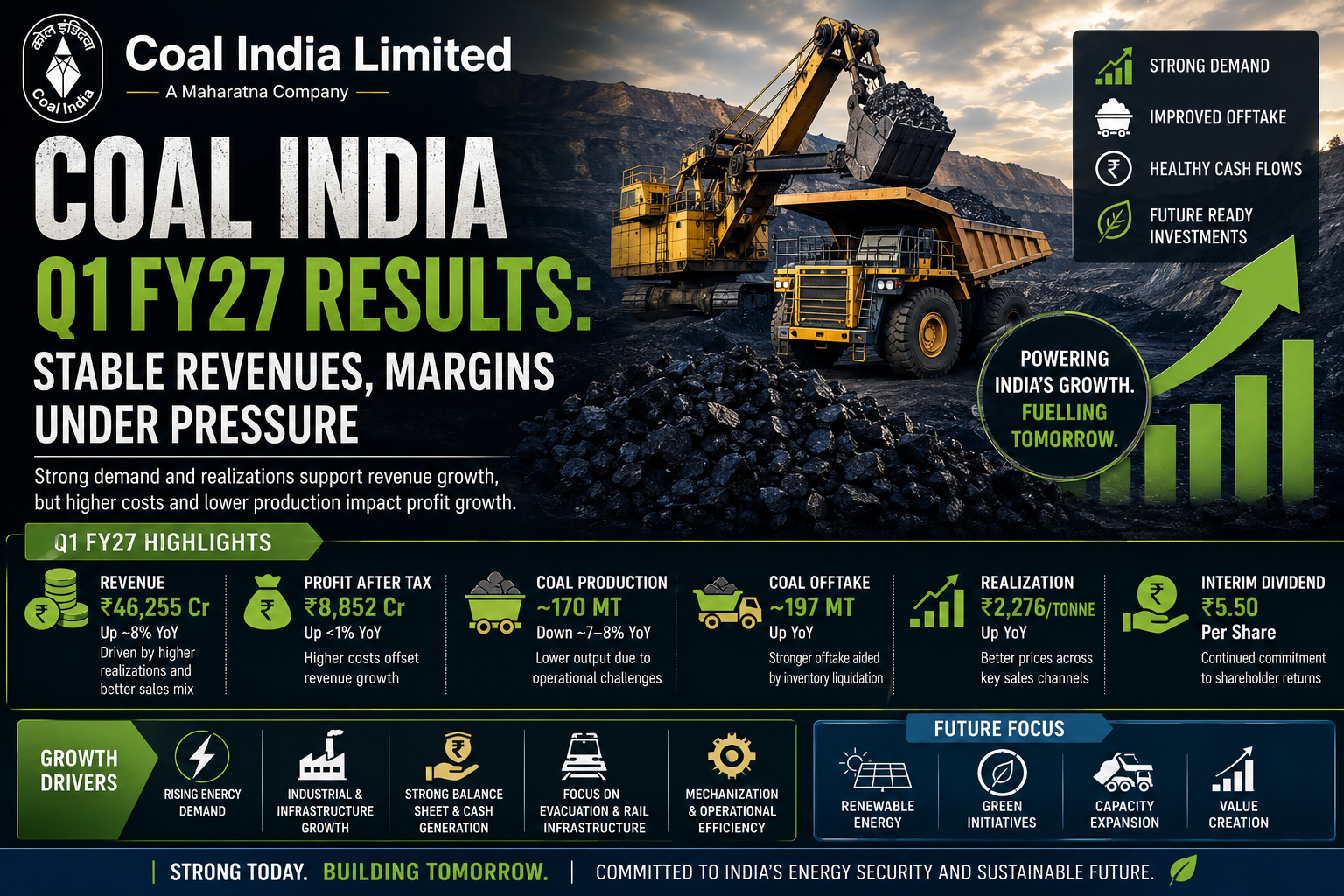
Coal India has started FY27 with a mixed set of quarterly results, delivering healthy revenue growth but only marginal growth in profitability. The latest numbers highlight an important shift in the company’s operating environment: while coal demand and realizations remain supportive, higher operating expenses and lower production volumes are putting pressure on margins.
For investors, the quarter presents a more nuanced picture. Coal India continues to generate enormous cash flows and maintain its position as India’s dominant coal producer, but the focus is increasingly moving toward cost control, productivity, production recovery, and the company’s ambitious capital expenditure plans.
Revenue Rises Despite a Challenging Operating Environment
Coal India’s consolidated revenue from operations increased to around ₹46,255 crore in Q1 FY27, compared with approximately ₹42,919 crore in the corresponding quarter of the previous year.
This represents growth of nearly 8% year-on-year.
The increase demonstrates that Coal India was able to maintain strong revenue generation despite lower production. Higher average realizations and improved sales mix helped offset some of the pressure created by weaker output.
However, revenue growth did not translate into comparable profit growth.
Profit Growth Remains Almost Flat
Coal India’s consolidated profit after tax came in at approximately ₹8,852 crore, compared with about ₹8,797 crore a year earlier.
That translates into a modest year-on-year increase of less than 1%.
The contrast between revenue growth of nearly 8% and profit growth of less than 1% is one of the most important takeaways from the quarter.
The primary reason is rising operating costs.
Expenses increased considerably during the period, with employee costs, contractual expenses, materials and other operating costs contributing to pressure on profitability.
This resulted in a weaker operating margin compared with the previous year.
Production Falls, but Offtake Improves
Coal production was one of the weaker areas during the quarter.
Coal India produced roughly 169–170 million tonnes during Q1 FY27, compared with more than 183 million tonnes during the same period last year.
This represents a decline of around 7–8%.
However, the company’s offtake performance was considerably better.
Coal offtake increased to approximately 197 million tonnes, helped by the liquidation of inventories.
This creates an interesting dynamic.
Coal India deliberately appears to be balancing production with actual demand rather than simply maximizing mine output and allowing inventories to accumulate.
For the company, this can improve inventory management and working capital efficiency, but sustained production weakness would eventually become a concern if demand continues to rise.
Realizations Provide an Important Cushion
One of the positive aspects of the quarter was improvement in average coal realization.
The company’s overall average realization increased to roughly ₹2,276 per tonne from around ₹2,208 per tonne a year earlier.
This improvement helped compensate for lower production volumes.
Long-term fuel supply agreement sales also saw a modest improvement in realization, while e-auction volumes and realizations remained important contributors to the company’s revenue mix.
The e-auction channel is particularly important because it generally provides Coal India with higher realizations compared with conventional supply arrangements.
Cost Inflation is the Biggest Concern
The biggest challenge emerging from the results is cost escalation.
Coal mining is heavily dependent on manpower, heavy earth-moving machinery, explosives, transportation and contractual services.
During the quarter, several of these expenses increased significantly.
Higher costs are particularly important because Coal India’s business is highly sensitive to operating margins.
Even when revenue increases, a sharp rise in expenses can significantly reduce the amount that ultimately reaches the bottom line.
This explains why the company’s profit growth remained almost flat despite healthy revenue growth.
Dividend Continues to Support the Investment Case
Coal India’s dividend profile remains an important attraction for investors.
The company announced an interim dividend of ₹5.50 per share for FY27.
For income-oriented investors, Coal India continues to stand apart from many other large-cap stocks because of its ability to generate substantial free cash flow and distribute a meaningful portion of that cash to shareholders.
The dividend story therefore remains an important part of the investment thesis, particularly for investors looking for cash-generating PSU businesses.
Capex is Becoming Increasingly Important
Coal India is entering an important phase of capital investment.
The company plans to significantly increase capital expenditure over the coming years, with investments directed toward:
- Mining capacity expansion
- Mine infrastructure
- Rail connectivity
- Evacuation infrastructure
- Mechanization
- Renewable energy
- Diversification into new energy opportunities
The proposed multi-year capex program signals that Coal India is preparing for a future in which energy demand remains strong while the company simultaneously works toward diversifying its business.
Renewable Energy Adds a New Dimension
Although coal remains the company’s core business, Coal India is gradually expanding its presence in renewable energy.
The company has been developing solar power projects and exploring other clean-energy opportunities.
This strategy is important because India’s energy transition does not mean that coal disappears overnight.
Instead, Coal India is attempting to participate in both sides of the energy equation—continuing to supply coal to meet India’s near- and medium-term energy requirements while building exposure to renewable energy for the longer term.
This diversification could eventually create an additional earnings stream outside the traditional mining business.
India’s Energy Demand Remains a Structural Tailwind
India’s economic expansion continues to support long-term energy demand.
Rapid industrialization, infrastructure development, urbanization, manufacturing growth and rising electricity consumption are likely to keep coal relevant to India’s power sector for years.
Coal continues to play a critical role in India’s electricity generation mix, particularly as the country balances rising energy requirements with the expansion of renewable capacity.
This provides Coal India with an important structural advantage.
However, the company will need to maintain production efficiency and infrastructure capacity to fully capitalize on this demand.
The Key Question: Can Production Recover?
For investors, production will be one of the most important metrics to monitor during the next few quarters.
The Q1 decline in output is not necessarily alarming on its own, particularly because offtake remained strong and inventories were being reduced.
But sustained production weakness could become problematic if it results in:
- Lower sales volumes
- Higher unit costs
- Reduced operating leverage
- Increased dependence on inventory liquidation
- Missed annual production targets
A recovery in production, combined with stronger offtake, would significantly improve the earnings outlook.
Coal India’s Long-Term Transformation
Coal India is gradually evolving from a traditional coal producer into a broader energy and natural resources company.
Its long-term strategy increasingly includes:
- Greater mechanization
- Higher productivity
- Large-scale mining expansion
- Improved rail infrastructure
- Renewable energy
- Critical minerals
- Diversification initiatives
This transformation could become increasingly important as India’s energy mix changes.
The company’s enormous scale, resource base and government backing provide it with significant advantages, but execution will determine how effectively these advantages translate into shareholder returns.
Risks Investors Should Monitor
Despite its strong fundamentals, Coal India is not without risks.
Key risks include:
- Falling international coal prices
- Lower domestic coal realizations
- Production shortfalls
- Rising employee and contractual costs
- Regulatory changes
- Environmental restrictions
- Faster-than-expected energy transition
- Higher capital expenditure requirements
The company’s ability to maintain margins while simultaneously investing heavily will be critical.
The Road Ahead
Coal India’s Q1 FY27 results present a mixed but fundamentally resilient picture.
Revenue growth remains strong, realizations have improved and offtake remains healthy. At the same time, lower production and higher costs have prevented those gains from translating into meaningful profit growth.
The next few quarters will therefore be crucial.
Investors will be watching closely for a recovery in production, improvement in operating efficiency, continued demand for coal and progress on the company’s ambitious capex and diversification plans.
Conclusion
Coal India’s latest earnings demonstrate both the strength and the challenges of India’s largest coal producer.
The company continues to generate enormous revenues and profits, supported by India’s structural energy demand. However, rising costs and lower production have exposed pressure on operating margins and limited earnings growth.
The positive takeaway is that Coal India’s strong cash generation, dividend distribution, massive resource base and long-term investment program provide a solid foundation for future growth.
The bigger story, however, lies beyond the current quarter. Coal India is preparing for a changing energy landscape by investing in mining capacity, infrastructure and renewable energy.
If the company can successfully combine higher production with better cost control while executing its diversification strategy, Coal India could remain an important player in India’s energy ecosystem for years to come.
Feel free to share your experiences and insights in the comments below. Let’s continue the conversation and grow together as a community of traders and analysts.
By sharing this experience and insights, I hope to contribute to the collective knowledge of our professional community, encouraging a culture of strategic thinking and informed decision-making.
As always, thorough research and risk management are crucial. The dynamic nature of financial markets demands vigilance, agility, and a deep understanding of the tools at your disposal. Here’s to profitable trading and navigating the election season with confidence!
Ready to stay ahead of market trends and make informed investment decisions? Follow our page for more insights and updates on the latest in the financial world!
For a free online stock market training by Yogeshwar Vashishtha (M.Tech IIT) this Saturday from 11 am – 1 pm, please sign up with https://pathfinderstrainings.in/training/freetrainings.aspx
Experience profits with my winning algo strategies – get a free one-month trial with ₹15 lakh capital! – https://terminal.algofinders.com/algo-terminal
Disclaimer
This article should not be interpreted as investment advice. For any investment decisions, consult a reputable financial advisor. The author and publisher are not responsible for any losses incurred by investors or traders based on the information provided.