

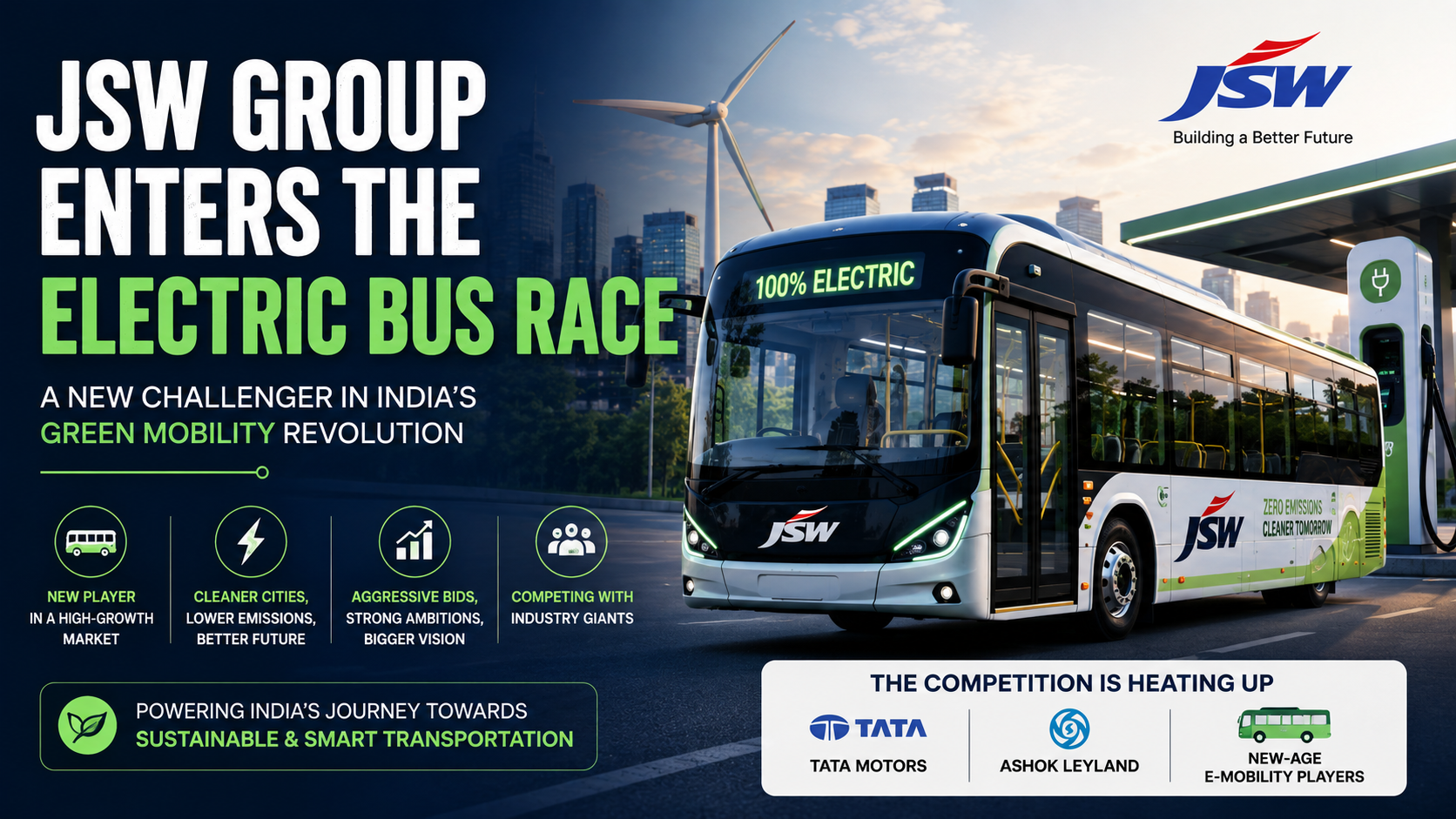
India’s electric mobility revolution is moving beyond passenger cars and two-wheelers. The next major transformation is taking place on city roads, where electric buses are expected to redefine public transportation by reducing emissions, lowering operating costs, and creating a cleaner urban mobility ecosystem.
The latest development in this space is the entry of the JSW Group into the electric bus market. The conglomerate’s participation in a large government electric bus tender signals its ambition to become a meaningful player in India’s rapidly expanding electric commercial vehicle industry.
JSW’s move introduces a new competitive force into a segment traditionally dominated by established automobile companies and specialized electric mobility players. The company’s aggressive approach highlights how India’s electric bus market is becoming one of the most important battlegrounds in the country’s clean energy transition.
JSW’s Entry Into the Electric Bus Race
JSW Group has built its legacy across steel, energy, infrastructure, and manufacturing. Its expansion into electric vehicles represents a strategic move toward future mobility and aligns with India’s push toward domestic EV manufacturing.
Through its electric mobility businesses, JSW is now looking to build capabilities in commercial electric vehicles, including buses. The company’s participation in the government-backed electric bus tender demonstrated its intent to compete directly with established names in the segment.
Although JSW did not secure orders in the latest tender, its competitive bidding strategy showed that the group is preparing for a larger role in the industry. The company emerged among the lower bidders in multiple city packages, indicating that it intends to compete aggressively on pricing and operational efficiency.
Why Electric Buses Are Becoming a Strategic Opportunity
Electric buses represent a much larger opportunity compared with conventional commercial vehicles because they sit at the intersection of transportation, energy transition, and government infrastructure development.
Cities across India are looking to modernize public transport systems while reducing pollution levels. Electric buses offer several advantages:
- Lower running costs compared with diesel buses
- Reduced dependence on fossil fuels
- Lower urban emissions
- Better integration with renewable energy systems
- Long-term cost benefits for public transport operators
The government’s push toward electric mobility has created a strong demand pipeline, especially through large-scale tenders designed to accelerate adoption across major cities.
The Changing Competitive Landscape
For years, companies such as Tata Motors and Ashok Leyland have been major names in India’s commercial vehicle market. Their manufacturing experience, supply chains, and relationships with transport operators have provided strong advantages.
However, the electric transition is changing the competitive dynamics.
New-age companies focused specifically on electric mobility have gained traction by offering competitive pricing, technology-driven solutions, and new business models. Recent electric bus tenders have seen emerging players secure significant portions of orders, challenging traditional industry leaders.
This shift highlights an important trend: success in electric mobility is not only about manufacturing vehicles. It depends on battery technology, financing models, fleet operations, charging infrastructure, and lifecycle management.
The Importance of Government Tenders
Unlike passenger vehicles, where consumers directly drive demand, electric buses in India are heavily influenced by government procurement.
Large tenders create the foundation for industry growth by providing companies with predictable demand and long-term contracts. Many of these projects operate under models where operators provide buses and services over extended periods while being compensated based on usage.
For companies entering the segment, winning early contracts is important because it helps establish operational experience, fleet credibility, and manufacturing scale.
JSW’s aggressive participation suggests that the company wants to build a strong position before the electric bus market reaches maturity.
The Challenge of Aggressive Pricing
While aggressive bidding can help companies enter new markets, it also creates challenges.
Electric buses require significant upfront investment. Companies must manage battery costs, charging infrastructure, maintenance expenses, and financing requirements over long contract periods.
Winning orders at extremely competitive prices may improve market share but can pressure margins if operating costs are higher than expected.
Therefore, the long-term winners in the electric bus industry will not necessarily be the companies offering the lowest price. They will be the ones that can combine cost efficiency with reliable operations and sustainable economics.
JSW’s Broader Electric Vehicle Strategy
JSW’s entry into electric buses is part of a broader automobile ambition. The group has been expanding its presence in the electric vehicle ecosystem, including plans around electric and hybrid vehicles.
The company’s advantage comes from its existing industrial capabilities. Experience in materials, manufacturing, energy, and infrastructure could provide strategic benefits as EV ecosystems develop.
Battery supply chains, charging networks, and manufacturing capabilities will determine the competitiveness of future electric vehicle companies. JSW’s industrial background positions it differently from pure-play automotive startups.
What This Means for India’s EV Future
JSW’s entry reflects a larger transformation taking place in India’s mobility sector.
The electric vehicle market is no longer limited to traditional automobile manufacturers. Energy companies, infrastructure groups, and technology-focused businesses are entering the space because the future of transportation is becoming increasingly connected with power generation, storage, and digital technology.
The electric bus segment could become one of the biggest drivers of India’s clean transportation goals. As cities expand and demand for sustainable public transport increases, competition among manufacturers is expected to intensify.
Conclusion: The Race for India’s Electric Roads Has Begun
JSW’s aggressive entry into electric buses marks an important development in India’s EV journey.
While the company’s first major tender participation did not result in immediate orders, it demonstrated a clear intent to compete in a market that is expected to grow rapidly.
The coming years will determine which companies can successfully balance technology, pricing, manufacturing scale, and profitability.
India’s electric mobility future is being built not only by vehicles on the road but also by the companies competing behind the scenes to power the next generation of transportation.
Feel free to share your experiences and insights in the comments below. Let’s continue the conversation and grow together as a community of traders and analysts.
By sharing this experience and insights, I hope to contribute to the collective knowledge of our professional community, encouraging a culture of strategic thinking and informed decision-making.
As always, thorough research and risk management are crucial. The dynamic nature of financial markets demands vigilance, agility, and a deep understanding of the tools at your disposal. Here’s to profitable trading and navigating the election season with confidence!
Ready to stay ahead of market trends and make informed investment decisions? Follow our page for more insights and updates on the latest in the financial world!
For a free online stock market training by Yogeshwar Vashishtha (M.Tech IIT) this Saturday from 11 am – 1 pm, please sign up with https://pathfinderstrainings.in/training/freetrainings.aspx
Experience profits with my winning algo strategies – get a free one-month trial with ₹15 lakh capital! – https://terminal.algofinders.com/algo-terminal
Disclaimer
This article should not be interpreted as investment advice. For any investment decisions, consult a reputable financial advisor. The author and publisher are not responsible for any losses incurred by investors or traders based on the information provided.