

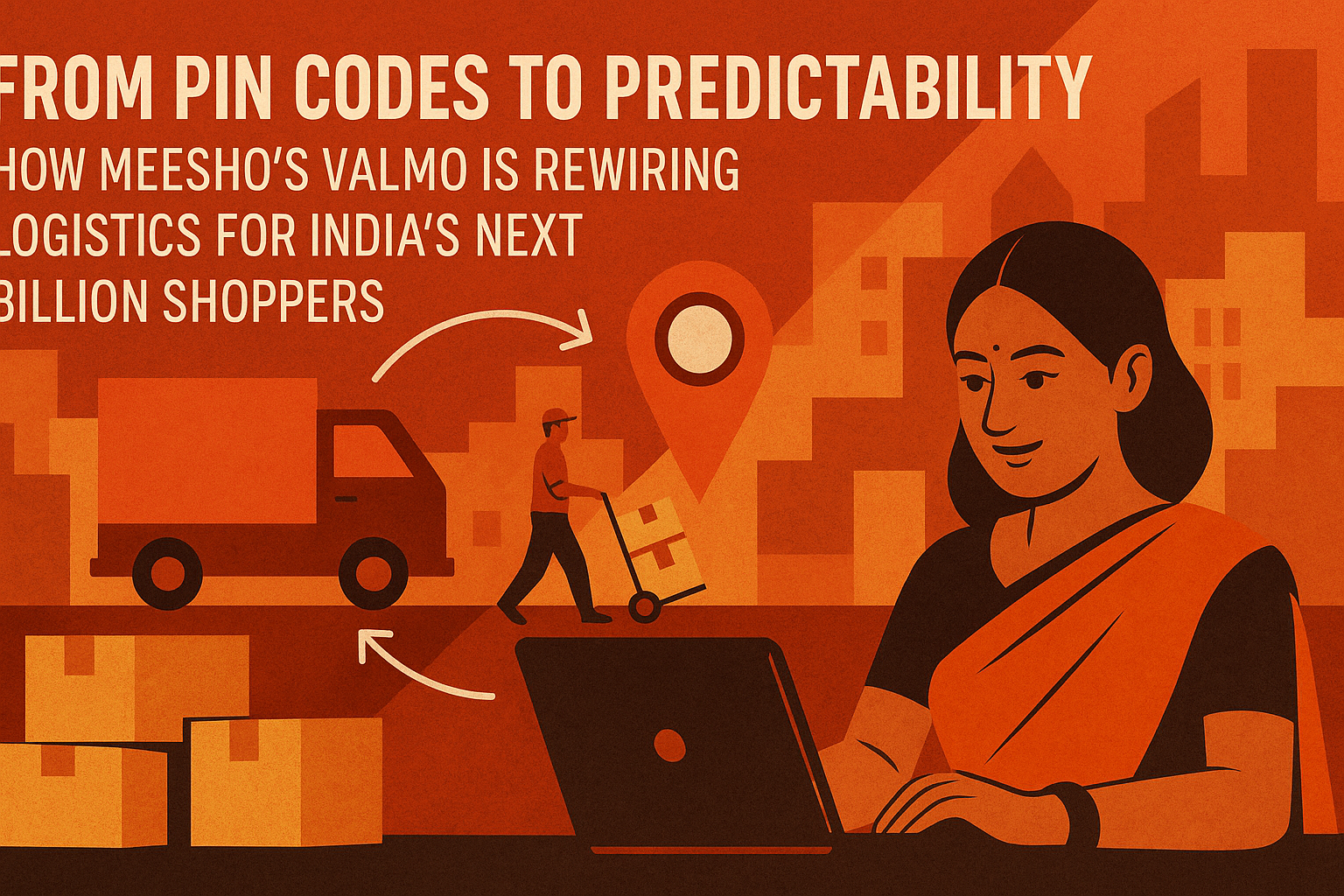
Six years ago, when Jaya Singh Yadav began selling home décor from her home in Indore, the internet promised scale—but logistics delivered chaos.
Indore had delivery options in abundance, the way a busy bazaar has vendors for everything. Yet nothing worked like a single, reliable system. Shipments moved through a patchwork of third-party courier operators—each strong in a few neighbourhoods, weak in others, and wildly inconsistent across pin codes. One day pickups would happen early; another day they’d shift without warning. Return cycles could be smooth one week and sluggish the next. Tracking often vanished at the exact moment it was needed most, dissolving somewhere between handovers.
So Yadav did what thousands of small entrepreneurs do when infrastructure won’t cooperate: she built “buffers” into her business like shock absorbers on a rough road. Extra stock. Flexible delivery promises. Handwritten notes to track parcels when systems went silent.
“It wasn’t that the services were bad,” she says. “It was just unpredictable, because no network covered every part of the city.”
Then—quietly—something changed.
When the City’s Logistics Started Breathing in Rhythm
Around late 2022, Yadav noticed that the unpredictability began to soften at the edges. Pickups felt steadier. Turnaround times shortened. Fewer parcels got stranded mid-route like forgotten suitcases between connecting trains.
She didn’t know the reason then, but the shift had a name: Valmo—Meesho’s in-house logistics layer that began routing shipments through local delivery partners connected into a more coordinated system.
“It just became more predictable,” she says. “I knew when parcels would move and there were fewer surprises in between.”
That word—predictable—isn’t glamorous. It doesn’t sparkle like “10-minute delivery” or “same-day shipping.” But for a home-based seller juggling inventory, customer expectations, and cash flow, predictability is power.
It means fewer cancellations, fewer angry messages, fewer nights spent wondering where a package disappeared.
Bengaluru Had Speed. It Needed Clarity.
Now shift the camera to Bengaluru, where Arjun Kumar sells handmade mobile accessories from home.
His problem was never a lack of delivery services. In metros, competition keeps service levels tight; delivery is already fast, and courier networks tend to be denser. For Kumar, the pain point wasn’t “Will the parcel get picked up?” but “Can I see what’s happening clearly enough to avoid disputes?”
“Metro deliveries were already quick,” he says. “What changed was better visibility and fewer disputes.”
So while Valmo steadied the basics for sellers like Yadav in tier-2 environments—pickup consistency, route stability, fewer stuck parcels—it sharpened the instrument panel for metro sellers like Kumar: tracking precision, returns settlement, dispute reduction.
Two sellers. Two cities. Two different logistics realities.
And that contrast explains a lot about why Valmo exists.
Why Meesho Built Valmo (Without Buying a Fleet)
Unlike logistics arms run by other giants—think Flipkart’s Ekart or Amazon’s transportation network—Meesho doesn’t operate as a traditional asset-heavy machine with its own massive fleet and warehouses. That’s a strategic choice: avoiding heavy capital expenditure helps keep the model lighter, but it also reduces direct control over delivery outcomes.
For years, Meesho leaned on third-party logistics (3PL) providers, which made early scaling easier. But scale has a way of turning “small inefficiencies” into expensive leaks. When you’re moving millions of parcels, a minor pickup delay or routing mismatch doesn’t stay minor—it multiplies.
Valmo was built to bridge that gap: more control and visibility, without fully replacing partners.
Instead of becoming a courier company, Valmo became an orchestration layer—a system that coordinates many logistics players as if they were part of one network.
Valmo’s Core Idea: Many Partners, One Choreography
Valmo connects multiple logistics providers—delivery partners, sorting hubs, truck operators, independent riders—inside a coordinated platform. A shipment may pass through several hands, but the journey is managed as a single flow.
In FY25, the average order passed through around four handovers, according to Meesho’s prospectus. That sounds like complexity—and it is—but it’s also the point.
Valmo’s routing software evaluates multiple possible paths in real time, weighing factors like capacity, cost, reliability, and promised delivery timelines. If one node faces disruption—overload, staffing issues, weather—the system can reroute parcels to reduce failures. Automated exception handling and partner performance tracking aim to prevent parcels from slipping into the blind spots that plagued sellers like Yadav earlier.
This is logistics as a living network, not a fixed corridor.
The Scale-Up: From Pilot to 763 Million Orders
After a pilot run, Valmo was officially launched in 2024 as Meesho’s in-house logistics aggregator. At launch, it reportedly had partnerships with 3,000+ small courier services across small towns—an early signal that the strategy wasn’t to dominate metros, but to stitch together India’s fragmented hinterland delivery map.
Then came the numbers that made investors pay attention:
- Valmo fulfilled 763 million orders in FY25.
- In FY25, it accounted for about half of Meesho’s fulfilled orders.
- Within roughly a year, it scaled from handling about 20% of Meesho’s orders to ~62% in the quarter ended June (as per the prospectus).
When a system moves from “pilot” to “majority of deliveries” that fast, it stops being a backend tweak—and becomes a core business lever.
The “Secret Sauce” Isn’t a Warehouse. It’s Competition.
So how does an orchestration layer reduce costs?
One big idea: more competition at each stage of the journey.
Instead of relying on a few large providers, Valmo enables dozens of regional operators to compete for legs of the route. More competition tends to improve pricing. And because shipments often travel shorter distances between handovers—frequently via bikes and local movement—logistics becomes more hyperlocal and intercity than long-haul, warehouse-to-warehouse.
Combine that with Meesho’s volume in tier-3+ regions and low fixed costs, and you get something powerful: a system designed for mass e-commerce economics, where the unit economics are fragile and every rupee matters.
Meesho’s prospectus links Valmo’s expansion to a meaningful cost shift: per-order fulfilment cost falling from ₹50.45 in FY23 to about ₹37.70 in the quarter ended June.
The Tech Bet: Routing, Risk, and AI as Logistics Muscle
Valmo isn’t just a marketplace for couriers—it’s increasingly a data machine.
Routing decisions rely on reliability signals, cost curves, capacity availability, and even pin code “risk.” That’s how you manage peak demand, keep partners motivated through fair allocation and payouts, and avoid creating incentives that degrade service quality over time.
Meesho has said it intends to accelerate tech investments, including AI/ML efforts (such as GeoIndia LLM and BharatML Stack referenced in its prospectus), and allocate IPO proceeds toward cloud infrastructure and hiring talent for AI/ML teams. The message is clear: logistics advantage won’t come only from contracts—it will come from algorithms and operational intelligence.
And importantly, Meesho’s CEO has indicated Valmo will remain captive—built to serve Meesho’s ecosystem rather than becoming a third-party logistics product for other companies.
The Hurdles: The Hinterland Doesn’t Scale Like a Metro
Here’s the uncomfortable truth: scaling in sparse regions is not linear.
“Scaling from 100 million to 300 million deliveries is one challenge,” an industry executive notes. “Scaling from 300 million to 600 million in sparse regions is a completely different one.”
Remote markets bring three stubborn problems:
- Weak infrastructure and patchy networks
- Non-standard or unclear addresses
- High cash-on-delivery (COD) and returns, which can destroy unit economics on low-ticket orders
These challenges are why “express delivery everywhere” is often a trap. In many hinterland markets, what works is not speed at any cost—but reliable 3–5 day delivery with tight service controls and performance management.
The other squeeze is labour. Competition for delivery partners intensifies during peak seasons, pushing wages up and making retention harder. In festival months, gig demand spikes and platforms end up competing for the same workforce.
The Ripple Effect: 3PLs Feel the Heat
As Valmo grows, it reshapes the broader logistics ecosystem.
When a marketplace moves deliveries internally—even without owning trucks—3PLs that depended heavily on that marketplace have to recalibrate routes, hiring, and asset allocation. Some are pushed to diversify into hyperlocal and express deliveries to reduce concentration risk.
In other words, Valmo isn’t just changing how Meesho ships. It’s changing how the logistics market behaves around Meesho.
The Road Ahead: What Investors Are Really Buying
As Meesho steps into public market scrutiny, Valmo becomes central to questions of defensibility.
Not just: How many parcels can you ship?
But: Can you make money shipping them—especially to difficult pin codes?
Market watchers increasingly care about operating leverage, Ebitda trajectory, and cash flows—signals that the logistics engine isn’t just moving boxes, but building a sustainable system.
Meesho’s financials underline the stakes: losses remain significant, even as the company scales. That makes Valmo’s promise—lower costs, higher reliability, better control—more than an operational story. It becomes a profitability story.
Takeaways: What Valmo Really Represents
Valmo’s story is easy to reduce to “Meesho built logistics.” But what’s happening is more specific—and more interesting:
- Valmo is not a fleet. It’s a coordination layer.
- For tier-2/tier-3 sellers like Yadav, it turns fragmented delivery into predictable movement.
- For metro sellers like Kumar, it improves visibility, tracking, and returns settlement.
- It scales by organizing competition among many regional operators, keeping costs sharper.
- Its biggest test lies ahead: maintaining predictability while pushing deeper into sparse, low-density geographies where logistics becomes expensive and messy.
And in the end, it comes back to the smallest seller’s daily reality: fewer surprises between pickup and delivery.
For Jaya Singh Yadav in Indore, that difference isn’t abstract.
It’s the difference between building a business around uncertainty—and building one around trust.
Feel free to share your experiences and insights in the comments below. Let’s continue the conversation and grow together as a community of traders and analysts.
By sharing this experience and insights, I hope to contribute to the collective knowledge of our professional community, encouraging a culture of strategic thinking and informed decision-making.
As always, thorough research and risk management are crucial. The dynamic nature of financial markets demands vigilance, agility, and a deep understanding of the tools at your disposal. Here’s to profitable trading and navigating the election season with confidence!
Ready to stay ahead of market trends and make informed investment decisions? Follow our page for more insights and updates on the latest in the financial world!
For a free online stock market training by Yogeshwar Vashishtha (M.Tech IIT) this Saturday from 11 am – 1 pm, please sign up with https://pathfinderstrainings.in/training/freetrainings.aspx
Experience profits with my winning algo strategies – get a free one-month trial with ₹15 lakh capital! – https://terminal.algofinders.com/algo-terminal
Disclaimer
This article should not be interpreted as investment advice. For any investment decisions, consult a reputable financial advisor. The author and publisher are not responsible for any losses incurred by investors or traders based on the information provided.