

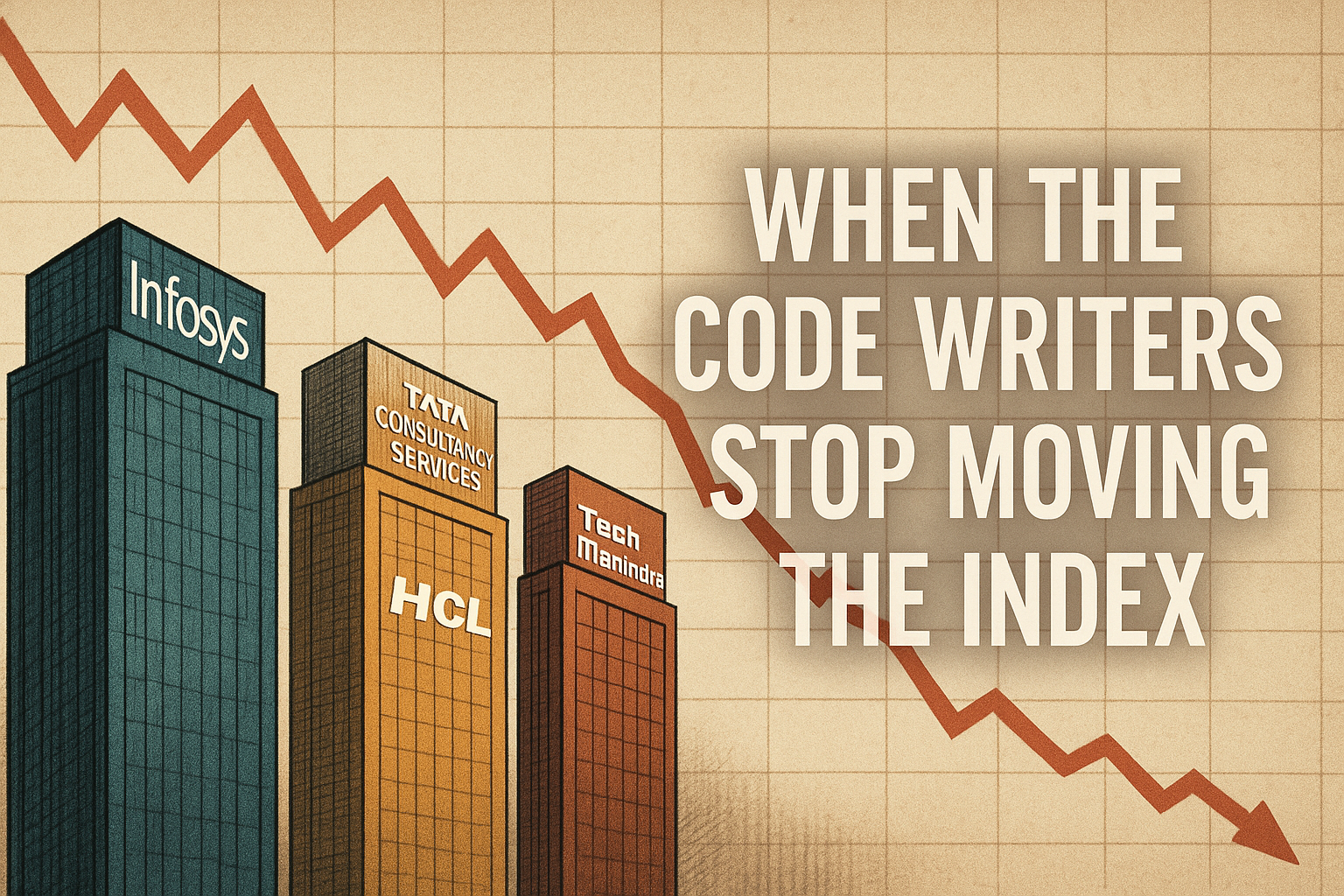
India’s $283-billion information technology sector used to feel like the metronome of the market—steady, reliable, always audible in the background of every rally. For years, the country’s biggest IT services firms weren’t just companies; they were index-shaping gravity. But lately, the numbers tell a different story. The sector is still enormous, still influential, still full of brand names that anchor portfolios—but it’s no longer the big hitter in India’s headline indices.
In the BSE Sensex, the combined weight of IT companies has slipped to an 18-year low. IT now accounts for 11.3% of the index—down sharply from the late-2021 peak of ~18.56%. Over in the Nifty 50, the story is similarly sobering: IT’s weight is at a decadal low near 10%, even as its share of Nifty profits has stayed roughly stable around 15% for the past four years. That mismatch—profits steady, index presence shrinking—reads like a market verdict: investors are no longer paying up for the same story.
The Quiet Meaning of a Falling Weight
Index weight isn’t sentiment—it’s math. A company’s weight rises when its market capitalization outpaces the rest of the index, and it falls when it lags. So when IT’s share shrinks, it’s not because these firms vanished. It’s because other parts of the market have moved faster, and IT has struggled to keep up.
The contrast is stark. Since the start of the year cited, TCS fell 23.47%, Infosys 17%, HCLTech 14.74%, Wipro 17.14%, and Tech Mahindra 9.97%—while the Sensex gained 8.64%. In a market that’s climbing, an industry that falls starts to feel like dead weight—literally and figuratively.
A Timeline With a Turning Point: November 2022
Markets love clean narratives, and this one has a timestamp: November 2022, the month OpenAI’s ChatGPT went public and generative AI stopped being a lab curiosity and became a boardroom agenda.
The timing matters not because ChatGPT “caused” the decline overnight, but because it symbolized an inflection point. For decades, India’s IT services engine thrived on a powerful formula: skilled talent + labor arbitrage + scale + offshore delivery. But GenAI threatens to bend that formula. When software can write software, when copilots assist developers, when automation compresses timelines, the old model begins to look… inflated.
That’s where the idea of GenAI’s “deflationary impact” bites: fewer manual hours, fewer billable seats, more output per person. Efficiency, in other words—great for clients, complicated for firms that monetized effort.
Automation Isn’t New—But Its Economics Are
Automation has been in the industry for years. The difference now is its intensity and its reach into white-collar workflows that used to be protected by complexity. If you’re an IT outsourcer, automation creates a fork in the road:
- Turn it into cost takeout (protect margins, flatter growth), or
- Turn it into new revenue (new products, new platforms, new outcomes)
Investors are clearly asking for option two—and not seeing enough proof yet.
Analysts and industry watchers describe this moment as a technology transition where expectations are being recalibrated. The market is less interested in how efficiently firms can deliver yesterday’s work and more curious about whether they can sell tomorrow’s value.
The US Bottleneck: Mobility and Visa Friction
Layered on top is a structural constraint that’s been persistent for years: labour mobility hurdles in the US. The IT services model has always relied on moving the right people to the right client site at the right time—especially for high-trust transformation work. When visa regimes tighten or become unpredictable, delivery planning becomes risk management. That friction doesn’t show up as a dramatic headline every week, but it quietly chips away at speed, flexibility, and deal confidence.
In an era where clients want rapid AI pilots, fast iteration, and tight integration with onshore teams, mobility constraints become more than an HR issue—they become a growth limiter.
The Valuation Message: P/E Pain
If index weight is math, valuation is emotion—scaled. The industry’s P/E ratios have drifted to multi-year lows: TCS at 23.7 and Infosys at 24.4 (lowest in at least five years), HCLTech at 25.8 and Wipro at 20.3 (three-year lows). A lower P/E doesn’t just mean “cheap.” It often means the market expects slower growth, less certainty, or a longer wait for the next big upcycle.
This is the investor-led verdict: show us the next engine.
The Big Five Still Matter—But the Crown Fits Looser
Even after the fall, the heavyweight names remain central. Infosys (5.49% Sensex weight) and TCS (3.17%) are still among the largest components. HCL Technologies and Tech Mahindra remain prominent. But the symbolism is important: Wipro, once a stalwart, was removed from the Sensex in 2024. Indices don’t just track markets—they reflect leadership. Being dropped is less about one company and more about what the market is choosing to prioritize.
And what it’s prioritizing right now seems to be sectors with clearer near-term growth visibility, stronger domestic tailwinds, or business models that feel less disrupted by automation.
The Slowdown Under the Surface
The sector’s growth has already shown signs of strain. The Big Five collectively logged their slowest pace in over a decade in the last fiscal year cited. Some firms managed single-digit growth; others saw marginal declines. Discretionary spending—the “nice-to-have” projects that drive outsized growth—has been weak. Fewer big-ticket deals mean fewer moments where growth accelerates and the market gets excited.
In short, the industry is caught between two weather systems:
- A cautious client environment today
- A transformative AI future that hasn’t yet become a dependable revenue stream
The Optimist’s Case: The Next Cycle Isn’t Dead—It’s Loading
Not everyone sees this as decay. Some brokerages see the low weights and compressed valuations as the market pricing in the “status quo”—and therefore setting up asymmetry if a recovery arrives.
The bullish narrative goes like this:
- The US has already invested in data centers and AI infrastructure.
- Now it needs applications and systems integration to make that infrastructure useful.
- That’s where large integrators and service providers can reassert relevance—if they adapt fast enough.
There’s also the macro tailwind argument: if the US Federal Reserve cuts rates, enterprises may loosen budgets and fund larger tech upgrades, including AI embedding across operations. Lower borrowing costs often revive transformation spending—which historically supports IT services.
One notable forecast in the mix: a projected recovery starting September 2026, when enterprises may shift from experimentation to full-scale AI deployment.
What Investors Are Really Watching Now
This isn’t a story about India’s IT giants becoming irrelevant. It’s a story about the market asking them to evolve in public.
Investors are watching for proof of transition:
- From billing effort to delivering outcomes
- From headcount-driven growth to platform-led growth
- From labor arbitrage to AI-enabled leverage
- From “we can execute” to “we can co-invent”
The old era rewarded predictability at scale. The new era rewards those who can turn automation into new categories of revenue, not just cleaner margins.
Takeaways: The Index Is a Mirror
India’s IT sector hasn’t shrunk into insignificance. It has simply lost its automatic right to dominate benchmark indices. The shrinking index weight is the market’s way of saying: we’re not paying for the past anymore.
The next phase will belong to the firms that can become strategic partners in GenAI—not just efficient service providers. The crown is still within reach. But it now has to be earned again, quarter by quarter, capability by capability, with a new story that fits the age of generative AI.
Feel free to share your experiences and insights in the comments below. Let’s continue the conversation and grow together as a community of traders and analysts.
By sharing this experience and insights, I hope to contribute to the collective knowledge of our professional community, encouraging a culture of strategic thinking and informed decision-making.
As always, thorough research and risk management are crucial. The dynamic nature of financial markets demands vigilance, agility, and a deep understanding of the tools at your disposal. Here’s to profitable trading and navigating the election season with confidence!
Ready to stay ahead of market trends and make informed investment decisions? Follow our page for more insights and updates on the latest in the financial world!
For a free online stock market training by Yogeshwar Vashishtha (M.Tech IIT) this Saturday from 11 am – 1 pm, please sign up with https://pathfinderstrainings.in/training/freetrainings.aspx
Experience profits with my winning algo strategies – get a free one-month trial with ₹15 lakh capital! – https://terminal.algofinders.com/algo-terminal
Disclaimer
This article should not be interpreted as investment advice. For any investment decisions, consult a reputable financial advisor. The author and publisher are not responsible for any losses incurred by investors or traders based on the information provided.