

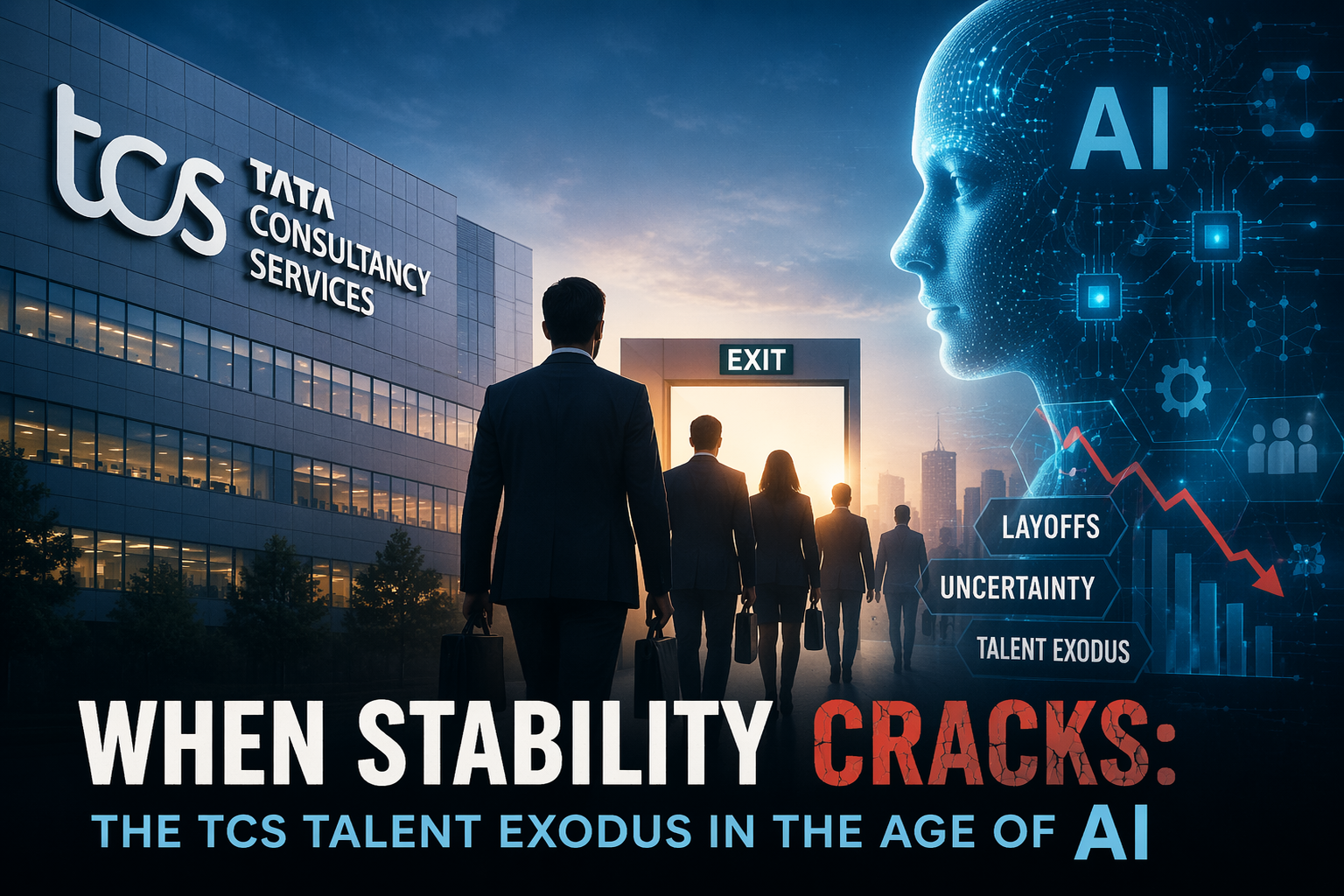
When Stability Cracks: The TCS Talent Exodus in the Age of AI
For decades, Tata Consultancy Services (TCS) stood as a symbol of stability in India’s corporate landscape—a company where careers were not just jobs but long-term commitments. Known for its strong brand, consistent growth, and promise of lifetime employment, TCS attracted some of the brightest minds in the industry. However, recent developments reveal a dramatic shift. A wave of senior-level exits, driven by artificial intelligence (AI)-led restructuring and internal dissatisfaction, has shaken this long-standing perception and raised serious questions about the future of traditional IT services.
A Sudden Surge in Senior Exits
The scale of change is hard to ignore. Around 300 senior executives—nearly 16% of TCS’s top leadership—have exited within just eight months, marking the highest churn at this level since the company went public in 2004 .
These weren’t routine departures. The exits included professionals with over two decades of experience—principal consultants, vice presidents, and senior vice presidents—individuals who formed the backbone of TCS’s execution excellence. Historically, senior-level attrition hovered at a modest 4–5% annually, making this spike both unusual and alarming .
This shift signals more than just employee movement—it reflects a deeper structural transformation underway.
AI Disruption and Workforce Restructuring
At the heart of this transformation lies artificial intelligence. TCS has initiated one of its largest workforce restructurings, cutting approximately 12,000 jobs—about 2% of its workforce—as AI reshapes the IT services industry .
The traditional model of IT services relied heavily on human capital, layered hierarchies, and large teams managing complex projects. AI, however, is changing that equation. Automation tools can now handle tasks that once required multiple levels of oversight, reducing the need for mid-to-senior management layers.
Industry analysts describe this as a “structural reset”—a transition from labor-intensive delivery to AI-driven execution. In this new model, fewer people are needed, but those who remain must possess broader, more integrated skill sets.
Breaking the Trust Equation
Beyond technological disruption, a more emotional factor is at play: trust.
TCS built its reputation not just on performance but on a psychological contract with employees—offering stability, diverse opportunities, and long-term career growth. That promise now appears fractured.
Employees have voiced concerns over layoffs and shifting priorities. As one executive noted, the company did not offer the highest salaries but compensated with strong brand value and career opportunities. With that foundation shaken, loyalty has weakened .
This erosion of trust is significant. In industries driven by intellectual capital, employee confidence is as critical as financial performance.
Compensation Concerns and Leadership Discontent
Another key driver of the exodus has been dissatisfaction with compensation—particularly variable pay.
Senior leadership reportedly received less than 10% of their variable pay for over two years, even as junior employees continued to receive increments and incentives . This imbalance has pushed many experienced professionals toward startups, Fortune 500 companies, and mid-sized firms offering better financial rewards.
When combined with job insecurity and organizational restructuring, compensation issues have amplified the sense of instability within the company.
Business Pressures and Market Realities
TCS is not operating in isolation—broader market conditions have also contributed to its challenges.
The global IT services sector is currently facing:
- Weak discretionary spending by clients
- Increased competition for large deals
- Pressure to reduce costs and margins
TCS has lost key contracts to competitors and faces difficulty maintaining revenue growth. Analysts suggest that in such an environment, companies are forced to choose between protecting margins and retaining expensive senior talent .
This balancing act often results in tough decisions—ones that directly impact workforce composition.
Implications for Clients and Execution Quality
The departure of senior executives raises concerns beyond internal operations. These individuals play a critical role in ensuring seamless project delivery, managing client relationships, and maintaining institutional knowledge.
As one insider pointed out, no amount of automation can fully replace the experience and judgment of seasoned professionals .
Clients may begin to feel the impact if continuity is disrupted, especially in long-term or high-value engagements. In a service-driven industry, trust and consistency are key—and both are at risk during periods of high churn.
A Broader Shift Across the Industry
TCS’s situation is not entirely unique—it reflects a wider transformation across the IT services sector.
As AI adoption accelerates, companies are:
- Flattening organizational structures
- Reducing middle management layers
- Prioritizing multi-skilled senior professionals
- Shifting focus from headcount to efficiency
This signals a move away from traditional employment models toward more agile, performance-driven frameworks.
Conclusion: The End of an Era or a New Beginning?
The developments at TCS mark a turning point—not just for the company but for the entire IT services industry. The era of guaranteed stability and linear career progression is giving way to a more dynamic, uncertain landscape shaped by technology and market forces.
While AI offers efficiency and scalability, it also challenges long-held assumptions about employment, leadership, and organizational structure.
For TCS, the road ahead will depend on how effectively it balances innovation with employee trust, cost optimization with talent retention, and technological advancement with human expertise.
For professionals, the message is clear: adaptability is no longer optional—it is essential.
Feel free to share your experiences and insights in the comments below. Let’s continue the conversation and grow together as a community of traders and analysts.
By sharing this experience and insights, I hope to contribute to the collective knowledge of our professional community, encouraging a culture of strategic thinking and informed decision-making.
As always, thorough research and risk management are crucial. The dynamic nature of financial markets demands vigilance, agility, and a deep understanding of the tools at your disposal. Here’s to profitable trading and navigating the election season with confidence!
Ready to stay ahead of market trends and make informed investment decisions? Follow our page for more insights and updates on the latest in the financial world!
For a free online stock market training by Yogeshwar Vashishtha (M.Tech IIT) this Saturday from 11 am – 1 pm, please sign up with https://pathfinderstrainings.in/training/freetrainings.aspx
Experience profits with my winning algo strategies – get a free one-month trial with ₹15 lakh capital! – https://terminal.algofinders.com/algo-terminal
Disclaimer
This article should not be interpreted as investment advice. For any investment decisions, consult a reputable financial advisor. The author and publisher are not responsible for any losses incurred by investors or traders based on the information provided.