

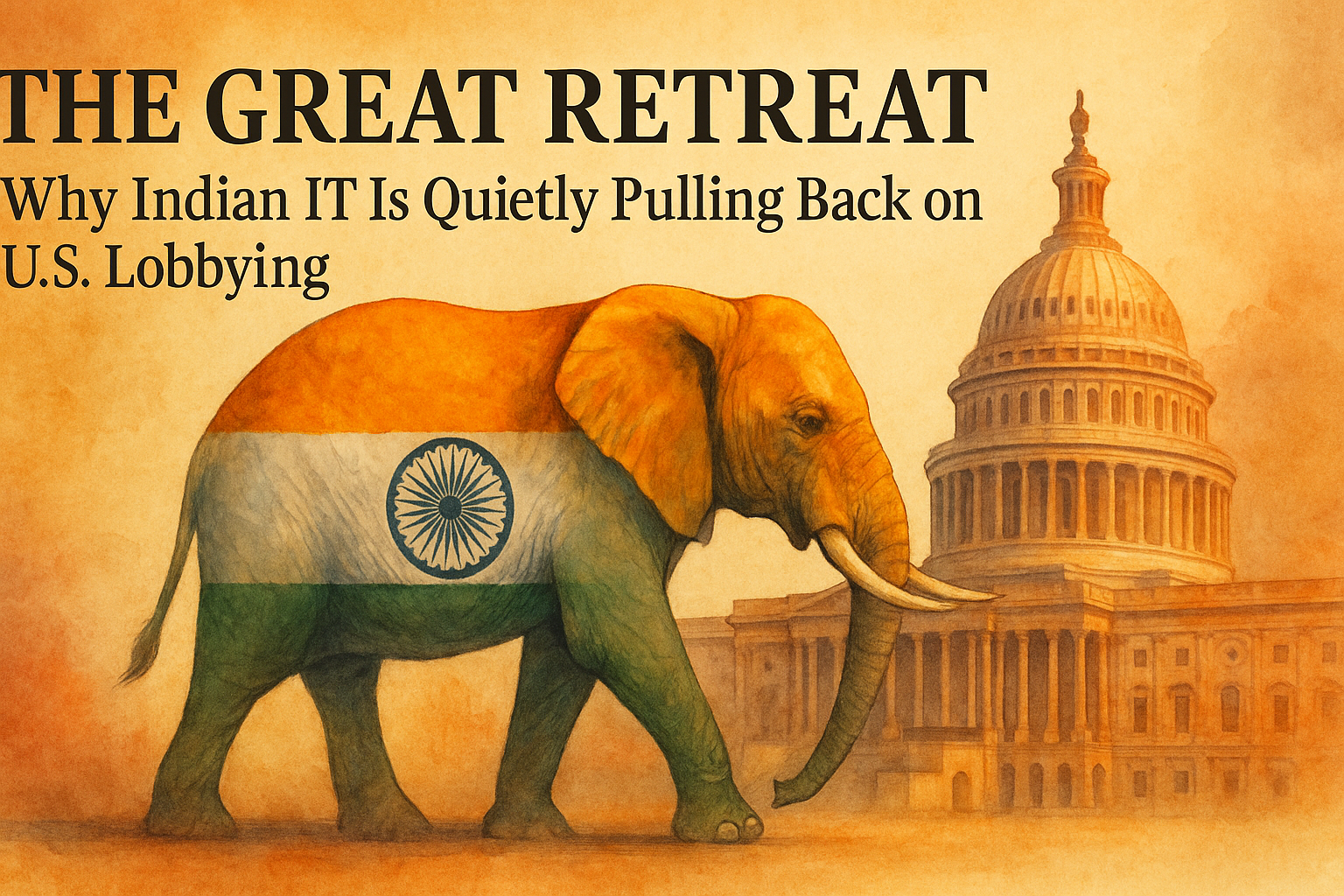
For over two decades, Indian IT giants relied on aggressive lobbying in Washington to protect their access to the U.S. talent market, secure favourable visa policies, and cushion regulatory shocks. But a striking shift is now underway. Fresh filings with the U.S. House of Representatives reveal that India’s largest IT services firms are dramatically cutting their lobbying spend—even as U.S. visa fees skyrocket and political sentiment hardens against offshore-heavy delivery models.
The question is: Why are they pulling back right when the pressure is highest?
This blog post takes you inside the numbers, the politics, and the evolving strategies reshaping Indian IT’s presence in Washington.
A Changing Landscape for Indian IT
The U.S. has long been the heart of India’s IT export engine, contributing over one-third of the industry’s revenue. Lobbying—while often opaque—has historically been a critical tool to ensure smooth operations, especially around immigration and worker mobility.
But recent data shows a clear retreat:
Falling Lobbying Spend Across the Board
| Company | 2020 | 2022 | 2024 | 2025 (Jan–Sep) |
|---|---|---|---|---|
| Cognizant | $3.15M | $2.3M | $2.01M | $1.71M |
| TCS | $0.75M | $0.93M | $1.04M | $0.67M |
| Infosys | $0.24M | $0.32M | $0.36M | $0.27M |
| Nasscom | $0.70M | $0.67M | $0.36M | $0.02M |
| Wipro | $0.21M | $0.09M | — | — |
The largest spender, Cognizant, has slashed lobbying by a third since 2020. Nasscom’s reduction is even more dramatic—down to just $20,000 in all of 2025 so far.
Only TCS and Infosys saw growth until 2024, before cutting back sharply this year.
Why the Pullback? Five Strategic Shifts
1. The H-1B Visa Becomes a Political Flashpoint
At the centre of the storm is the H-1B visa program, the lifeline for Indian IT firms’ onshore operations.
When President Trump increased H-1B application fees to $100,000—a tenfold jump—the industry braced for impact. Soon after, Senators Charles Grassley and Richard Durbin accused TCS and Cognizant of displacing American workers and demanded accountability.
With this level of scrutiny, lobbying no longer guarantees influence—if anything, it risks amplifying criticism.
2. Local Hiring and Offshore Delivery Are Rewriting the Model
As HFS Research CEO Phil Fersht notes:
“The traditional visa-dependent model is being rewritten.”
Companies are leaning heavily into:
- Local hiring in the U.S. to reduce dependency on visas
- Offshore-heavy delivery, minimizing onshore staff requirements
- AI-driven automation, reducing headcount needs overall
With fewer employees needing U.S. placement, visa reform—once mission-critical—now carries less urgency.
3. A Less Receptive U.S. Political Climate
Everest Group’s Peter Bendor-Samuel puts it bluntly:
“Indian firms feel a higher lobbying profile may be counterproductive.”
Offshoring is unpopular. Policymakers increasingly prioritize protecting domestic jobs. Under these circumstances, Indian IT sees limited returns—and potentially higher risks—in maintaining a strong lobbying footprint.
4. Lobbying Itself Is Evolving
Cognizant’s filings show a new focus on:
- AI policy
- Federal workforce development programs
- STEM education
- Tax issues
This shift reflects a broader industry recalibration toward next-generation technologies, where regulatory frameworks are still debated. With fewer entrenched positions, firms may feel no urgency to lobby aggressively.
5. Diminishing ROI on Traditional Lobbying
When the primary battle—defending the H-1B program—is being reshaped politically and economically, the payoffs from lobbying are simply not what they used to be.
H-1B: Still the Core Pain Point
Despite spending cuts, H-1B remains the dominant issue in lobbying filings.
- TCS highlighted H-1B reform in its January–March 2025 report.
- Cognizant flagged immigration-related issues in multiple filings through 2025.
- Infosys expanded its lobbying to AI, skills training, and workforce programs—areas tightly linked to future immigration needs.
Even as firms shift operationally, visa policy still influences margins, project staffing, and client satisfaction.
The Domino Effect of Stricter U.S. Policies
Beyond fees, the U.S. is tightening scrutiny on offshore-heavy delivery models. Recent actions include:
- Senator Bernie Moreno’s proposed HIRE Act, penalizing firms that rely on offshore talent
- Public criticism of major Indian IT firms for replacing American workers
- Increasing political tension around immigration in an election cycle
Each layer adds uncertainty for IT firms—and greater caution around public lobbying.
Lobbying Firms Behind the Scenes
Indian IT’s Washington presence spans powerful networks:
- TCS → Squire Patton Boggs
- Cognizant → BGR Government Affairs
- Infosys → DGA Group Government Relations
These firms routinely engage Congress, the Senate, and even the White House. But with diminishing budgets, their mandate is shrinking.
Nasscom, notably, used Squire Patton Boggs this year but spent less than $5,000 per filing—a token level of engagement compared to previous years.
Who Spends More? Not IT—Pharma and Big Tech
In the broader U.S. landscape, Indian IT isn’t even close to the biggest lobbying spenders. Pharmaceuticals and U.S. tech behemoths—Microsoft, Apple, Google—dwarf their expenditures, driven by issues like drug pricing, AI regulation, and antitrust investigations.
What This Means for the Future of Indian IT
1. Lower dependency on visas = lighter lobbying
The industry is evolving toward a model that no longer requires thousands of employees onshore.
2. Automation and AI could permanently reduce immigration reliance
AI-led delivery models are beginning to absorb work traditionally handled by onshore teams.
3. Financial prudence is back in focus
Slower growth, margin pressure, and “AI deflation” are already squeezing budgets. Lobbying is an easy line item to shrink.
4. Political winds matter more than ever
With offshoring under attack and H-1B viewed skeptically, lobbying visibility can sometimes hurt more than help.
Conclusion: A Strategic Retreat, Not a Surrender
Indian IT isn’t abandoning Washington—it’s repositioning.
The traditional levers of influence have weakened. Visa politics have turned hostile. AI is reshaping delivery models. And the U.S. labour market is demanding local talent over imported skills.
What we’re witnessing is not disengagement but a recalibration—from loud lobbying to quiet adaptation. As the next wave of tech regulation (especially around AI) takes shape, Indian IT may very well re-enter the lobbying arena with renewed focus.
For now, however, the message is clear:
Spend less, adapt more, and wait for the political winds to shift.
Feel free to share your experiences and insights in the comments below. Let’s continue the conversation and grow together as a community of traders and analysts.
By sharing this experience and insights, I hope to contribute to the collective knowledge of our professional community, encouraging a culture of strategic thinking and informed decision-making.
As always, thorough research and risk management are crucial. The dynamic nature of financial markets demands vigilance, agility, and a deep understanding of the tools at your disposal. Here’s to profitable trading and navigating the election season with confidence!
Ready to stay ahead of market trends and make informed investment decisions? Follow our page for more insights and updates on the latest in the financial world!
For a free online stock market training by Yogeshwar Vashishtha (M.Tech IIT) this Saturday from 11 am – 1 pm, please sign up with https://pathfinderstrainings.in/training/freetrainings.aspx
Experience profits with my winning algo strategies – get a free one-month trial with ₹15 lakh capital! – https://terminal.algofinders.com/algo-terminal
Disclaimer
This article should not be interpreted as investment advice. For any investment decisions, consult a reputable financial advisor. The author and publisher are not responsible for any losses incurred by investors or traders based on the information provided.