

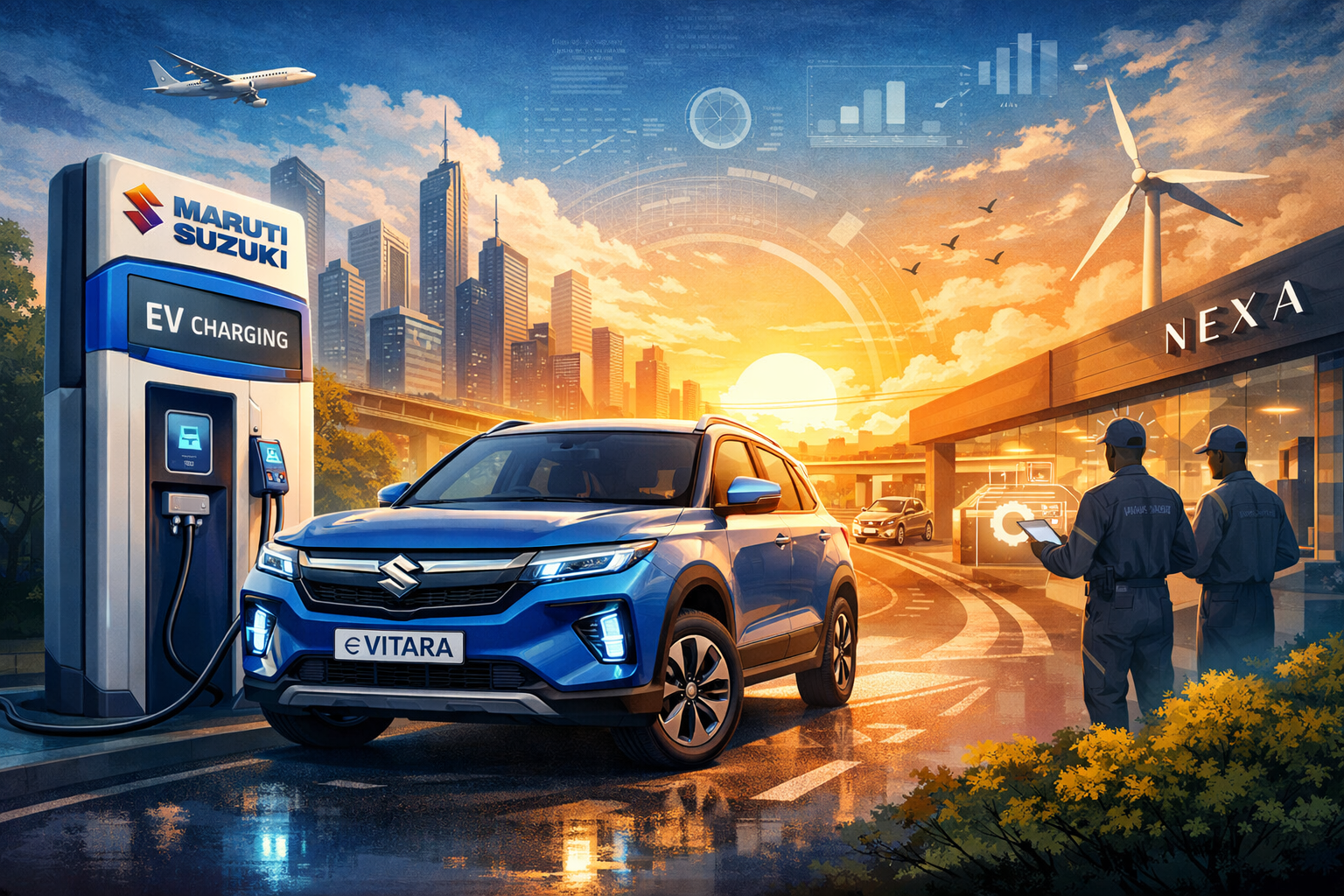
After four decades of defining what affordable, reliable mobility means for India, Maruti Suzuki is approaching its electric vehicle (EV) debut not as an incumbent rushing to defend territory, but as a cautious newcomer relearning the market. Even as rivals accelerate EV launches and scale volumes, India’s largest carmaker is deliberately slowing down—betting that trust, infrastructure, and reassurance matter more than first-mover advantage.
Its first electric SUV, the eVitara, is expected to be commercially launched in the January–March quarter, with bookings opening soon. But before the product reaches showrooms, Maruti wants to ensure that the ecosystem around it is ready.
A Familiar Playbook for a New Era
For Maruti Suzuki, the EV transition echoes its own beginnings. When the company entered India’s nascent car market in the early 1980s, it didn’t just sell vehicles—it helped build an ecosystem around them. According to Partho Banerjee, senior executive officer of marketing and sales, the same philosophy guides its EV strategy today.
Launching an electric car, Banerjee argues, makes little sense if customers remain anxious about charging access, service readiness, and resale value. These concerns, he says, are among the biggest reasons EV penetration in India is still low.
To tackle this, Maruti is focusing on three pillars before going big on sales:
- Charging infrastructure: Over 2,000 charging stations have already been set up across 1,100 cities, with an ambitious target of 100,000 by 2030.
- Service preparedness: More than 150,000 service professionals have been trained nationwide to handle EVs.
- Resale confidence: An assured buyback scheme aims to reduce fears around depreciation and long-term value.
In a symbolic nod to its cautious approach, Maruti plans to let customers test-drive the eVitara before even opening bookings—placing experience before commitment.
Entering Late, Entering Crowded
Founded in 1981 and credited with shaping India’s automobile manufacturing ecosystem, Maruti Suzuki today commands close to 40% of the passenger vehicle market. Yet in EVs, it is stepping into unfamiliar territory.
The eVitara will arrive in a competitive mid-size SUV segment already populated by models like Hyundai’s Creta EV, Tata Motors’ Curvv EV, Mahindra’s BE 6, and upcoming offerings from Vinfast. Rivals have already built early momentum, while Maruti is only now preparing to officially start domestic sales.
Despite this, the company has set an ambitious production target of 70,000 electric vehicles for FY26, largely earmarked for exports. Confidence remains high that these numbers can be achieved.
Betting on the Ecosystem, Not Just the Car
Maruti’s patience is partly enabled by its global strategy. In August, the company began exporting its first EV to over 100 international markets, particularly Europe, where higher prices offer better margins. This export-led approach gives Maruti the breathing room to move slower at home, even as India’s EV market heats up.
According to the Federation of Automobile Dealers Association (Fada), EV sales surged 83% year-on-year between April and November, reaching nearly 120,000 units. The past six months alone have seen a wave of launches, from Tata’s Harrier EV to Mahindra’s XEV 9s, alongside entries by Vinfast and Tesla.
Yet Maruti believes its real advantage lies beyond the product. Unified charging apps, visible fast-charging networks, trained service staff, and consistent messaging are all meant to reduce friction for first-time EV buyers.
Banerjee draws a parallel with Maruti’s earlier push for CNG vehicles. Adoption only took off, he notes, once customers were confident that fuel availability and service support were reliable. EVs, he believes, will follow the same trajectory—just not overnight.
When Waiting Might Actually Pay Off
Some analysts agree that Maruti’s late entry may not be a strategic misstep. With EV penetration in India still below 5%, the market remains wide open.
Industry experts suggest that while Tata Motors and Mahindra enjoy a head start, Maruti’s unmatched dealer network and brand trust could quickly close the gap. A later launch may also give the company greater clarity on pricing, technology costs, and consumer expectations.
The eVitara will be sold through Maruti’s premium Nexa dealership network, reinforcing its positioning in the mid-to-premium space. Still, Banerjee is clear that the market leader cannot afford to serve only one segment.
Maruti, he says, intends to stay technologically agnostic—offering multiple powertrain options and price points over time rather than betting everything on a single solution.
The Long Game Begins
Maruti Suzuki’s EV story is less about catching up and more about setting the stage. In a market obsessed with speed and scale, the company is choosing reassurance over rush, ecosystem over hype.
If history is any indication, this measured approach—slow at first, then decisive—has worked before. Whether it will do so again in the electric era remains to be seen, but Maruti is clearly betting that, sometimes, waiting is not falling behind.
Feel free to share your experiences and insights in the comments below. Let’s continue the conversation and grow together as a community of traders and analysts.
By sharing this experience and insights, I hope to contribute to the collective knowledge of our professional community, encouraging a culture of strategic thinking and informed decision-making.
As always, thorough research and risk management are crucial. The dynamic nature of financial markets demands vigilance, agility, and a deep understanding of the tools at your disposal. Here’s to profitable trading and navigating the election season with confidence!
Ready to stay ahead of market trends and make informed investment decisions? Follow our page for more insights and updates on the latest in the financial world!
For a free online stock market training by Yogeshwar Vashishtha (M.Tech IIT) this Saturday from 11 am – 1 pm, please sign up with https://pathfinderstrainings.in/training/freetrainings.aspx
Experience profits with my winning algo strategies – get a free one-month trial with ₹15 lakh capital! – https://terminal.algofinders.com/algo-terminal
Disclaimer
This article should not be interpreted as investment advice. For any investment decisions, consult a reputable financial advisor. The author and publisher are not responsible for any losses incurred by investors or traders based on the information provided.