

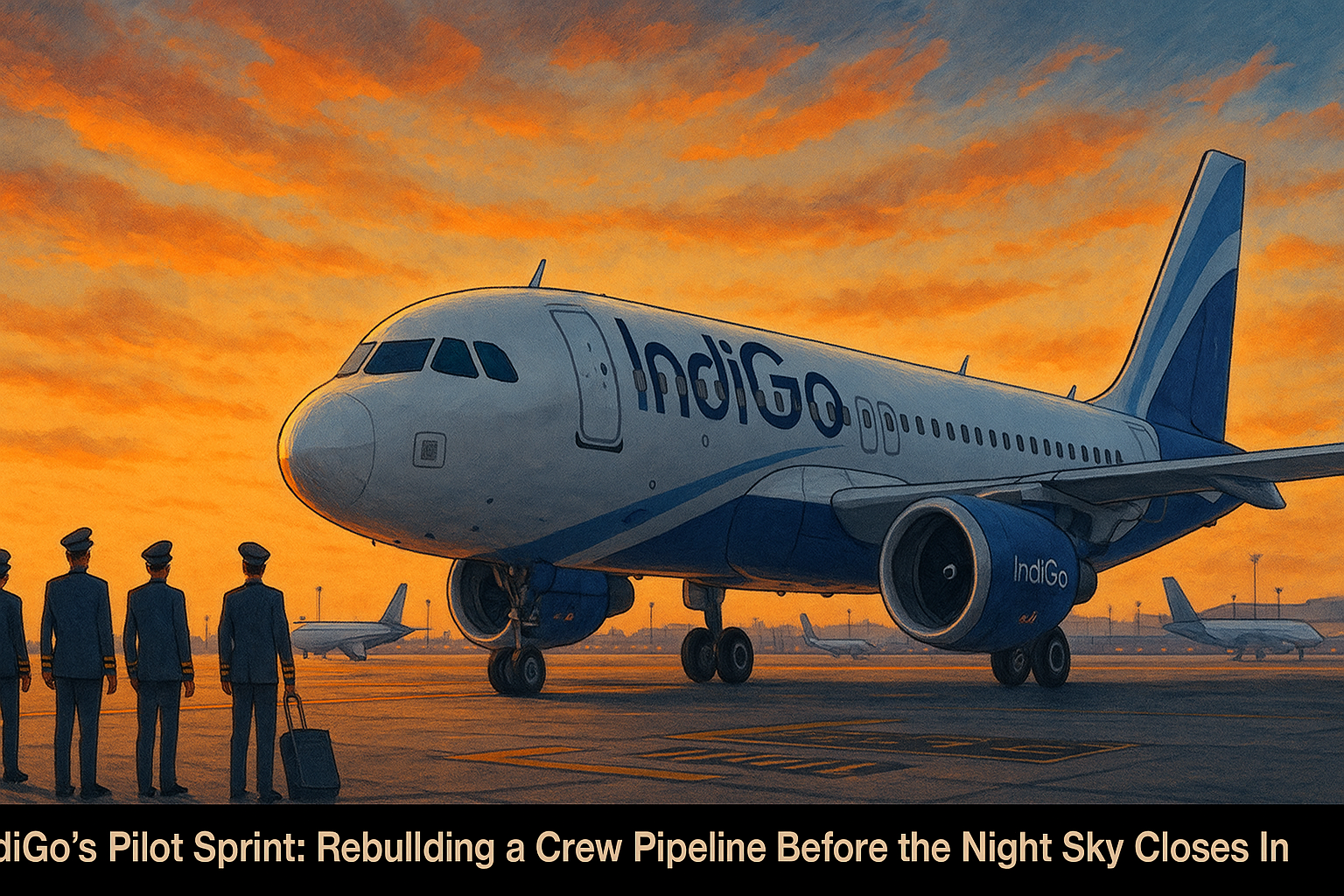
India’s air travel engine doesn’t run on jet fuel alone—it runs on people. And last week, that truth landed with a thud as IndiGo, the country’s biggest airline by market share, grappled with a pilot shortage severe enough to trigger mass cancellations and delays that rippled across the network. Airports filled with stranded passengers and rescheduled plans. The winter rush, usually a season of packed terminals and steady departures, turned into a stress test.
Now, IndiGo is moving fast—almost breathlessly—to rebuild its pilot pool. The airline has told the aviation regulator it plans to add 158 pilots by 10 February 2026, and another 742 by December 2026. On paper, it’s a bold recovery arc. In the real world of notice periods, regulatory checks, simulator slots, and fatigue rules, it’s a logistical mountain.
The Plan on the Table: Numbers, Deadlines, and a Compressed Calendar
IndiGo’s hiring ramp-up, detailed in a submission to the Directorate General of Civil Aviation (DGCA) (as referenced in the report), reads like an airline trying to stitch a parachute mid-air:
- Over the next 12 months, the airline expects to hire/upgrade 300 captains and 600 junior first officers.
- It also has an under-training pool of 250 junior first officers meant to feed the pipeline.
- For its Airbus fleet, the December availability figure in the document lists 2,357 captains and 2,194 first officers.
- By 10 February, IndiGo aims to add 68 captains and 90 first officers, taking the combined tally to 2,425 captains and 2,284 first officers.
The timeline matters because it’s not just about filling seats in cockpits—it’s about complying with a new reality of how many hours a pilot can safely and legally fly.
Why 10 February Matters: Night-Flying Limits and the New Math of Scheduling
The 10 February deadline isn’t a symbolic target. It’s tied to compliance with new limits on consecutive night operations, which effectively change how airlines build rosters.
A key rule effective 1 November limits pilots to two back-to-back flights between midnight and 6 am. While this applies broadly, IndiGo reportedly received additional time to fully comply. The impact is immediate and structural:
- Each pilot can operate night flights for only two consecutive nights before mandatory rest.
- That means more pilots are required to cover the same night schedule.
- When you combine high utilization with stricter fatigue rules, the staffing “buffer” airlines rely on gets eaten up quickly.
In short: even if flights and aircraft stay constant, the crew requirement rises—like a staircase you didn’t know was there until you’re already climbing it.
Resetting the Machine: Cancellations as a Stabilization Strategy
Part of IndiGo’s submission indicates the airline would cancel 300–400 flights a day during 5–8 December to “reset” the schedule and stabilize operations, followed by a revised roster for 10–31 December.
That approach can sound shocking—until you picture airline operations like a tightly wound spring. When crew availability slips, delays multiply, duty limits get hit, and recovery becomes harder each hour. Large-scale cancellations, painful as they are, can be a deliberate move to stop the domino effect and rebuild a workable roster from a clean baseline.
The Timeline of a System Under Strain
The chain of events described forms a clear escalation:
- 1 November: DGCA norms limiting night landings/operations kick in
- 1 December: delays and cancellations begin increasing due to pilot shortages
- 1–6 December: over 2,500 flights cancelled
- 5 December: DGCA gives IndiGo time until 10 February for fatigue norm implementation
- 6 December: Ministry of Civil Aviation imposes an airfare cap
- 6 December: DGCA issues a show-cause notice to IndiGo CEO Pieter Elbers
- Now: IndiGo’s hiring plan aims for 158 pilots by 10 Feb 2026, 742 more by Dec 2026
The sequence reads less like a single bad week and more like a slow pressure build that finally found its weakest point: crew availability.
Why Experts Think the Hiring Targets Will Be Hard to Hit
Hiring pilots isn’t like hiring customer support staff or ground crew. Aviation staffing has bottlenecks that don’t care how big your recruitment budget is.
1) Notice periods block “instant” hiring
Analysts point out that poaching experienced pilots is hard because of long notice periods:
- Six months for co-pilots
- Twelve months for captains
So even if IndiGo finds the right people today, many can’t legally or contractually join before the deadline that matters most.
2) Foreign pilots aren’t plug-and-play
Hiring from abroad can help, but it still takes time—one expert notes three months minimum for regulatory clearances, assuming everything moves smoothly.
3) Training and simulator capacity is a real choke point
Even when candidates are available, conversion training, line checks, and simulator time can become the limiting factor. That’s not always visible in headlines, but it’s often where expansion plans slow down.
The Bigger Problem: Structural Shortages and a Fleet Worked Hard
IndiGo’s operation is intense by design. The report describes a fleet of 417 aircraft, including A320s, ATRs, a wet-leased Boeing from Turkish Airlines, and freighters. But reality is messier:
- Nearly 40 A320s are grounded due to Pratt & Whitney engine issues
- The effective flying A320 fleet is around 325
- Those aircraft are reportedly being “sweated” at ~14 hours/day, compared with a standard of ~8.5
High utilization sounds efficient, but it inflates crew needs. The report notes that instead of needing roughly 14 pilot-and-copilot sets, IndiGo needs at least 17 at those utilization levels.
One set of calculations cited suggests:
- Required crew for ~325 flying A320s at that utilization: 5,525
- IndiGo’s December crew count in the submission: 4,551
- Shortfall: 974 pilots
That’s not a gap you patch with a few quick offers. It’s a structural deficit.
The Competitive Benchmark That Stings: Pilots per Departure
A Mint analysis referenced in the text highlights how tight IndiGo’s staffing is compared to rivals:
- IndiGo: 2.5 pilots per departure
- Air India: 5.4
- Air India Express: 4.7
- Akasa: 5.4
Even allowing for differences in fleet mix and scheduling strategies, the contrast paints IndiGo as an airline operating with far less crew “slack” than competitors—meaning disruptions hit harder and recovery takes longer.
The Cost Factor: Paying More to Buy Stability
One equity note cited adds a crucial angle: pilots are expensive—and increasingly so.
- Pilot salaries account for ~60% of IndiGo’s employee costs
- A 20% pay raise could increase total employee costs by ~12%
This turns hiring from a staffing problem into a financial one. Even if IndiGo can recruit at scale, keeping pilots—especially in a competitive market—may require compensation adjustments that ripple through the P&L.
Takeaways: A Race Against Rules, Reality, and Time
IndiGo’s hiring plan is a clear admission that the airline needs more crew depth—and fast. But the same factors that caused the shortage also make rapid recovery hard:
- New night-operation limits mean the airline needs more pilots to fly the same schedule.
- Long notice periods slow down experienced hires.
- Training pipelines can’t be expanded overnight.
- High aircraft utilization amplifies crew demand.
- Cost pressures make retention as important as recruitment.
If IndiGo pulls it off, it won’t just be a hiring success—it will be an operational reinvention under regulatory and market pressure. And if it doesn’t, the consequences won’t stay inside the airline. In a network as busy as India’s, when the biggest carrier stumbles, the whole system feels the turbulence.
Feel free to share your experiences and insights in the comments below. Let’s continue the conversation and grow together as a community of traders and analysts.
By sharing this experience and insights, I hope to contribute to the collective knowledge of our professional community, encouraging a culture of strategic thinking and informed decision-making.
As always, thorough research and risk management are crucial. The dynamic nature of financial markets demands vigilance, agility, and a deep understanding of the tools at your disposal. Here’s to profitable trading and navigating the election season with confidence!
Ready to stay ahead of market trends and make informed investment decisions? Follow our page for more insights and updates on the latest in the financial world!
For a free online stock market training by Yogeshwar Vashishtha (M.Tech IIT) this Saturday from 11 am – 1 pm, please sign up with https://pathfinderstrainings.in/training/freetrainings.aspx
Experience profits with my winning algo strategies – get a free one-month trial with ₹15 lakh capital! – https://terminal.algofinders.com/algo-terminal
Disclaimer
This article should not be interpreted as investment advice. For any investment decisions, consult a reputable financial advisor. The author and publisher are not responsible for any losses incurred by investors or traders based on the information provided.