

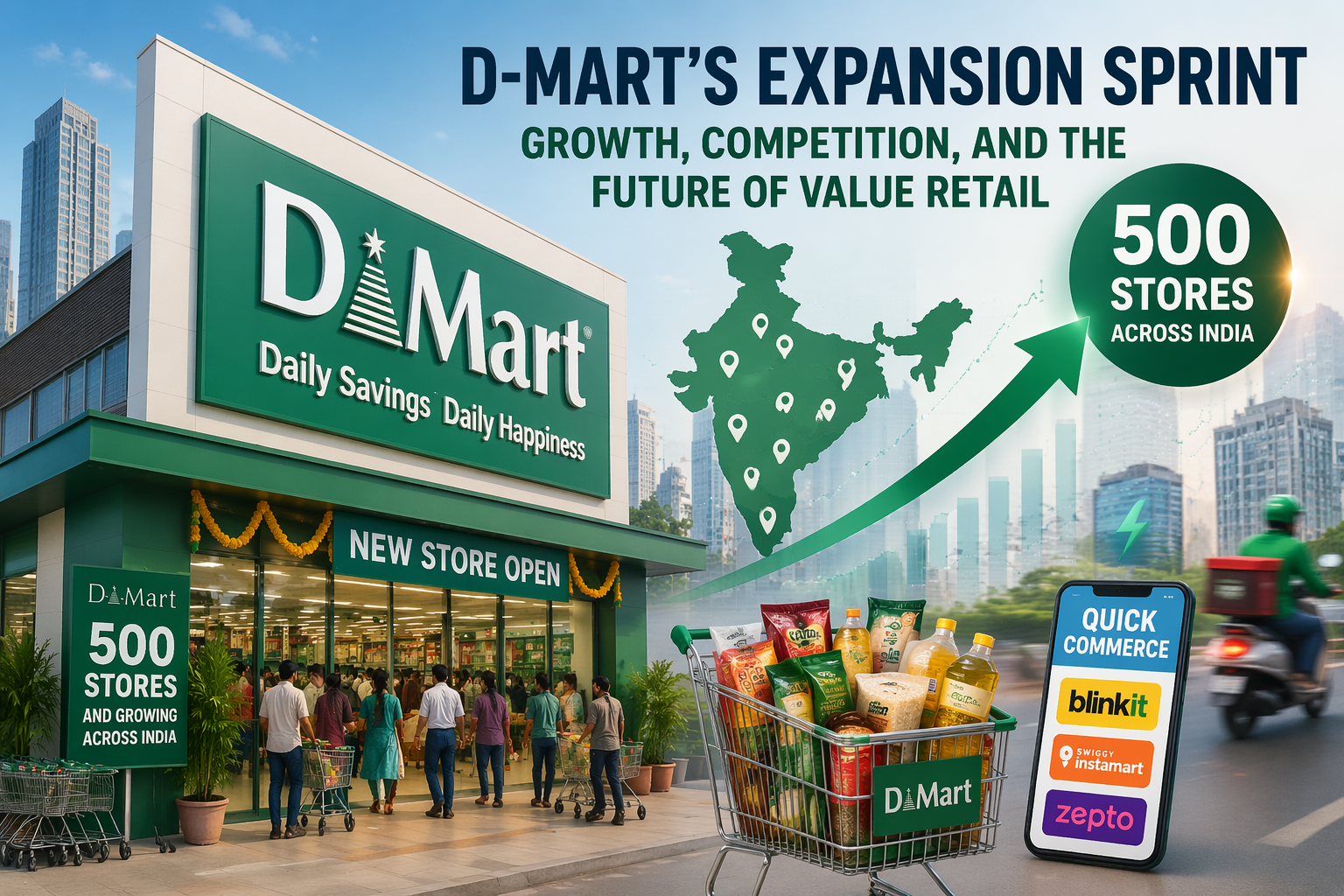
In a bold closing move to the financial year, Avenue Supermarts—the company behind India’s beloved D-Mart—made headlines by rapidly expanding its store network, reaching a milestone of 500 stores nationwide. This aggressive push signals more than just physical growth; it reflects a strategic shift in response to evolving consumer behavior, rising competition, and the growing dominance of quick commerce platforms.
A Record-Breaking Expansion Strategy
D-Mart’s expansion in FY26 marks a significant departure from its traditionally cautious growth model. Historically, the company preferred owning land before opening stores, ensuring long-term cost control and stability. However, this year tells a different story.
- 85 stores added in FY26, the highest ever in a single year
- 47 stores opened in March alone, compared to its usual annual pace of 40–50 stores
- 12 stores launched in a single day, across states like Maharashtra, Gujarat, Tamil Nadu, and Odisha
This accelerated rollout indicates a strategic pivot—D-Mart is increasingly open to leasing spaces, including locations in malls, to speed up expansion and compete more effectively.
Expansion Beyond Strongholds
While Maharashtra and Gujarat remain D-Mart’s core markets, the company is clearly aiming for deeper national penetration.
New stores have been opened in emerging cities such as:
- Dehradun
- Cuddalore
- Amritsar
- Bareilly
This move reflects a broader retail trend—targeting Tier II and Tier III cities where organized retail still has significant room to grow.
The Quick Commerce Challenge
Despite its strong offline presence, D-Mart faces a growing threat from quick commerce platforms like:
- Blinkit
- Swiggy Instamart
- Zepto
These platforms now operate in 200+ cities, offering rapid delivery that appeals especially to urban consumers .
A key vulnerability lies in D-Mart’s product mix:
- Over 57% of revenue comes from staples and packaged goods, categories heavily targeted by quick commerce
Even D-Mart’s leadership has acknowledged this disruption, recognizing quick commerce as a “very large business” with significant long-term impact.
Brick-and-Mortar Still Holds Ground
Despite digital disruption, D-Mart remains confident in the power of physical retail.
The reasoning is simple:
- India’s vast population and geographic diversity
- Continued demand for value-driven, in-store shopping experiences
- Cost advantages from owned real estate
The company is doubling down on property investments, with land holdings reaching over ₹7,500 crore, signaling long-term commitment to its physical retail model .
Competitive Landscape: Not Just Online Rivals
D-Mart isn’t just competing with startups—it’s also facing pressure from major retail giants:
Reliance Retail
- Operates across 5,000+ pin codes
- Backed by acquisitions like Future Group and Metro AG
- Strong omnichannel presence with JioMart
Tata’s Trent (Star Bazaar)
- Smaller network (79 stores)
- Slower expansion pace
- Focus on consolidation and upgrades
Despite competition, D-Mart still leads in scale and efficiency, reporting quarterly revenues of over ₹18,100 crore.
Growth vs Profitability: A Delicate Balance
While expansion is impressive, challenges remain:
- Like-for-like growth slowed (5.6% vs 8.3% last year)
- Heavy reliance on low-margin staples
- Increasing pricing pressure in value retail
However, there’s optimism for the future. Analysts expect recovery driven by:
- Improved store productivity
- Growth in higher-margin segments like apparel
- Stabilizing consumer demand
The Road Ahead: Adaptation is Key
D-Mart stands at a crucial crossroads. Its strengths—cost efficiency, strong brand trust, and disciplined operations—have made it a retail powerhouse. But the landscape is changing rapidly.
To stay ahead, the company must:
- Balance physical expansion with digital integration
- Diversify beyond staples into higher-margin categories
- Compete with the convenience of quick commerce
Final Takeaways
D-Mart’s journey to 500 stores is more than a milestone—it’s a signal of transformation. The company is evolving from a cautious, asset-heavy retailer into a more agile player adapting to modern retail dynamics.
The big question isn’t whether D-Mart can grow—it’s whether it can reinvent itself fast enough in a world where convenience, speed, and digital access are redefining how India shops.
Feel free to share your experiences and insights in the comments below. Let’s continue the conversation and grow together as a community of traders and analysts.
By sharing this experience and insights, I hope to contribute to the collective knowledge of our professional community, encouraging a culture of strategic thinking and informed decision-making.
As always, thorough research and risk management are crucial. The dynamic nature of financial markets demands vigilance, agility, and a deep understanding of the tools at your disposal. Here’s to profitable trading and navigating the election season with confidence!
Ready to stay ahead of market trends and make informed investment decisions? Follow our page for more insights and updates on the latest in the financial world!
For a free online stock market training by Yogeshwar Vashishtha (M.Tech IIT) this Saturday from 11 am – 1 pm, please sign up with https://pathfinderstrainings.in/training/freetrainings.aspx
Experience profits with my winning algo strategies – get a free one-month trial with ₹15 lakh capital! – https://terminal.algofinders.com/algo-terminal
Disclaimer
This article should not be interpreted as investment advice. For any investment decisions, consult a reputable financial advisor. The author and publisher are not responsible for any losses incurred by investors or traders based on the information provided.