

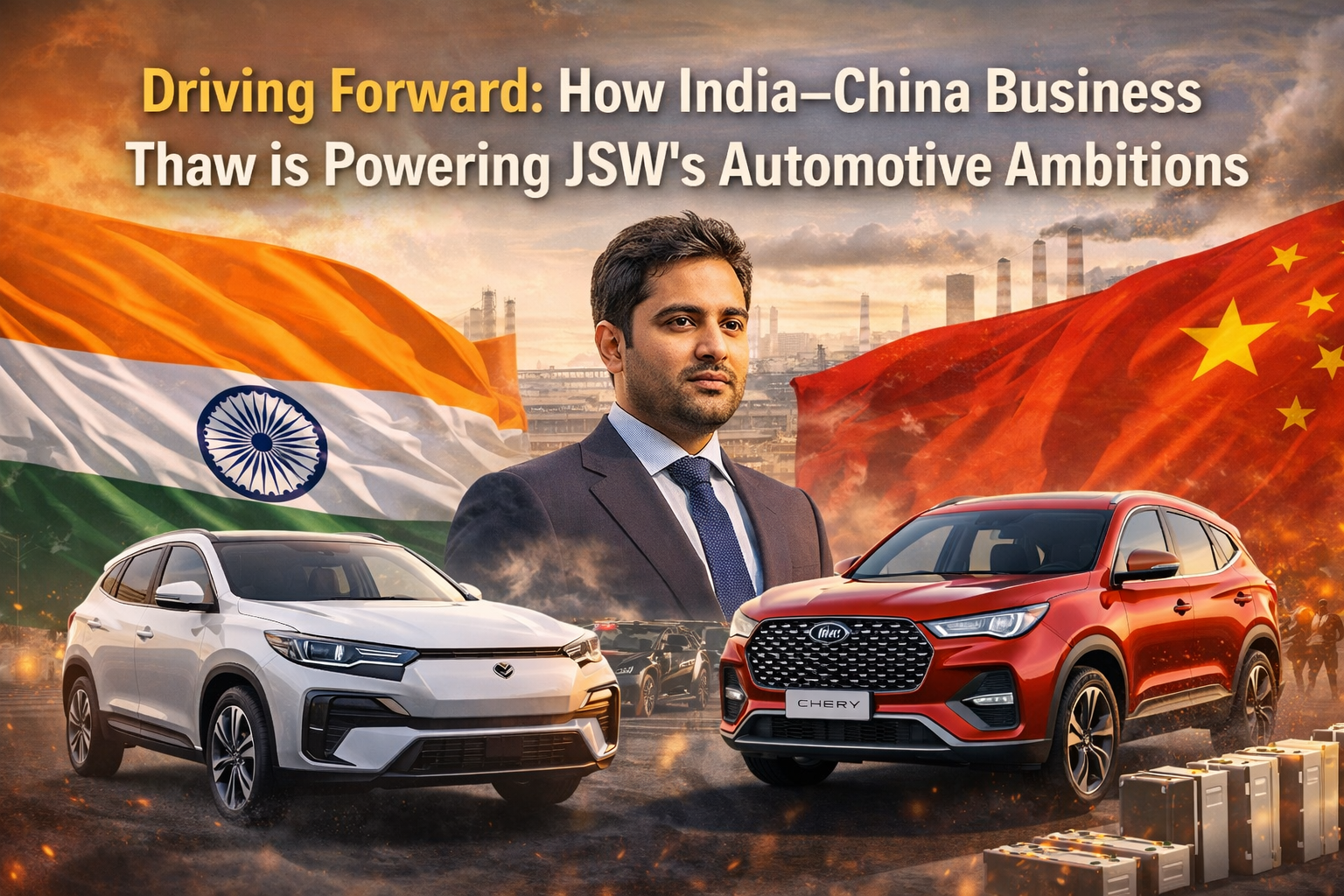
The global automotive industry is no stranger to geopolitical influence, but few developments are as intriguing as the recent warming of business relations between India and China. What was once a tightly regulated and cautious engagement is now gradually opening up, creating new opportunities for collaboration, innovation, and growth. At the center of this shift stands JSW Group, gearing up to make its bold entry into India’s automobile market—backed by strategic partnerships and improving cross-border dynamics.
A Changing Landscape: From Restriction to Collaboration
For years, India maintained strict oversight on investments from neighboring countries through regulations like Press Note 3, introduced in 2020 amid heightened tensions. This policy required government approval for investments from countries sharing land borders with India—primarily affecting Chinese firms.
However, recent easing of these rules has begun to reshape the business environment. The relaxation, combined with the resumption of direct flights between India and China, has significantly improved operational ease and engagement between companies in both nations.
This shift is not just regulatory—it’s psychological. Improved sentiment is enabling smoother communication, faster decision-making, and stronger trust between partners, especially in sectors dependent on advanced technology.
JSW Group’s Automotive Vision Takes Shape
JSW Group is stepping into the automobile industry with ambitions that go beyond a simple market entry. With plans to launch its debut car by late 2026, the conglomerate is positioning itself as a serious contender in a space long dominated by Tata and Mahindra.
Its strategy is built on two key pillars:
- JSW MG Motor India: A joint venture with China’s SAIC Motor
- JSW Green Mobility: An independent arm focusing on both passenger and commercial vehicles
These ventures reflect a hybrid approach—leveraging global expertise while building domestic capability. The collaboration with Chinese partners is particularly crucial, as it provides access to scalable platforms and advanced automotive technologies.
Technology as the Core Differentiator
Modern automobiles are no longer just mechanical machines—they are sophisticated ecosystems of software, electronics, and energy systems. For a new entrant like JSW, accessing cutting-edge technology quickly is essential.
Improved India–China relations are playing a key role here:
- Easier technology transfer processes
- Reliable supply chain continuity
- Access to proven vehicle platforms
As industry experts suggest, the strengthening of bilateral trust is likely to accelerate partnerships with Chinese firms, enabling JSW to stay competitive in both cost and innovation.
Beyond Cars: The Battery Revolution
JSW’s ambitions don’t stop at vehicles. The group is also exploring partnerships to establish its first lithium-ion battery plant—an essential step in the era of electric mobility.
Discussions with major Chinese battery players highlight a broader strategy:
- Initial focus on battery energy storage systems
- Gradual transition to cell manufacturing
- Targeting 10GWh capacity in early phases
This move aligns JSW with India’s growing ecosystem of battery manufacturing, where companies like Ola Electric and Reliance are already making significant strides.
Competing with Giants: A Bold Entry
Entering the automobile sector is no small feat. Tata and Mahindra, pioneers in this space, collectively command a significant share of India’s passenger vehicle market.
Yet JSW brings distinct advantages:
- Strong financial backing
- Strategic global partnerships
- Focus on next-generation technologies
Rather than replicating existing models, JSW appears to be building a future-ready automotive ecosystem from the ground up.
The Road Ahead: Opportunity Meets Uncertainty
While the outlook is promising, challenges remain:
- Geopolitical relations can shift unpredictably
- Regulatory frameworks may evolve
- Competition in EV and battery space is intensifying
However, the current momentum suggests that JSW is entering the market at a uniquely favorable time—when policy, technology, and partnerships are aligning.
Conclusion: A New Chapter in Indian Mobility
The easing of India–China business relations is more than a diplomatic development—it is a catalyst for industrial transformation. For JSW Group, it has unlocked access to global expertise and accelerated its journey into the automotive world.
As the company moves closer to its first vehicle launch, it represents not just a new entrant, but a symbol of how collaboration can drive innovation—even in the face of past tensions.
If executed well, JSW’s venture could redefine competition in India’s auto sector—and perhaps signal the beginning of a new era in cross-border industrial partnerships.
Feel free to share your experiences and insights in the comments below. Let’s continue the conversation and grow together as a community of traders and analysts.
By sharing this experience and insights, I hope to contribute to the collective knowledge of our professional community, encouraging a culture of strategic thinking and informed decision-making.
As always, thorough research and risk management are crucial. The dynamic nature of financial markets demands vigilance, agility, and a deep understanding of the tools at your disposal. Here’s to profitable trading and navigating the election season with confidence!
Ready to stay ahead of market trends and make informed investment decisions? Follow our page for more insights and updates on the latest in the financial world!
For a free online stock market training by Yogeshwar Vashishtha (M.Tech IIT) this Saturday from 11 am – 1 pm, please sign up with https://pathfinderstrainings.in/training/freetrainings.aspx
Experience profits with my winning algo strategies – get a free one-month trial with ₹15 lakh capital! – https://terminal.algofinders.com/algo-terminal
Disclaimer
This article should not be interpreted as investment advice. For any investment decisions, consult a reputable financial advisor. The author and publisher are not responsible for any losses incurred by investors or traders based on the information provided.