

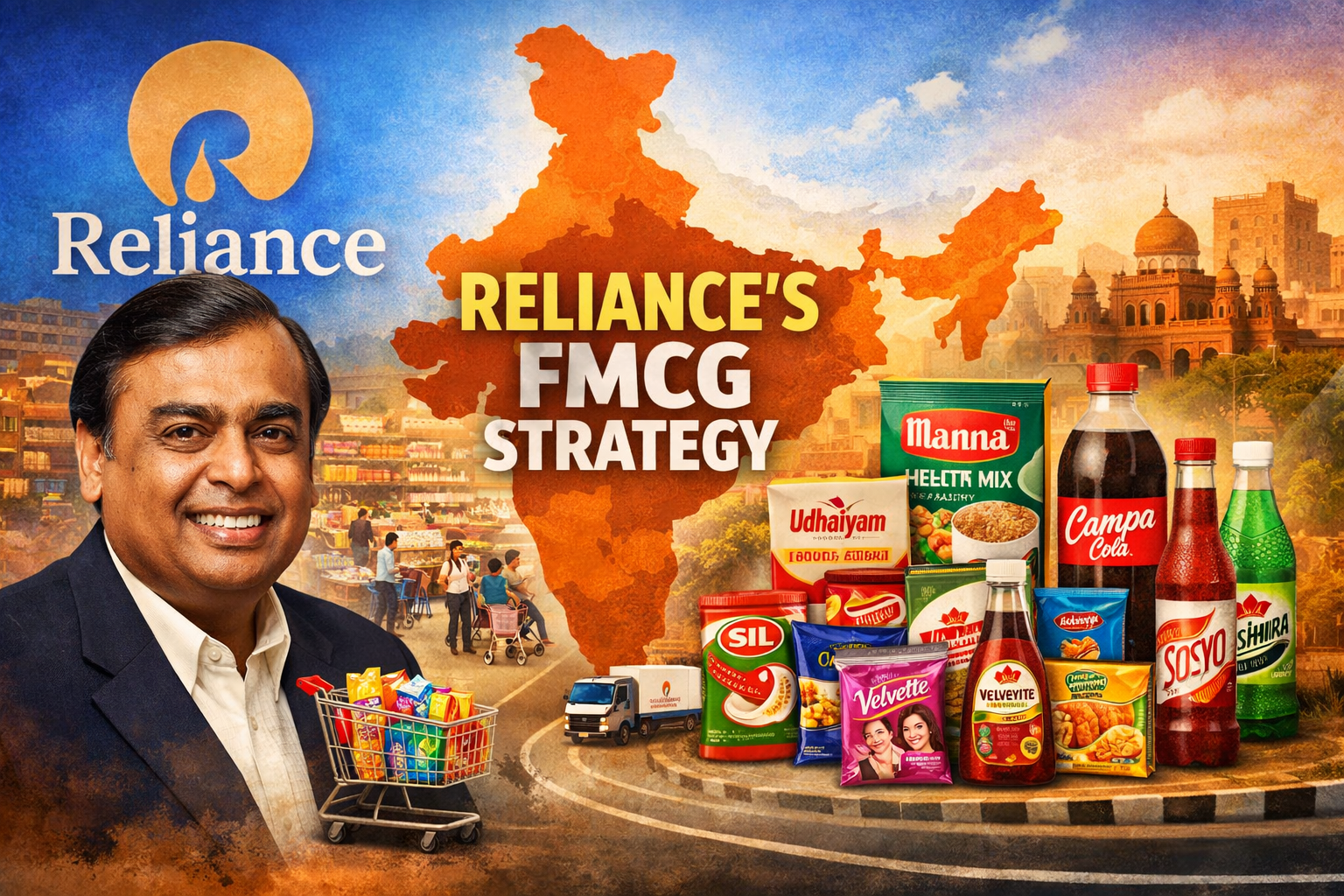
In a market where most consumer goods giants are chasing trendy digital-first startups, Reliance Consumer Products Ltd (RCPL) is taking a refreshingly contrarian route. Instead of betting on flashy D2C brands, Reliance is quietly assembling a powerful portfolio of regional legacy brands—names that already live in the hearts and homes of local consumers. By combining these trusted brands with its unmatched retail and distribution muscle, Reliance is crafting a unique blueprint to challenge India’s FMCG heavyweights.
The Rise of a Different Strategy
India’s FMCG sector is massive—and fiercely competitive. Established giants like Hindustan Unilever dominate with revenues exceeding ₹64,000 crore annually. Yet, Reliance is carving its own path.
RCPL reported gross revenue of ₹5,065 crore in the December quarter alone, marking an impressive 60% year-on-year growth. This rapid rise reflects not just scale, but a well-thought-out strategy: build, not from scratch, but from momentum.
Rather than investing years in nurturing new brands, Reliance is acquiring businesses that already enjoy customer trust and market traction—especially in regional strongholds.
Building a Portfolio of Local Champions
Over the past few years, RCPL has been actively acquiring and partnering with regional brands across food, beverages, and personal care. Each acquisition adds a new layer to its growing FMCG ecosystem.
- Manna (Southern Health Foods) – A Chennai-based brand specializing in millet-based and nutrition products, acquired for ₹156 crore, signaling Reliance’s entry into health foods.
- Udhaiyam – A trusted Tamil Nadu staple brand dealing in pulses, flours, and spices, with revenues crossing ₹668 crore.
- SIL (Delhi) – A legacy condiments brand known for jams, sauces, and cooking pastes.
- Velvette – A nostalgic personal care brand that once revolutionized shampoo consumption with sachets.
- Campa Cola – A revived Indian beverage icon positioned as a mass-market challenger.
- Regional beverage tie-ups – Including Sosyo, Kashmira, Ginlim, and Sri Lanka’s Elephant House.
This portfolio isn’t random—it’s strategically diverse, covering everyday consumption categories that form the backbone of FMCG demand.
What Regional Brands Gain
For regional brands, partnering with Reliance is like plugging into a high-voltage growth engine.
1. Nationwide Distribution at Scale
Many regional brands are limited by geography. Reliance solves this instantly by offering access to:
- Millions of kirana stores
- Reliance Retail outlets
- Modern trade channels
2. Supply Chain & Manufacturing Efficiency
Reliance’s infrastructure improves sourcing, logistics, and production capacity—helping brands scale faster and cheaper.
3. Marketing and Financial Muscle
With deeper pockets and stronger branding capabilities, these companies can:
- Upgrade packaging
- Invest in advertising
- Launch new product variants
The result? Local favorites get a shot at becoming national household names.
Why Reliance Prefers Regional Over D2C
Reliance’s strategy is rooted in pragmatism.
Faster Market Entry
Regional brands already have:
- Proven products
- Existing customer base
- Operational setups
This eliminates the uncertainty of building a brand from scratch.
Lower Risk, Higher Predictability
Unlike many D2C startups that burn cash on digital marketing, regional brands often have:
- Stable demand
- Strong loyalty
- Better unit economics
Portfolio Diversification
By acquiring across categories—staples, beverages, personal care—Reliance is building a well-rounded FMCG empire capable of competing with industry leaders.
The Rival Playbook: Betting on D2C Startups
While Reliance bets on legacy, its competitors are chasing the future.
- Hindustan Unilever acquired skincare startup Minimalist
- Dabur invested in RAS Luxury Skincare
- Marico backed brands like Beardo and Just Herbs
These companies are targeting:
- Premium segments
- Younger, digital-native consumers
- Fast-growing niche categories
D2C brands offer innovation and trend appeal—but often struggle with profitability and scaling beyond online channels.
The Challenges Ahead for Reliance
Despite its advantages, Reliance’s strategy isn’t without hurdles.
1. Regional Taste vs National Appeal
India is incredibly diverse. A product loved in Tamil Nadu may not resonate in North India.
2. Brand Identity Risk
Scaling too aggressively could dilute the authenticity that made these brands successful in the first place.
3. Dependence on Distribution Push
Many regional brands scale not because of inherent demand expansion, but due to stronger distribution—this may not always sustain long-term growth.
4. Cultural and Pricing Sensitivity
Consumer preferences vary widely in:
- Taste
- Packaging expectations
- Price tolerance
Balancing these factors is critical.
A Battle of Philosophies: Legacy vs Digital
At its core, this is more than a business strategy—it’s a clash of philosophies.
- Reliance: Scale proven brands with deep-rooted trust
- Rivals: Build or acquire futuristic, digital-first brands
Both approaches aim for the same prize: dominance in India’s evolving consumption landscape.
Conclusion: Can Reliance Rewrite the FMCG Rulebook?
Reliance Consumer Products Ltd is betting big on a simple yet powerful idea—India’s next FMCG giants may not be born online, but rediscovered from within its regions.
If executed well, this strategy could:
- Transform regional brands into national leaders
- Disrupt traditional FMCG dominance
- Redefine how scale is built in India
However, success will depend on a delicate balance—preserving local authenticity while achieving national expansion.
In a country as diverse as India, that balance could be the difference between a good strategy and a game-changing one.
Feel free to share your experiences and insights in the comments below. Let’s continue the conversation and grow together as a community of traders and analysts.
By sharing this experience and insights, I hope to contribute to the collective knowledge of our professional community, encouraging a culture of strategic thinking and informed decision-making.
As always, thorough research and risk management are crucial. The dynamic nature of financial markets demands vigilance, agility, and a deep understanding of the tools at your disposal. Here’s to profitable trading and navigating the election season with confidence!
Ready to stay ahead of market trends and make informed investment decisions? Follow our page for more insights and updates on the latest in the financial world!
For a free online stock market training by Yogeshwar Vashishtha (M.Tech IIT) this Saturday from 11 am – 1 pm, please sign up with https://pathfinderstrainings.in/training/freetrainings.aspx
Experience profits with my winning algo strategies – get a free one-month trial with ₹15 lakh capital! – https://terminal.algofinders.com/algo-terminal
Disclaimer
This article should not be interpreted as investment advice. For any investment decisions, consult a reputable financial advisor. The author and publisher are not responsible for any losses incurred by investors or traders based on the information provided.