

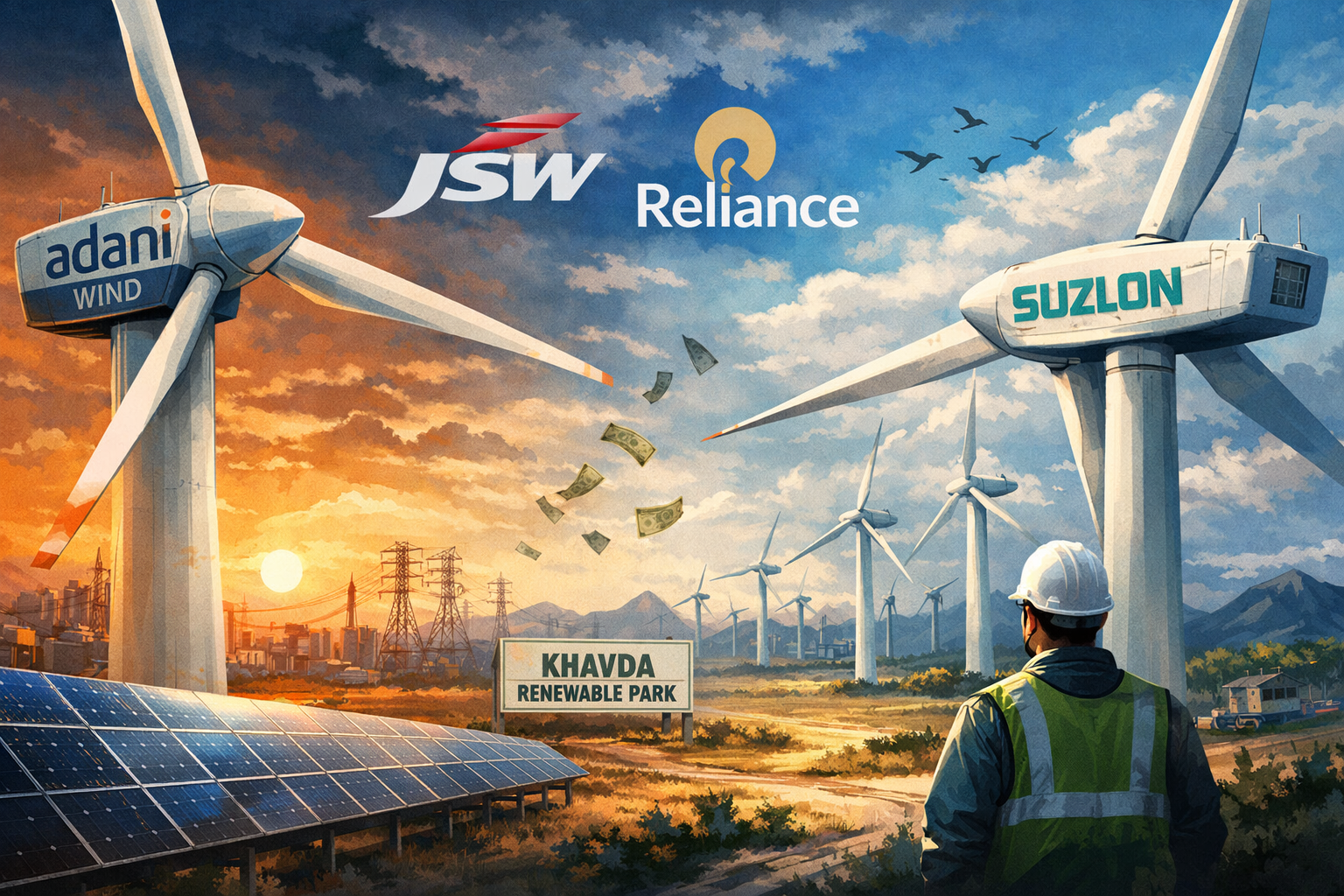
When Adani Wind delivered its first external turbine order—3.3MW machines for a 70MW project for Opera Energy in Gujarat—it marked more than a commercial milestone. It was a signal. After reshaping India’s renewable landscape through solar parks, transmission lines and green hydrogen, the Adani Group is now stepping into wind turbine manufacturing not just as a captive buyer, but as a market-facing supplier. In doing so, it has unsettled an industry where experience is earned painfully and remembered for decades.
A New Signal in the Wind
Adani’s ambition is unapologetically large. The group has stated its intention to deploy nearly 30GW of wind capacity by 2030—almost a third of India’s national target. Until recently, most assumed that Adani’s turbine manufacturing would remain internal, designed to fuel its own projects at scale. The Opera Energy order punctured that assumption.
This move positions Adani not merely as a developer with deep pockets, but as a manufacturer willing to be judged by customers beyond its own ecosystem. It is also a test: whether financial muscle and execution speed can be translated into credibility in a business where performance is measured not in quarters, but over 20 years of wind, wear and warranty.
An Unsettling Moment for Suzlon
For Suzlon Energy Ltd, India’s largest wind turbine maker and one of the few global survivors of a brutally cyclical industry, the timing is delicate. After years in financial distress, Suzlon is finally debt-free, profitable again, and operating in a market that has rediscovered the value of wind as India grapples with a structural mismatch in its power mix.
Yet just as conditions turn favourable, a new class of competitors is entering the field. Alongside Adani, both JSW Group and Reliance Industries Ltd have signalled intent to manufacture turbines. These are conglomerates that can afford early losses, compress supply chains and wait out long gestation periods—luxuries that nearly destroyed Suzlon a decade ago.
“This industry has a very long memory,” says Girish Tanti, vice chairman of Suzlon. “Wind is not forgiving if you cut corners. It always comes back to performance over 20 years.”
That idea of memory—technological, financial and reputational—runs deep in Suzlon’s DNA today.
Lessons Written in Debt
There was a time when Suzlon itself embodied the same restless ambition now associated with Adani. In the mid-2000s, founder Tulsi Tanti rode India’s early renewable boom to global prominence. Flush with domestic success, Suzlon leapt into Europe and the US, acquiring Hansen in Belgium and REpower in Germany to challenge global giants like Vestas, GE and Gamesa.
The strategy was bold, but brittle.
Suzlon expanded faster than its systems could support. Blade failures in the US exposed gaps in life-cycle testing and quality assurance—weaknesses that domestic markets had masked. Orders were cancelled, repair costs mounted and reputational damage spread. Debt ballooned, rising from ₹5,162 crore in 2008 to a peak of ₹17,749 crore in 2015.
The REpower acquisition, meant to deliver technology and stature, became a quagmire of regulatory hurdles, cultural resistance and funding constraints. Policy shifts at home, including reverse auctions that favoured solar over wind, further eroded Suzlon’s business case.
At its nadir, Suzlon was selling prized assets and diluting promoter stake simply to survive. The ambition that once defined it nearly erased it.
The Chalasani Reset
When J.P. Chalasani took over as CEO in 2016, survival—not growth—was the priority. Debt was suffocating, lender confidence was fragile and customer trust was shaken.
The mandate from Tulsi Tanti was clear: cut costs everywhere except research and development. Technology, Chalasani was told, was non-negotiable.
What followed was a quiet but structural reset. Suzlon exited non-core activities, renegotiated debt, tightened working capital and rebuilt credibility with lenders—while ring-fencing engineering and product development. Product launches slowed. Testing cycles lengthened. Risk appetite narrowed.
“We took pain everywhere else,” Chalasani says. “Cutting cost is easy. Cutting the right cost is very hard.”
Today, Suzlon is net debt-free, with borrowings of ₹397 crore and cash of ₹701 crore. But there is no triumphalism. “This is not the time to be arrogant,” Chalasani says. “Wind always humbles you.”
Why Wind Is Still Hard
India’s renewed interest in wind is driven by physics, not fashion. Solar generation peaks during the day, while demand spikes in the morning and evening. Wind, with its complementary generation profile, is becoming essential for round-the-clock renewable power.
Yet execution remains punishing. Transporting massive blades across narrow highways, securing right-of-way permissions, arranging specialised cranes and managing local resistance often prove harder than winning bids.
“Crane operators make more money than wind companies,” notes Chintan Shah of SustCred. In China, cranes can erect five or six turbines a month. In India, it is two or three.
This friction explains why wind has lagged solar despite comparable potential—and why experience still matters.
Capital Rushes In
Against this backdrop, Adani’s entry into turbine manufacturing is formidable. The group brings scale, capital and control over large wind-rich regions like Kutch in Gujarat, home to the ambitious Khavda renewable park.
Its decision to sell 3.3MW turbines—squarely in the segment dominated by Suzlon—signals serious intent. The current Indian sweet spot lies in 3–4MW machines, balancing higher hub heights and blade lengths with the realities of transport and installation.
Yet history offers a cautionary note. Globally, the wind turbine industry has shrunk, not expanded, over the past two decades. Despite rising demand, only a handful of manufacturers have survived relentless pricing pressure, technology cycles and warranty liabilities. Wind sits awkwardly between infrastructure and precision engineering, demanding patience that even deep capital often underestimates.
The Tanti Legacy
Tulsi Tanti is no longer at the helm, but his influence endures. Vinod Tanti, credited as the technical brain behind Suzlon, provides continuity and internal discipline, while Girish Tanti has become the company’s public face, shaping policy dialogue as wind re-enters the national agenda.
Investors like Dilip Shanghvi, who backed Suzlon during its darkest phase, point to this blend of experience and restraint as the company’s quiet strength.
“Policy matters enormously in wind,” Girish Tanti says. “If policy is not designed correctly, no amount of technology can compensate.”
The Next Phase
Suzlon today looks steadier than it has in years. An order book of over 6GW offers visibility, but execution risk remains. Debt-free status has restored credibility, while also imposing restraint.
“We will never again grow at the cost of survival,” Chalasani says. “That chapter is closed.”
Adani’s arrival sharpens the contrast. One player carries the memory of near collapse. The other arrives with confidence born of scale. In an industry that remembers everything, the real contest may not be about who grows fastest—but who endures longest.
Key Takeaways
- Suzlon Energy has emerged from a long financial winter and is now debt-free and profitable.
- India’s power mix is reviving wind as a critical complement to solar.
- Capital-heavy groups like Adani, JSW and Reliance are entering turbine manufacturing.
- Wind remains execution-intensive, with structural challenges beyond demand.
- The global turbine industry has few survivors despite rising demand.
- Suzlon is unlikely to chase growth at any cost again.
- Its next phase will hinge on disciplined execution and working capital management.
Feel free to share your experiences and insights in the comments below. Let’s continue the conversation and grow together as a community of traders and analysts.
By sharing this experience and insights, I hope to contribute to the collective knowledge of our professional community, encouraging a culture of strategic thinking and informed decision-making.
As always, thorough research and risk management are crucial. The dynamic nature of financial markets demands vigilance, agility, and a deep understanding of the tools at your disposal. Here’s to profitable trading and navigating the election season with confidence!
Ready to stay ahead of market trends and make informed investment decisions? Follow our page for more insights and updates on the latest in the financial world!
For a free online stock market training by Yogeshwar Vashishtha (M.Tech IIT) this Saturday from 11 am – 1 pm, please sign up with https://pathfinderstrainings.in/training/freetrainings.aspx
Experience profits with my winning algo strategies – get a free one-month trial with ₹15 lakh capital! – https://terminal.algofinders.com/algo-terminal
Disclaimer
This article should not be interpreted as investment advice. For any investment decisions, consult a reputable financial advisor. The author and publisher are not responsible for any losses incurred by investors or traders based on the information provided.